
The relationship between the likes of Merlot and Molinara or Viognier and Vermentino is not always an easy one, but Italian winemakers are striking a balance between the glamour and marketability of international varieties and the tradition and resilience of native ones.
Charles de Gaulle once complained of France: “How can you govern a country in which there are 246 kinds of cheese? Italian wine poses a similar predicament, with its abundance of niche and highly-localised grape varieties (conservative estimates place the figure around 500, it is likely far greater) making it the most diverse of
wine-producing countries, fiendishly so for those attempting to study it.
Of course, there are established Italian heartlands for certain international grapes: Pinot Noir in Oltrepò Pavese, Cabernet Sauvignon in Bolgheri and Syrah in Sicily.
Then there are the international varieties which have existed for centuries under a pseudonym. Perhaps the worst offender in this regard is Grenache, which goes by aliases including Cannonau in Sardinia, Vernaccia Nera in Marche and Gamay del Trasimeno in Umbria. As will not surprise, its genetic and viticultural histories are
equally blurred.
International becomes indigenous
The reality is that many of these ‘international’ varieties have a long history in the Apennine Peninsula, with some even pre-dating the existence of a national entity of ‘Italy’.
“Merlot has been in Friuli-Venezia Giulia for so many years that it is considered an international grape,” remarks Tenuta Stella oenologist Erika Barbieri. “Our Merlot vines were planted 70 years ago, though today we only produce three-to-four barriques of it, so there’s a very small production of our Collio DOC Merlot Riserva.”
Merlot was likely first planted in this border region in the late 19th century, but the area of Collio would not become part of Italy until after the First World War, meaning that this Bordeaux variety has been here for longer than it has been Italian.
Barbieri suggests that Merlot and Pinot Noir perform especially well in Friuli-Venezia Giulia due to the region’s high rainfall which inhibits the ripening of thicker-skinned grapes such as Cabernet Sauvignon.
However, other Italian wine regions are less keen on Merlot, though not because it cannot grow well in the Mediterranean. The sheer abundance of regionally-specific grape varieties means that there is a high chance that there is a local cultivar that can already do the job of an international one.
“We don’t need Merlot to make a modern Amarone with good acidity, we already have varieties like Corvina for that,” says Christian Zulian, newly-appointed director general of Cantina Valpolicella Negrar.
Much as db explored in a recent report about the renaissance of field blends, “we like the co-plantation of different indigenous varieties together in the same plot as it provides a kind of insurance against climate change and vintage variation. This was how farmers reduced risk in the past,” Zulian notes. “One year the Corvina will be good, the next the Corvinone will be good. Together they provide harmony and balance. It’s a matter of economic sustainability.”
However, international varieties, particularly Merlot, still have their uses.
“Merlot gives roundness to our Rosso di Montepulciano,” says Cristian Pepi, sales manager of Montepulciano’s Talosa. “It makes up 5% of the Rosso di Montepulciano, alongside 10% Canaiolo and 85% Sangiovese.”
Of Talosa’s 33 hectares of vines, 3ha are planted with Merlot, but this small fraction is gradually falling out of use. Talosa used to add a small part of Merlot to the blend of its Nobile di Montepulciano range – for example, its Alboreto contained 10% Merlot until the 2014 harvest, it is now 100% Sangiovese.
“For Vino Nobile di Montepulciano we must use a minimum of 70% Sangiovese and up to 30% from a list of approved varieties,” Pepi shares. “Our use of Merlot was about the palate. When our Sangiovese vines were young, complexity was lacking, but now that they are 20-30-years-old, that complexity is present. The Merlot
was just there for support.”
Simply put: the winemaking has now outgrown the need to use anything other than indigenous varieties.
Superb Tuscans
This is not to say that international varieties cannot perform exceptionally well on Italian soil. The commercial success of the Super Tuscans and of Northern Italian traditional method sparklings proves as much. What is required to get the best out of them is time and research.
“Not all international grapes work very well in Italy,” says Serena Gusmeri, winemaker of Chianti Classico’s Vecchie Terre di Montefili. “The first Cabernet Sauvignon was planted in Chianti Classico in 1965, our’s was planted in 1983 and today 1.5ha in our 12ha vineyard is Cabernet Sauvignon, the rest is Sangiovese.”
Montefili’s Bruno di Rocca is 50% Sangiovese and 50% Cabernet Sauvignon, a blend that is emblematic of how international and indigenous varieties do not exist in opposition to one another.
“International grapes have adapted to our soil. Think of Cabernet Sauvignon in France, it’s completely different to that grown at altitude on poor soil, such as in Chianti Classico,” Gusmeri explains. “Personally, I do not have a taste for the Cabernet Sauvignon from the Tuscan coast, I prefer this lighter, more approachable style.”
Marketing metrics
Beyond any of the taste benefits Cabernet Sauvignon or Merlot might give to the final blend, international varieties do present a key advantage to wineries wishing to raise their profile in export markets: they are recognisable.
One winery to have benefitted from this is Librandi, arguably the most well-known producer from Calabria, the ‘toe’ of Italy.
“We were the first Calabrian winery to grow in other markets,” remarks Raffaele Librandi. “At the time, in the 1980s, there was a trend for international varieties, thanks to the Super Tuscans. Gravello, our best-known wine, is a blend of Cabernet Sauvignon and Gaglioppo and it was one of the first wines of Southern Italy to win lots of awards.”
However, while Gravello’s ability to tap into the Super Tuscan trend enabled Librandi to gain a foothold in international markets, the company has switched its focus to Calabrian grapes, researching the DNA of cultivars including Magliocco Dolce, Pecorello, and the aforementioned Gaglioppo. Newly-gained knowledge has helped
to foster appreciation for the peculiarities of certain varieties.
“Of course, we still make the wines that we were making before, like Gravello, but all the new wines are with local varieties,” says Librandi. “Through the international varieties we gained knowledge and we grew a lot in international markets, so now we can promote the local varieties.”
Local concerns
There is a general sentiment from many of Italy’s top producers that international grapes have their place, but that new plantings, and indeed marketing efforts, should focus on the indigenous.
“I believe that Tuscany cannot change its image,” says Andrea Cecchi of Tuscan wine titan Famiglia Cecchi. “As a company we are not trying to find other grapes to grow, as they are doing in Bordeaux. I believe that Sangiovese will continue to be one of the best. We need to look at rootstocks, clones, planting density etc., but we do not need big changes.”
Indeed, Sangiovese, a grape synonymous with many of the most classic Italian wines, including Chianti Classico and Brunello di Montalcino, is still capable of surprising.
At Vinitaly 2026, producer Sensi shared a new wine, one that is not even on the market yet, which is a still blanc-de-noirs expression of Sangiovese.
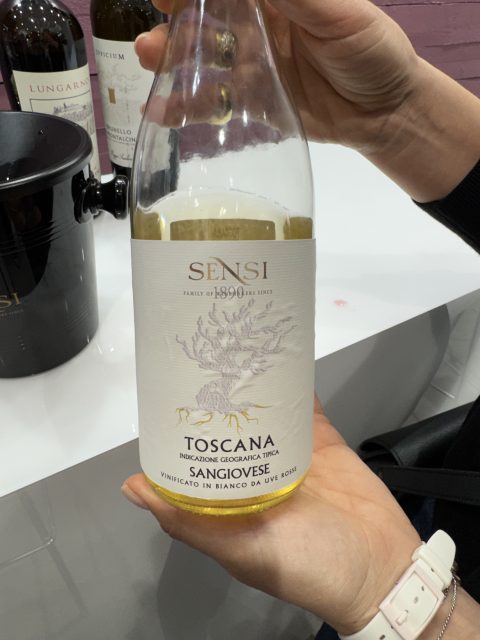
If this demonstrates anything, it is that there are still plenty of stylistic avenues to be explored, even with Italy’s most-planted variety.
Then there is the other crucial asset of indigenous cultivars: their resilience. Italian varieties have proven hardy for millennia, and in a changing climate this ability to withstand difficult growing seasons – be it due to drought, searing temperatures or sudden cold snaps – could be crucial.
As Cecchi points out, whereas the climate crisis is prompting Bordeaux vignerons to look to Portugal for the likes of Touriga Nacional and Alvarinho, such conversations just aren’t happening in Italy. The country already has the viticultural tools to ensure the long-term future of its wine industry, it just needs to deploy them correctly.
Just as France does not need more types of cheese, the last thing Italian wine needs is more grape varieties.
Related news
Five key talking points from Vinitaly 2026
Vinitaly becomes stage for Meloni’s defence of Pope Leo after Trump criticism
Italy minister vows to invest in Sicily’s wine tourism
Dining and Cooking