
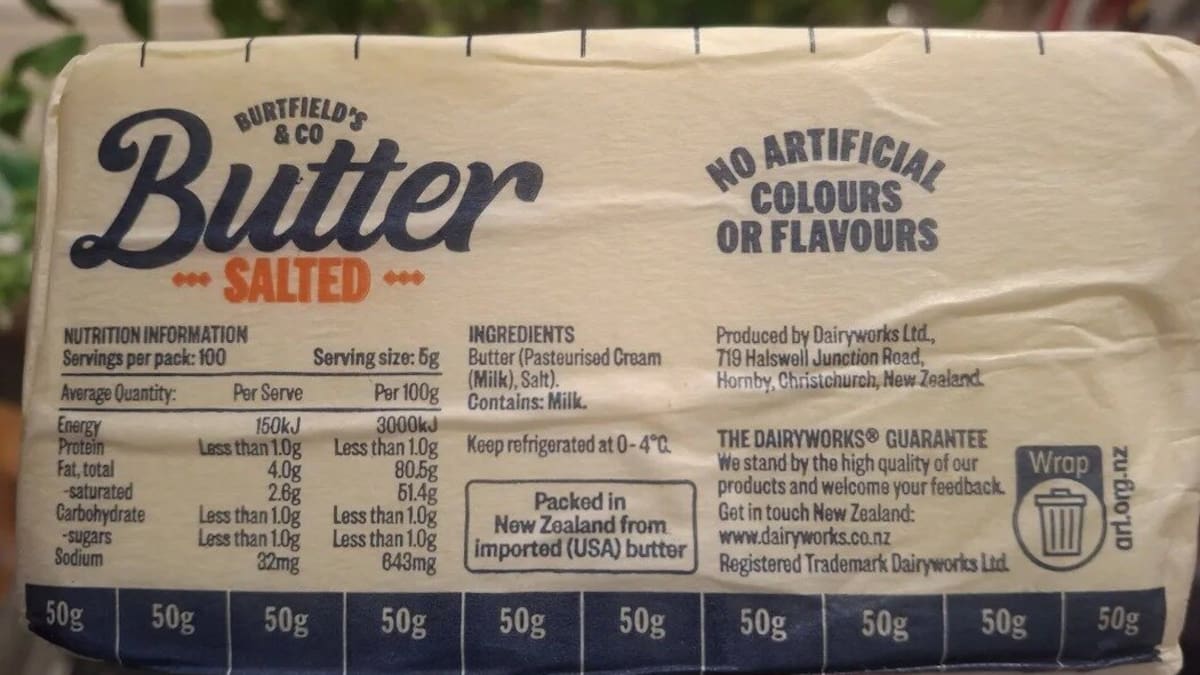
Some people have missed the small print on the back stating the butter is packed in New Zealand and imported from the United States.
“Obviously, for the consumer, it is a possible alternative,” Dean said.
“But I would say the comments that have been raised online, many people find the country of origin labelling a bit hard to find.”
Usually, the international brands are typically easier to distinguish on the shelves, he said.
Some consumers have been surprised when they’ve opened a block at home, because it doesn’t resemble the sunny yellow colour they’re used to seeing.
“There is international butter that’s sold in New Zealand, but I think that’s in foil packaging, it’s in a smaller block, a more premium type product,” Dean said.
“Whereas here we have a product that looks very, very similar in terms of our paper packaging.”
Dairyworks head of marketing and innovation Maja Szarmach said the USA product has “certainly created some healthy debate”.
“It was always intended as a test for us.
“It’s actually going pretty well. We’re really pleased with how it’s been performing so far. It has been around for a month or two.”
The paler product, coming from grain-fed cows, is priced in the range of $6.49 to $6.99 for a 500g block.
Value-focused local butter starts at around $7.29 for home brand products in the same-sized packet.
Szarmach said the company took advantage of a period when American butter prices were low enough to offset freight costs for the 12,000 or so kilometre trip.
The sunny yellow block (left) is a New Zealand-made product, while the American butter from grain-fed cows is paler. Photo: supplied
“If you think about NZ butter, it is a premium global product; most of the butter that is produced here is exported,” Szarmach said.
“So local prices are pretty much driven by global market rates, not just what it might cost to produce the butter here.
“Think of it as a bit of an opportunity, or a window where the US butter price was at a bit of a low, so we could source that butter and bring it into New Zealand at a competitive price.”
Dairyworks is owned by Synlait. It also imports some cheese from abroad, but it won’t be rushing to bring more in at that at this stage.
“We’re pretty proud to obviously have a lot of great Kiwi cheese right at our doorstep and within our portfolio,” Szarmach said.
“There’s definitely potential for that, but at the moment we’re just focusing on this butter and seeing how that goes as a trial.”
– RNZ
Dining and Cooking