
Mediterranean Sea Salt Micro-Mineral Complexes Market Size, Market Forecast and Outlook By FMI
Mediterranean sea salt micro-mineral complexes market was valued at USD 112.0 million in 2025. The valuation is projected to reach USD 118.4 million in 2026 and expand at a CAGR of 6.1% between 2026 and 2036 to reach USD 214.7 million by 2036. Food seasonings are expected to lead the application segment with 36.8% share in 2026. Powder complexes are likely to lead the form segment with 46.5% share in 2026.
Summary of the Mediterranean Sea Salt Micro-Mineral Complexes Market
Demand and Expansion Drivers
Hydration powder brands use marine minerals to support electrolyte claims and premium source positioning.
Premium seasoning brands add Mediterranean origin cues to drive price separation in retail salt formats.
Food processors need mineralized salt systems with steady taste and predictable blending performance.
Wellness brands prefer traceable ingredients near mineral enrichment ingredients for sachets and capsules.
Product and Segment View
Food seasonings are projected to account for 36.8% of application demand in 2026.
Powder complexes are expected to record 46.5% share in 2026 due to dry mix compatibility.
Trace mineral sea salt complexes are likely to capture 41.2% product share in 2026.
Direct B2B supply is expected to contribute 52.4% of sales channel revenue in 2026.
Geography and Competitive Outlook
Spain is projected to record 7.5% CAGR during the forecast period due to saltworks and export capacity.
Italy is expected to advance at 6.8% CAGR by 2036 through culinary salt and seasoning demand.
Salins Group and Salinera Española hold stronger positions through Mediterranean salt sourcing and retail access.
SaltWorks and Cargill Salt rely on B2B channels and specialty salt supply for premium accounts.
Analyst Opinion
, Principal Consultant at FMI states: “Mediterranean sea salt micro-mineral complexes gain value from verified origin and controlled mineral content. These products are preferred in seasoning and hydration applications as they help brands combine taste and electrolyte positioning. Companies now expect stronger proof around sodium contribution and heavy metal limits. ”
Mediterranean Sea Salt Micro-Mineral Complexes Market Value Analysis
Powder complexes serve dry blend programs needing stable flow and low clumping across sachets.
Food seasoning demand rises as premium brands use origin value and mineral texture together.
Direct B2B programs support repeat supplier access as companies approve ingredient specifications early.
Adoption improves as suppliers prove mineral profile stability and sodium contribution in one certificate.
Price pressure is highest in mass snack formats as premium salt cost affects seasoning margins.

Mediterranean sea salt micro-mineral complexes are expected to gain use in seasonings, drink powders and premium savory products. Randazzo et al. showed in January 2024 that Mediterranean saltwork bitterns contain recoverable potassium and magnesium-rich mineral streams. The study estimated recovery potential at about 190 EUR/m³ of bittern. Campus Bio-Medico University also reported in March 2026 that whole sea salt contains magnesium, potassium and calcium. These minerals support taste positioning when verified by batch testing. Coca-Cola’s February 2025 hydration patent adds demand support through electrolyte formats using sodium, potassium, calcium and magnesium. Medina-García et al. showed in December 2025 that microplastic testing is becoming relevant for Mediterranean sea salt. Demand is expected to favor clean-label mineral blends with proven purity and consistent taste.
Mediterranean Sea Salt Micro-Mineral Complexes Market Definition
Mediterranean sea salt micro-mineral complexes include marine salt systems with controlled trace mineral profiles. Scope includes sea salt complexes from coastal evaporation and processed brine mineral fractions. Powder and liquid concentrate formats are included. Applications cover seasonings and foodservice blends. Products serve brands needing mineral positioning without weak taste performance or unclear origin proof.
Mediterranean Sea Salt Micro-Mineral Complexes Market Inclusions
Market scope covers all commercially traded Mediterranean sea salt micro-mineral complexes categorized by product type, including trace mineral sea salt complexes and brine-derived mineral complexes; applications, including food seasonings, hydration products, dietary supplements, personal care, and foodservice blends; grade types, including food-grade, nutraceutical-grade, cosmetic-grade, and industrial-grade complexes; and sales channels, including direct B2B supply, ingredient distributors, private-label partners, and online B2B platforms. Revenue scope covers 2026 to 2036. The key stakeholders include sea salt producers, brine mineral processors, ingredient suppliers, seasoning manufacturers, hydration product brands, supplement companies, personal care firms, foodservice suppliers, distributors, private-label salt packers, testing laboratories, certification bodies, and regulatory authorities.
Scope includes food-grade and nutraceutical-grade mineral complexes. Cosmetic-grade complexes are covered separately. Direct B2B sales and distributor supply are included. Private-label salt blends are within scope.
Mediterranean Sea Salt Micro-Mineral Complexes Market Exclusions
Scope excludes standard refined table salt sold without mineral positioning. Industrial de-icing salt is outside scope. Pharmaceutical sodium chloride is excluded separately. Non-Mediterranean Himalayan pink salt and rock salt products are outside scope. Commodity iodized salt without premium mineral processing is excluded. Pure potassium chloride salt substitutes are excluded from core revenue.
Mediterranean Sea Salt Micro-Mineral Complexes Market Research Methodology
Primary Research: FMI analysts reviewed sea salt producers and ingredient suppliers. Seasoning manufacturers and hydration product formulators were reviewed separately. The research focused on mineral profile control and sodium contribution. Purchaser approval requirements were assessed across food and wellness applications. Testing laboratories and distributors were reviewed separately. Product pricing and grade separation were checked across food and personal care channels.
Desk Research: Desk research covered food-grade salt standards and EU sea salt production data. Sodium guidance and mineral salt safety references were reviewed as distinct reference inputs.
Market Sizing and Forecasting: The sizing model combined Mediterranean sea salt supply and premium salt conversion. Mineral complex pricing and application penetration were assessed as distinct inputs. Forecasts were cross-checked with hydration product demand and specialty seasoning use. Country salt production presence was used as a country-level check. Country-wise product adoption and supplier activity were assessed as different forecast inputs.
Data Validation: Validation compared company portfolios and food-grade salt standards. Application-level ingredient use was reviewed as a separate validation input. Forecasts were adjusted for sodium guidance and price sensitivity. Documentation requirements were checked as a buyer approval input. Europe and North America were assessed as different import and demand regions. Export-facing food production was used as another demand indicator.
Why the Mediterranean Sea Salt Micro-Mineral Complexes Market is Growing?
Hydration brands require marine mineral systems with cleaner taste and verified electrolyte contribution.
Premium seasoning formats create demand for source-specific salts with mineral and texture value.
Food processors seek natural salt systems able to support sodium reduction work selectively.
Personal care brands use Mediterranean mineral stories across bath salts and exfoliating blends.
Supplier documentation improves approval chances across food and wellness channels.
Hydration products are expanding the sales base for Mediterranean sea salt micro-mineral complexes. Brands using hydration supplements need sodium and calcium inputs with controlled taste. Marine mineral complexes help position products near sports and daily hydration use. Formulators prefer powders with low moisture and fast dispersion. Suppliers with detailed certificates can shorten approval discussions with contract manufacturers.
Premium food applications create another sales opportunity. Gourmet salts and mineralized seasoning blends support higher shelf pricing in retail and foodservice. Food manufacturing salt normally requires high sodium chloride purity, excluding permitted additives. [1] This quality base raises attention toward purity and contaminant records. Companies with low-moisture particles and consistent mineral profiles can supply gourmet salts and seasoning brands with fewer reformulation issues.
Sodium guidance shapes product design and claim control. WHO recommends adult sodium intake below 2,000 mg daily, equal to less than 5 g salt per day. This limit does not block premium salt use. It narrows dosage and claim freedom across wellness products. Suppliers supporting sodium reduction ingredients need stronger formulation support around taste and sodium contribution.
Market Segmentation Analysis
Food seasonings are estimated to account for 36.8% share in 2026 because of premium savory blend use.
Powder complexes are expected to hold 46.5% share in 2026 because of dry formulation compatibility.
Trace mineral sea salt complexes are anticipated to capture 41.2% product in 2026.
Food grade is projected to represent 61.0% of grade in 2026 through packaged food use.
Direct B2B supply is expected to contribute 52.4% of sales channel in 2026.
Segmentation covers product type and form. Application, grade, and sales channel form separate cuts. Product type covers trace mineral sea salt complexes and brine-derived mineral complexes. Low-sodium mineral blends and fortified sea salt systems are included. Form includes powder and granules. Flakes and liquid concentrates are covered. Application includes food seasonings and hydration products. Dietary supplements and personal care are included. Foodservice blends are covered. Grade includes food grade and nutraceutical grade. Cosmetic grade and industrial grade are covered. Sales channel includes direct B2B and ingredient distributors. Private label and online B2B are included.
Mediterranean Sea Salt Micro-Mineral Complexes Market Analysis By Product Type

In 2026, trace mineral sea salt complexes are estimated to account for 41.2% of product demand through broad food use.
Brine-derived minerals serve higher-value hydration products. Low-sodium blends support reformulation work in selected packaged foods.
Mediterranean Sea Salt Micro-Mineral Complexes Market Analysis By Form
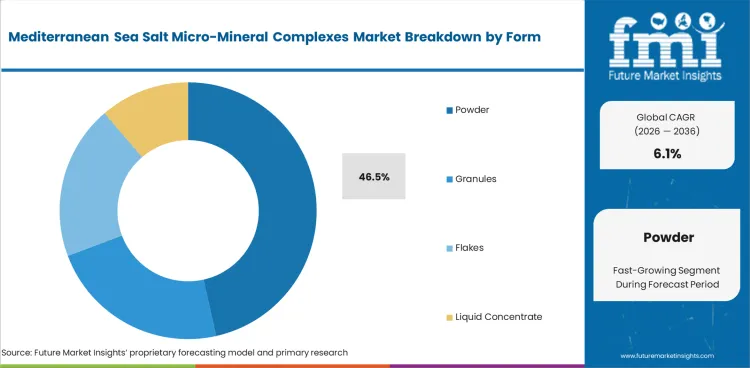
Powder complexes are projected to represent 46.5% of form in 2026 through seasoning and sachet use.
Granules support finishing salts and foodservice blends. Flakes serve premium culinary formats with stronger texture appeal.
Mediterranean Sea Salt Micro-Mineral Complexes Market Analysis By Application

Food seasonings are expected to represent 36.8% of application segment in 2026 because of premium savory formats.
Hydration products grow faster as electrolyte brands seek marine minerals with documented source and taste control.
Mediterranean Sea Salt Micro-Mineral Complexes Market Analysis By Grade

Food grade is likely to account for 61.0% share in 2026 because of wider packaged food applications.
Nutraceutical grade earns higher pricing. Cosmetic grade serves bath salt and exfoliating product lines separately.
Mediterranean Sea Salt Micro-Mineral Complexes Market Analysis By Sales Channel

Direct B2B supply is expected to hold 52.4% share in 2026 through specification-heavy purchase cycles.
Distributors serve smaller brands needing flexible volumes. Private-label partners reinforce premium retail salt programs.
Mediterranean Sea Salt Micro-Mineral Complexes Market Drivers, Restraints, and Opportunities

Premium seasoning brands increase demand for origin-specific salts with controlled mineral and texture profiles.
Hydration powder makers add sales because electrolyte formats need marine mineral differentiation.
Sodium guidance limits broad wellness claims and requires tighter dosage control.
Mineral profile variation can delay approval among large food and beverage companies.
Personal care creates an opportunity for cosmetic-grade mineral streams with separate testing records.
Premium Seasoning Conversion
Premium seasoning conversion creates steady demand for Mediterranean-origin mineral complexes. Retail brands use natural food flavors and source-specific salts to improve product differentiation. Mineralized sea salt works well in seafood seasoning and bakery toppings. Processors need low moisture and steady flow for automated filling lines. Suppliers with several particle sizes can serve retail and packaged food accounts.
Hydration and Electrolyte Reformulation
Hydration brands need mineral systems with taste control and simple ingredient recognition. Mediterranean sea salt complexes can support electrolyte powders and tablets without a fully synthetic mineral profile. Product teams test sodium level and dissolving speed before final approval. This creates opportunities near chewable hydration and daily wellness formats. Suppliers with clean certificates and low-grit powders can enter repeat programs faster.
Sodium Claim Risk
Sodium claim risk restrains wider use in wellness products and functional beverages. Marine mineral systems may strengthen electrolyte positioning. Excessive sodium can weaken health claims. Brands must balance taste and mineral identity. This issue makes formulation support necessary for suppliers serving reduced salt packaged foods. Poor claim control can create legal review delays and launch restrictions.
Food Grade Identity Is Tightening Approval
For the Mediterranean sea salt micro-mineral complexes market, compliance starts with food grade identity and contaminant control. Codex states that the standard applies to salt used as an ingredient of food. Codex states that food grade salt is a crystalline product consisting predominantly of sodium chloride. It is obtained from the sea and from underground rock salt deposits. Codex states that NaCl shall not be less than 97% on a dry matter basis. Copper shall not exceed 2 mg/kg expressed as Cu. Customers need origin proof and label discipline before approving premium salt complexes. [
Analysis of Mediterranean Sea Salt Micro-Mineral Complexes Market By Key Countries
.webp "Top Country Growth Comparison Mediterranean Sea Salt Micro Mineral Complexes Market Cagr (2026 2036)")
Country
CAGR
Spain
7.5%
Italy
6.8%
France
6.3%
Greece
6.2%
United States
5.9%
Germany
5.7%
United Kingdom
5.5%

Source: FMI analysis based on primary research and proprietary forecasting model.
Mediterranean Sea Salt Micro-Mineral Complexes CAGR Analysis By Country
Spain is estimated to progress at 7.5% CAGR by 2036.
Italy is likely to record 6.8% CAGR through 2036.
France is forecast to record 6.3% CAGR during the assessment period.
The United States is anticipated to expand at 5.9% CAGR over the forecast period.
Germany is predicted to post 5.7% CAGR by 2036.
The United Kingdom is expected to advance at 5.5% CAGR through 2036.
Greece is expected to register 6.2% CAGR during the forecast period.
Demand Outlook for Mediterranean Sea Salt Micro-Mineral Complexes in Spain
Spain’s position reflects coastal saltworks and food export activity. Both areas support faster conversion of sea salt into value-added mineral complexes. EU Blue Economy reporting identifies Spain as the largest EU sea salt company base, with 11 large-scale industrial sea salt companies. This supply base creates repeated opportunities for ingredient-grade processing. Spain is anticipated to register 7.5% CAGR by 2036 as seasoning purchasers seek Mediterranean sourcing. Local suppliers obtain orders if traceability and mineral testing match customer specifications.
Saltworks support premium mineral salt sourcing across foodservice and retail seasoning channels.
Food processing hubs create demand for mineralized seasoning blends and dry food ingredients.
Export activity aids supplier access to Mediterranean snack and culinary product makers.
Sales Analysis of Mediterranean Sea Salt Micro-Mineral Complexes in Italy
Italy is expected to expand at 6.8% CAGR through 2036 with culinary salt use and premium food production supporting uptake. Italian food brands apply sea salt complexes in sauces and snack coatings. EU Blue Economy reporting identifies 5 large-scale sea salt production companies in Italy, giving the country a meaningful supply base. Ingredient suppliers can use local culinary credibility to drive adoption of clean-label ingredients. Manufacturer opportunity improves if taste stability and documentation match export market needs.
Salt resources encourage origin value across premium culinary salt applications.
Food processors create demand for stable mineralized ingredients across sauces and bakery products.
Supplement brands can use Italian sourcing cues across sachets and wellness blends.
Demand Analysis of Mediterranean Sea Salt Micro-Mineral Complexes in France
French demand reflects premium grocery channels and natural food expectations. Customers evaluate mineral salt complexes through origin and compliance documentation. France is forecast to record 6.3% CAGR during the assessment period. Gourmet salt products and natural seasoning formats create demand for crystals and fine powders. Suppliers support salt content reduction ingredients work in selected food products. Approval speed improves only if sodium contribution and impurity data are clear.
Salt traditions support premium salt positioning across retail and foodservice channels.
Natural food brands need mineral complexes with simple processing records and contaminant limits.
Culinary applications require texture consistency across finishing salts and seafood seasoning blends.
Opportunity Analysis of Mediterranean Sea Salt Micro-Mineral Complexes in Greece
Greece offers an active consumption base for Mediterranean mineral salt complexes. Demand links with olive snacks and spa formulations. Greece is expected to register 6.2% CAGR during the forecast period as culinary exports and wellness products expand. Suppliers can use origin story effectively. Larger accounts require stronger batch testing. Partnerships with processors can help smaller saltworks serve natural flavors and seasoning manufacturers. Documentation quality decides access to export-oriented customers.
Salt resources support origin cues across food and wellness products.
Food exporters use mineralized salts across olive snacks and seafood applications.
Spa and personal care brands apply marine mineral stories in bath salt formats.
Future Outlook for Mediterranean Sea Salt Micro-Mineral Complexes in the United States

The United States has strong demand from hydration powders and specialty food channels. Brands use Mediterranean sea salt complexes in electrolyte sachets and premium seasoning blends. The United States is anticipated to expand at 5.9% CAGR over the forecast period. Importers need documentation covering mineral composition and food safety systems. Supplier qualification improves if products show clean taste and low grit in functional foods. Feedstock consistency decides movement beyond trial orders.
Wellness brands drive marine mineral demand across hydration powders and premium supplements.
Contract manufacturers require certificates and stable flow across sachet filling lines.
Specialty food retailers support imported Mediterranean salts with culinary and origin appeal.
Demand Outlook for Mediterranean Sea Salt Micro-Mineral Complexes in Germany
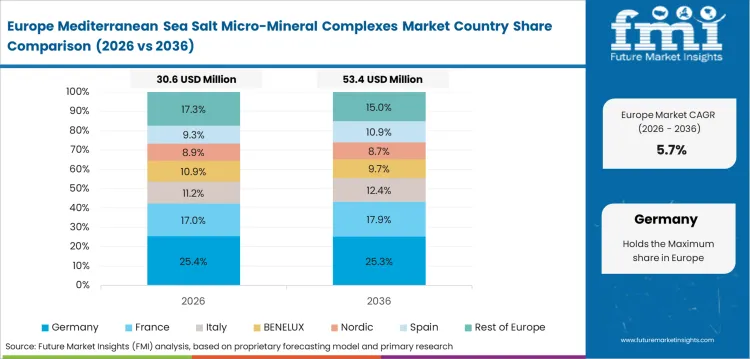
Germany’s industry reflects strict purchasing qualification and controlled ingredient specifications. Food and supplement producers require strong documentation before approval. Germany is projected to post 5.7% CAGR by 2036 with demand connected to organic foods, premium seasonings, and hydration powders. Companies compare Mediterranean complexes with micronized salt through particle size, dosage accuracy, and audit support. Supplier audits are expected to be strict across large accounts. Batch repeatability will decide long-term supply access.
German companies support adoption among premium food and supplement brands needing controlled mineral ingredient systems.
The country strengthens distributor access to food processors and wellness manufacturers.
Import channels support Mediterranean ingredient movement into wider German markets.
In-depth Analysis of Mediterranean Sea Salt Micro-Mineral Complexes in the United Kingdom
The United Kingdom consumer base reflects premium grocery and foodservice channels. Imported Mediterranean salts hold appeal across gourmet retail and hydration products. The United Kingdom is expected to advance at 5.5% CAGR through 2036 as wellness channels expand. Sodium messaging remains a purchase concern across functional beverages and supplement blends. Suppliers aligned with food minerals can support safer formulation discussions. Retail buyers need origin proof and clear serving guidance.
Premium grocery chains create space for Mediterranean-origin salts and mineralized seasoning blends.
Hydration brands need differentiated electrolyte sources with simple labeling and clean taste.
Foodservice suppliers use gourmet salts across seafood and finishing applications.
Competitive Landscape and Strategic Positioning

Competition is moderately fragmented, with regional saltworks and specialty ingredient suppliers competing in the same account base.
Larger suppliers differentiate through certificates and repeatable food-grade processing capability.
Smaller producers compete through Mediterranean origin and premium culinary appeal.
Barriers to entry include contaminant testing and large purchasing documentation needs.
Supplier strength starts with proof of mineral consistency across food and hydration applications. Food and hydration companies test taste and contaminant limits before approving suppliers. Salins Group and Salinera Española benefit from Mediterranean salt sourcing and established trade presence. Their position supports premium seasoning and retail salt accounts. Ingredient purchasers require proof around sodium contribution and heavy metal limits.
Established salt suppliers benefit from broader product coverage and supply reliability. Cargill Salt and K+S Aktiengesellschaft support purchasing confidence through industrial salt knowledge and quality systems. SaltWorks participates through specialty salts and private-label programs. These companies can support packaging and application discussions for premium salt customers. Their service range reduces switching risk for food brands using mineralized salt systems.
Specialist regional producers can win orders through origin value and flexible product formats. Infosa and smaller Mediterranean salinas can supply solar-evaporated salts for premium uses. These suppliers perform well in accounts needing origin value and culinary appeal. Larger companies may require partnerships with processors or distributors for documentation depth. The strongest suppliers combine coastal sourcing with controlled drying and testing support.
Key Companies in the Mediterranean Sea Salt Micro-Mineral Complexes Market
Mediterranean sea salt micro-mineral complex competition includes regional salt producers and specialty ingredient companies.
Mediterranean Salt Producers
Salins Group and Salinera Española strengthen their position through coastal saltworks and branded salt experience. Infosa supports Spanish sea salt supply through solar evaporation and Mediterranean sourcing. These companies are strongest in premium culinary salts and food-grade mineral systems. Their advantage improves as customers request verified origin and stable mineral profiles.
Global Salt Suppliers
Cargill Salt and K+S Aktiengesellschaft maintain an advantage through scale and wider salt portfolios. Their strength is highest in accounts requiring repeat supply and documentation support. Compass Minerals participates through salt processing and minerals expertise. Larger suppliers can support standard quality control and longer-term supply programs.
Specialty Salt and Ingredient Suppliers
SaltWorks and selected specialty salt companies support premium salts and B2B ingredient supply. Their role is strongest in retail seasoning and specialty food programs. These suppliers can move faster in product development and packaging support. They gain preference in accounts needing custom particle sizes and smaller production runs.
Competitive Benchmarking: Mediterranean Sea Salt Micro-Mineral Complexes Market
Company
Mediterranean Sourcing Strength
Mineral Testing Support
B2B Ingredient Access
Strategic Position
Salins Group
High
High
High
Strong European salt position
Salinera Española
High
Medium
High
Strong Spain sea salt base
Infosa
High
Medium
Medium
Regional Mediterranean supplier
SaltWorks
Medium
High
High
Strong specialty salt channel
Cargill Salt
Medium
High
High
Broad industrial supply access
K+S Aktiengesellschaft
Low
High
High
Strong mineral quality systems
Compass Minerals
Low
High
Medium
Strong salt processing base
Source: Future Market Insights competitive analysis, 2026.
Key Developments in Mediterranean Sea Salt Micro-Mineral Complexes Market
In January 2025, SaltWorks launched specialty salts for food industry and private-label companies, for premium salt sourcing programs.
In October 2024, SEASALT Europe held its first annual meeting in Ibiza, to increase collaboration among European sea salt producers.
In March 2025, Codex listed the food-grade salt standard as updated, providing reference points for food salt compliance.
In January 2025, EFSA published a safety opinion on potassium and magnesium mineral salt, for mineral salt review discussions.
In March 2025, Compass Minerals published fiscal 2024 ESG reporting, for minerals supply transparency in buyer review.
Key Players in the Mediterranean Sea Salt Micro-Mineral Complexes Market
Mediterranean Salt Producers
Salins Group
Salinera Española
Infosa
Global Salt Suppliers
Cargill Salt
K+S Aktiengesellschaft
Compass Minerals
Specialty Salt Suppliers
SaltWorks
Maldon Crystal Salt Company
Cornish Sea Salt Company
Report Scope and Coverage

Mediterranean Sea Salt Micro-Mineral Complexes Market Breakdown By Product Type, Form, Application, Grade, Sales Channel and Region
Parameter
Details
Quantitative Units
USD 118.4 million in 2026 to USD 214.7 million by 2036. CAGR is forecast at 6.1%.
Market Definition
Mediterranean-origin sea salt and brine mineral systems used in food, hydration, supplement, and personal care applications.
Regions Covered
North America and Latin America are covered. Europe and East Asia are covered. South Asia and Pacific are covered. Middle East and Africa is covered.
Countries Covered
Spain and Italy are covered. France and Greece are covered. United States, Germany, and United Kingdom are covered.
Key Companies Profiled
Salins Group and Salinera Española are profiled. SaltWorks and Cargill Salt are profiled. K+S and Infosa are profiled separately.
Forecast Period
2026 to 2036
Approach
Hybrid method using sea salt supply, premium salt pricing, application demand, and supplier presence.
Mediterranean Sea Salt Micro-Mineral Complexes by Segments
Mediterranean Sea Salt Micro-Mineral Complexes Market Segmented by Product Type:
Trace Mineral Sea Salt Complexes
Brine-Derived Mineral Complexes
Low-Sodium Mineral Blends
Fortified Sea Salt Systems
Mediterranean Sea Salt Micro-Mineral Complexes Market Segmented by Form:
Powder
Granules
Flakes
Liquid Concentrate
Mediterranean Sea Salt Micro-Mineral Complexes Market Segmented by Application:
Food Seasonings
Hydration Products
Dietary Supplements
Personal Care
Foodservice Blends
Mediterranean Sea Salt Micro-Mineral Complexes Market Segmented by Grade:
Food Grade
Nutraceutical Grade
Cosmetic Grade
Industrial Grade
Mediterranean Sea Salt Micro-Mineral Complexes Market Segmented by Sales Channel:
Direct B2B
Ingredient Distributors
Private Label
Online B2B
Mediterranean Sea Salt Micro-Mineral Complexes Market by Region:
North America
United States
Canada
Mexico
Latin America
Brazil
Chile
Rest of Latin America
Western Europe
Spain
Italy
France
Germany
United Kingdom
Greece
BENELUX
Rest of Western Europe
Eastern Europe
Poland
Hungary
Balkan and Baltic
Rest of Eastern Europe
East Asia
South Asia and Pacific
India
ASEAN
Australia and New Zealand
Rest of South Asia and Pacific
Middle East and Africa
Kingdom of Saudi Arabia
Other GCC Countries
Turkiye
South Africa
Rest of Middle East and Africa
Research Sources and Bibliography
FAO and WHO. 2025. Standard for food-grade salt. Codex Alimentarius Standard. No. CXS 150-1985. Codex Alimentarius Commission. Rome.
Codex Alimentarius Commission. (2025, March). Standard for food-grade salt CXS 150-1985. FAO and WHO.
European Commission. (2025, June). The EU Blue Economy Report 2025: Marine non-living resources. Publications Office of the European Union.
European Food Safety Authority. (2025, January). Safety of mineral salt containing potassium and magnesium as a novel food. EFSA Journal.
European Union. (2025, July). Commission Implementing Regulation (EU) 2025/1530 on authorising mineral salt containing potassium and magnesium. EUR-Lex.
FoodDrinkEurope. (2024, October). Guidance for industry to reduce sodium in food products. FoodDrinkEurope.
SaltWorks. (2025, January). SaltWorks debuts exclusive line of specialty salts for food industry and private label markets.
SEASALT Europe. (2024, October). SEASALT Europe celebrates in Ibiza the first annual meeting of European sea salt producers.
Compass Minerals. (2025, March). Fiscal 2024 ESG report. Compass Minerals.
K+S Aktiengesellschaft. (2025, March). K+S 2024 annual report. K+S Aktiengesellschaft.
The bibliography provides reader reference and uses regulatory publications, public institutional sources, and official company material.
This Report Answers
Which value is projected for Mediterranean sea salt micro-mineral complexes in 2026 and 2036?
Which CAGR is forecast for Mediterranean sea salt micro-mineral complexes between 2026 and 2036?
Which product type is projected to lead Mediterranean mineral complex demand in 2026?
Which application is expected to account for the highest share in 2026?
Which countries are forecast to record faster mineral salt complex expansion through 2036?
Which companies hold stronger positions in Mediterranean salt sourcing and specialty salt supply?
Which product types are included and excluded from this Mediterranean mineral complex scope?
Which grade types shape food, supplement and personal care approval demand?
Which method supports FMI’s market size and country-level forecast view?
Frequently Asked Questions
Which value is projected for Mediterranean sea salt micro-mineral complexes in 2026?
In 2026, the global market is expected to be worth USD 118.4 million through wider food seasoning and hydration use.
Which value is projected for the market by 2036?
By 2036, valuation is projected to reach USD 214.7 million as mineralized salt use expands across premium products.
Which CAGR is expected for the market between 2026 and 2036?
The market is forecast to expand at 6.1% CAGR between 2026 and 2036 across food and personal care applications.
Which application is projected to lead in 2026?
Food seasonings are projected to account for 36.8% share in 2026 through premium savory blends and culinary salt use.
Which country is forecast to expand fastest through 2036?
Spain is projected to record 7.5% CAGR through 2036 as coastal saltworks support ingredient-grade mineral complex supply.
Which products are included in this market?
Scope includes trace mineral sea salt complexes and fortified sea salt systems.
Which companies are active in this market?
Companies include Salins Group and Compass Minerals.
Which method supports the forecast?
FMI used Mediterranean salt supply and country demand checks separately.
Dining and Cooking