
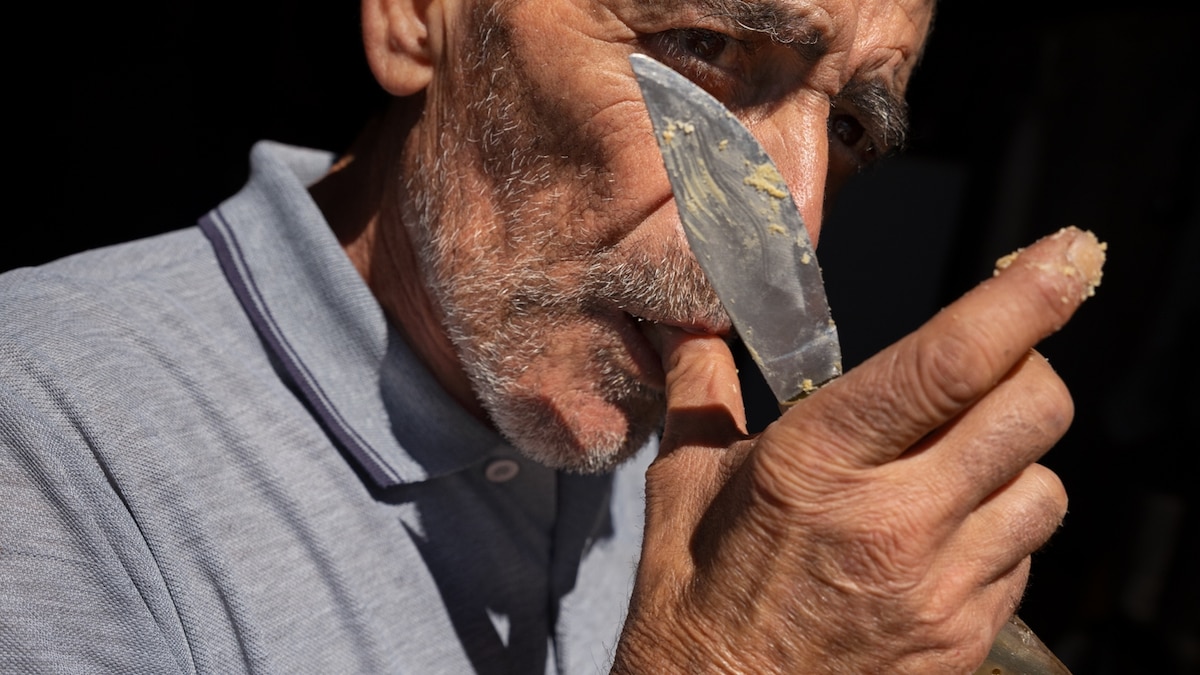
In 1962, Italian legislation prohibited commercial sales of the cheese due to safety concerns. Further restrictions in a wider 2002 law banned casu marzu trade within the European Union. Still, it remains available for Sardinians who know where to look. Between its underground status and the fact that production happens on a microscale, it’s difficult to pinpoint the number of shepherds making casu marzu, though one estimate suggests they churn out more than 200,000 pounds yearly. That the process relies on a certain amount of randomness—some shepherds will end up with a surplus of wheels in a given season, some none—gives the annual search a certain frantic thrill.
One night in Cala Gonone, a seaside resort not far from Dorgali, I stopped by a beach bar called Baby Luna to visit its co-owner, Giuseppe Ventura, one of the area’s most passionate casu marzu devotees. Sure enough, I had barely sat down at a table when Ventura joined me, opening a bottle of Cannonau and plopping down a plate of cheese that wiggled faintly in the Mediterranean breeze. Ventura told me he has the contacts of 10 shepherds that he calls in rotation, the better to ensure a regular supply for his personal use.
Among them is 32-year-old Mario Nieddu, the fourth generation in his family to raise farm animals in the hills near Cala Gonone. I could hear his flock before I saw it, a cacophony of bleating and bells that came from beyond a screen of scrabbly juniper and holm oak. We sat on a boulder in the shade of an olive tree, looking out on the landscape covered in fragments of limestone, as though a giant had come by with a hammer. Far below, we could see a sparkling blue piece of the Gulf of Orosei. It was the kind of view that made people, when I told them that I was going to Sardinia to eat maggot cheese, recoil, then stop, think for a moment, and say, “You know, I’d probably eat maggot cheese if I could go to Sardinia.”
It’s a fragile time for casu marzu. Increasingly hot summers because of climate change have affected the life cycle of cheese flies, making their work even less predictable than usual. Last year, out of about 60 wheels, only four or five of the Nieddu family’s ended up as casu marzu. (If the maggots inside a cheese are dead, it is considered inedible.)
Dining and Cooking