
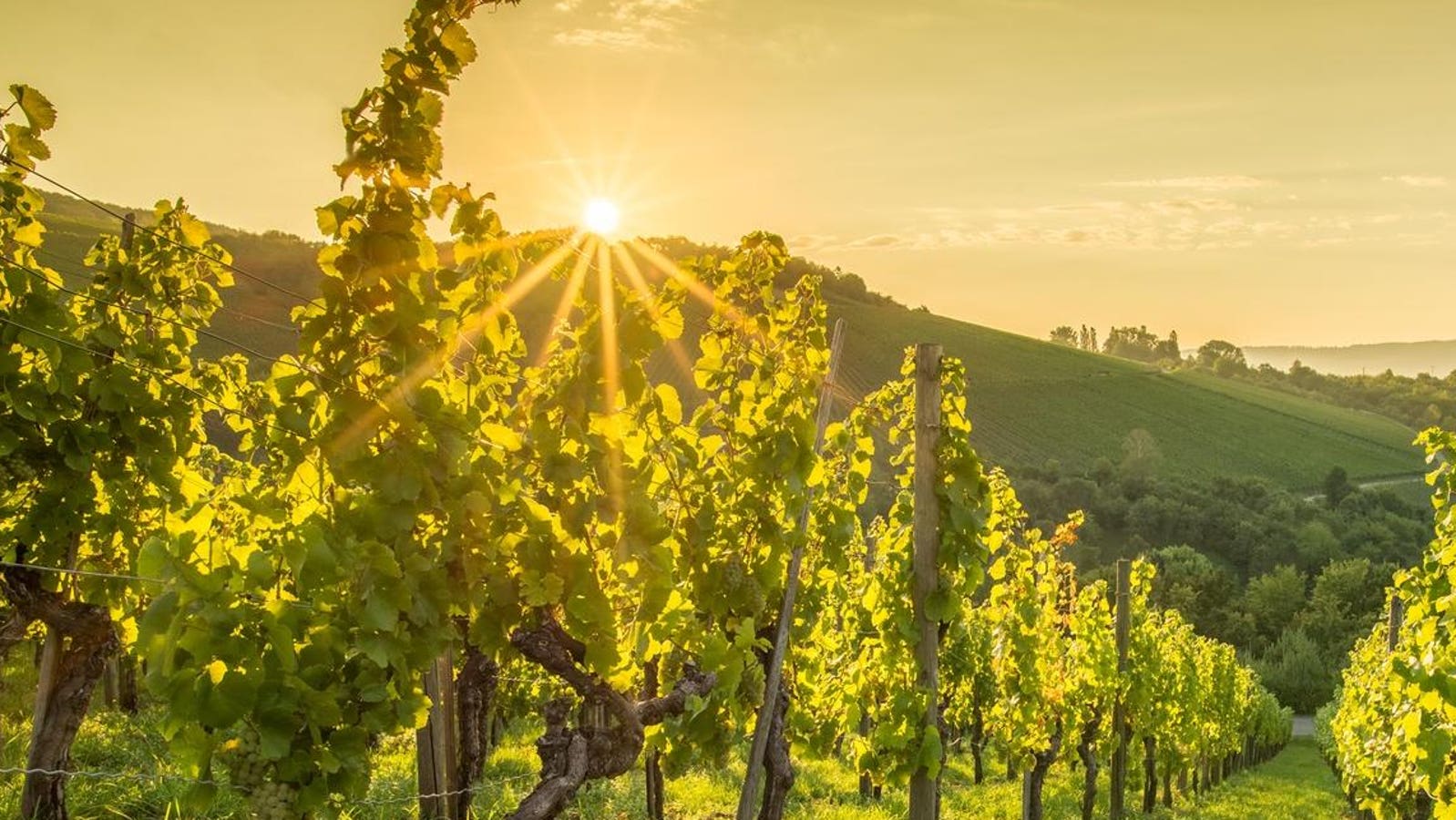
Sunbeams in a vineyar with green foliage
getty
Almost a century of a family lineage making wine had come to a close, as siblings wanted to pursue their own ventures in the wine world, just as their father had before them. One of the sons was the director of winemaking for 30 years at his family’s famous wine empire. Hence, he not only knew the vineyards of California, especially Napa Valley, like the back of his hand, but he had also traveled to many stellar wine regions, either forming partnerships or sitting at the feet of some of the most legendary wine families in Europe, and here he was, at a pivotal crossroads of his life. As he felt in the shadow of a large giant, as his father was as big of a figure as one could be in the world of wine, and he was a main factor in the success of Napa, as well as opening the doors to other emerging wine regions, and so, he thought about walking away from wine, his whole world since he was a child, to finally escape the comparison to his father that had loomed large over his entire life. But one day, as he thought about his fate, which seemed to belong not only to him, since his grandparents had sacrificed so much, leaving their home in Italy to make the dangerous trip, filled with many unknowns, to America, he reached within himself to find the strength to keep their dream alive. He would find a way to move forward on his own path, inspired by Isaac Newton’s words: “If I have seen further, it is by standing on the shoulders of giants.”
Famous Château du Clos de Vougeot standing amidst vineyards in Burgundy
getty
Ultimately, his love for Burgundy wines that were, in his estimation, the epitome of expressing site and overall elegance, combined with his history within Napa Valley, would lead him to a place that not only had no existing prestige but was utterly obscure when it came to the lore of Napa, when ironically, his father had owned To Kalon, the most prestigious vineyard in American. And he would find a site that would conjure the magic of sense of place for Cabernet Sauvignon and Cabernet Franc like the top vineyards in Burgundy have done for Pinot Noir.
Continuum Estate
It was December 2004 when it seemed like an incredibly historic wine lineage was going to come to an end; the iconic Robert Mondavi sold his wine business, freeing up his adult children to follow their own journeys, but leaving his son, Tim Mondavi, who had been his director of winemaking for so long, with a challenging decision of where to take his life. When Tim was coming up, the spotlight was more on the celebrity personalities of the business or a brand name, and he was more about the team behind the wines, who were obsessed with rare vineyards that could make transcendent libations that wowed on their own, not simply because of manufactured hype. And so, being a devoted naturalist and all his years of experience of knowing which sites are ideal for particular varieties that have an affinity for terroir, he found a stellar property in an area called Pritchard Hill, in Napa Valley, located between 1,300 and 1,600 feet in elevation, on the slopes of the Vaca Mountains, where one can see the San Francisco Bay and the Mayacamas Range. The property would be named Sage Mountain Vineyard for its flourishing biodiversity, and he aptly named his new family winery Continuum Estate.
Tim Mondavi with his winemaking daughter Chiara, who also designed the labels for Continuum
Continuum Estate
Continuum Estate was started by Tim and his sister Marcia, and through time, they have brought on five of their kids, Tim’s daughters and sons, Carissa, Chiara, Carlo and Dante as well as Marcia’s son Brian, and all have a combined mission in conservation, encouraging biodiversity and a natural expression of their wines, which is evident by their biodynamic-focused farming and low-intervention winemaking. Brian noted that he learned what the difference was between a good vineyard and a truly gifted site from Tim, as it comes down to the fact that a gifted site will “make fantastic wine even in a challenging year,” such as the 2011 vintage, as it was a difficult one for many in Napa due to cold and wet weather, yet Continuum made a beautiful wine in 2011. Many factors go into the idea of why their Sage Mountain Vineyard is a gifted site – such as the shallow red, rocky volcanic soils that make the vines struggle, producing low yields and small berries, as well as giving a lifted quality to the wines that Carissa believes comes from the volcanic soils, like the sommelier favorite grapes grown on Mount Etna, in Sicily. Yet, she also speaks about their elevation, lifting them above the fog line, and in cold and wet years, the fog exacerbates uneven growing conditions on the valley floor, as opposed to up on Sage Mountain Vineyard, the grapes get plenty of sunshine while getting consistent moderate temperatures that avoid the spikes that the valley is more likely to suffer.
These attributes, with Tim’s thoughtful approach in the cellar, avoid severe weather, over-vigorous vines and a heavy hand in the winery from forcing these wines into extreme versions of themselves, but instead, come into their own with a nuanced beauty found within these Cabernet Sauvignon, Cabernet Franc, Merlot and Petit Verdot blends that brings out a multifaceted finesse paired with a layered complexity.
A Heart of Iron
Sage Mountain Vineyard
Continuum Estate
As Tim thinks back on his childhood, the most powerful memories are being around his grandparents at their winery, Charles Krug, and what an amazing couple they were, with his grandfather, Cesare, a gifted winemaker. His grandmother, Rosa, was an amazing cook, and so their home was a place where the community gravitated. But before Napa, they were natives of the Sassoferrato area in Marche, Italy, and were barely surviving as sharecroppers, so they made the challenging move to America. But first, they ended up in Minnesota as Cesare was able to get a job in an iron ore mine. As Prohibition was impending, and as a resourceful man, he decided to take advantage of the future demand for home winemaking, since it would become illegal to buy alcohol. In 1919, he started shipping wine grapes from California to the Midwest so that Italian-American families could make wine.
Old street in a medieval village in Marche
getty
Serendipitously, there would be a strong connection with iron and his family’s journey in the wine world. The area where Cesare and his wife came from, in Marche, Sassoferrato, translates to “rocks of iron,” and it was a place where he was deeply rooted in the land. Then, when working at an iron ore mine in Minnesota, he would help make it possible for Italian families to still drink their precious wine during family dinners, which were at the heart of their culture. And now, Tim and his sister, his children and his nephew have a property that has a tremendous amount of rocks on top of iron-rich red volcanic soil, which Tim says gives nerve and vibrancy to their wines, especially combined with the breezes from the San Francisco Bay, and he realizes that the Mondavi family ending up at this property was “meant to be.”
It is indisputable that there would be no Napa without Robert Mondavi. Still, there is a sacrifice when one has to carry a whole industry on his back, always having to grow, be bigger, as not only is it unacceptable for that leader to let Napa down, but the rest of the emerging wine world that has been toiling away in the shadows depends on a new world superstar to show the old world traditions that it is possible. Along the way, people forget that the Mondavi family has it in their DNA to be deeply connected to the land and to strive to make the best wines in the world, as that can get lost in the hype behind the name. And so now, the next generations of the Mondavi family are giving everything to a special piece of land and staying laser-focused on a small production, around 4,000 cases a year. And in a way, it seems the Mondavi family has come full circle, truly making the dream of Cesare and Rosa come true – a family united through their bond with nature, making wines that bring together a devoted community.
Lineup of Continuum wines
Cathrine Todd
2023 Continuum, Sage Mountain Vineyard, Pritchard Hill, Napa Valley, California: 46% Cabernet Sauvignon, 41% Cabernet Franc, 7% Merlot and 6% Petit Verdot. I knew this wine was going to be really good but I had no idea it would be stratospheric. It has a marvelous quality of high and low notes that play off each other, decadent while also delicate, mysteriously secretive while also generously effusive with cherry preserves with ribbons of sage that has a fierce backbone of minerality and marked acidity with a nimble body and very fine tannins that has an overall ethereal quality (I actually noted a “Burgundian quality” before knowing Tim’s love for Burgundy) balanced by a deep concentration. This is truly a magnificent wine!
2023 Novicium, Sage Mountain Vineyard
Cathrine Todd
2023 Novicium, Sage Mountain Vineyard, Pritchard Hill, Napa Valley, California: 91% Cabernet Sauvignon, 4% Cabernet Franc, 3% Petit Verdot, and 2% Merlot. Novicium was originally conceived as their second wine to Continuum but through time has come into its own as a Cabernet Sauvignon-dominant superstar. Novicium translates into “novice” and it was the wine where they experimented many years to find the ideal blends for their property, and despite Cabernet Sauvignon playing a much lesser role in Continuum, it is prominent in Novicium as they have found some parcels that do well as making up a significant majority of the blend. Intriguing aromas of tobacco and graphite with rich blueberry flavors with chiseled tannins that are perfectly integrated into the concentrated body with hints of cocoa powder and a long, expressive finish leaving wildflowers in one’s head. It seems absurd to call this a “second wine” when it surpasses many top first wines (grand vins).
2019 Continuum, Sage Mountain Vineyard, Pritchard Hill, Napa Valley, California: 50% Cabernet Sauvignon, 37% Cabernet Franc, 7% Petit Verdot and 6% Merlot. An enchanting bouquet of aromas on the nose with violets, rose petals and crushed rocks with boysenberry tart flavors lifted by spicy notes of grated nutmeg and bright acidity with a plush palate and chiseled tannins that intertwines dense fruit with hints of forest floor. It will be difficult to cellar this outstanding wine as it is showing so well right now but it does have the structure and balance to go for many more years.
2011 Continuum, Sage Mountain Vineyard, Pritchard Hill, Napa Valley, California: 75% Cabernet Sauvignon, 12% Petit Verdot, 11% Cabernet Franc and 2% Merlot. This is from the very difficult 2011 Napa vintage with its cooler and wetter weather and was unfairly deemed a bad vintage overall, although that doesn’t tell the whole story as some made fantastic wines. But this goes back to the idea of Sage Mountain Vineyard being a “gifted” site that always makes fabulous wines even in the off vintages and it certainly proves it with this vintage. A strong sense of place with complex notes of wet river stones, gravelly rocks and a smoky minerality balanced by juicy cassis fruit with very fine tannins and mouthwatering acidity across the sustained finish.
The above descriptions of the wines are Cathrine Todd’s tasting notes.
Dining and Cooking