

This article contains affiliate links. We may receive compensation if you make a purchase using one of these links at no additional cost to you. See our Disclaimers and Terms of Use for more information.
Discover what it’s like to take a pasta making class in Rome with Devour Tours. Both educational and fun, this Rome cooking class will turn you into a pasta pro.
 Image: ©2foodtrippers
Pasta. We all love it. It’s the one food that defines Italian cuisine around the world. It’s also the one food that many of us have cooked at home, generally from a box, with varying success. (To be clear, there’s nothing wrong with dry pasta. Semolina-based al dente noodles have their own place in Italian cuisine.)
Don’t be surprised by the popularity of pasta at local restaurants when you travel to Rome. After all, the city has made an international culinary reputation out of its four classic pastas – cacio e pepe, carbonara, alla gricia and amatriciana.
Discover the best noodle dishes to eat in Rome and beyond.
 Fresh pasta, like these fettuccine noodles we made during our class, is good pasta in Rome. | Image: ©2foodtrippers
Unlike Emilian cities like Bologna, Modena and Parma, Rome isn’t famous for being a fresh pasta mecca. However, fresh pasta is indeed worth seeking and eating in the eternal city.
For us, there’s nothing better than eating a bowl of fresh fettuccine or tonnarelli served in one of the city’s four classic pasta preparations. In Rome, sauces like cacio e pepe have unique way of binding to fresh noodles – it’s something special worth experiencing.
Rome Pasta Making Class with a Local Chef
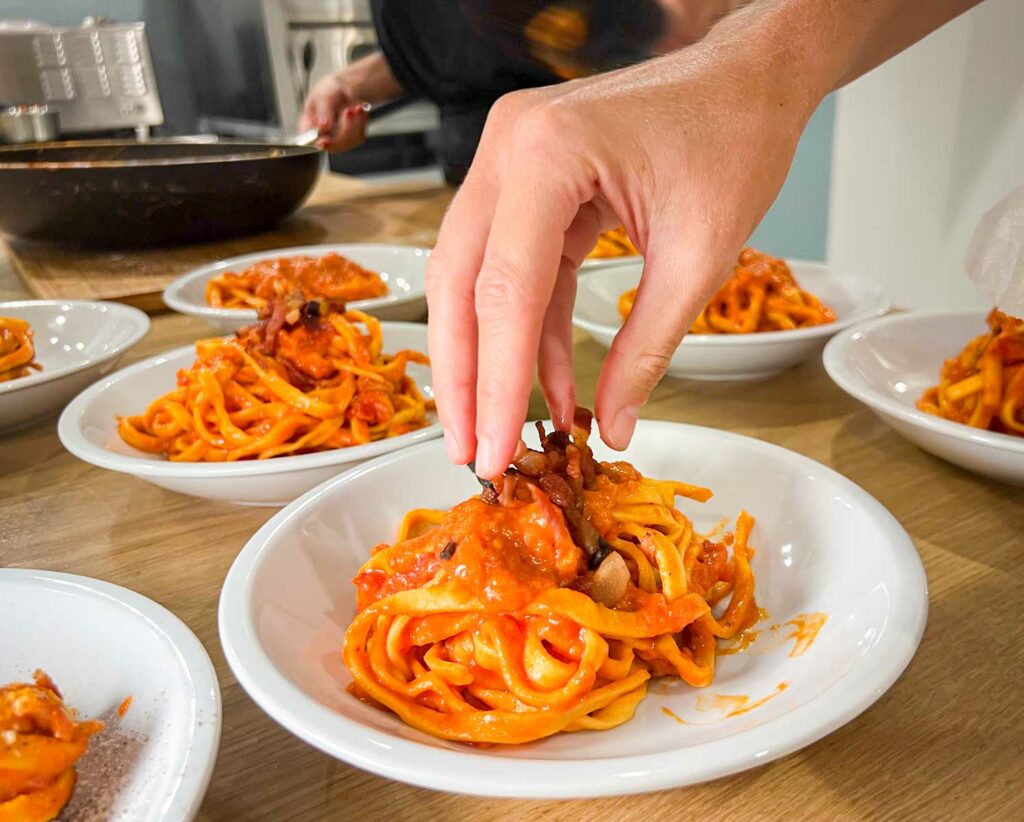 Eating dishes like fettuccine alla Amatriciana was a highlight of our Rome pasta making class. | Image: ©2foodtripper
Our Rome pasta making class wasn’t just fun and games.
We learned how to form dough, shape pasta and cook sauce. And, as we completed these tasks, we also learned that making pasta from scratch is so simple if done the right way.
Our instructors, Fernanda Vaca and Elisa Della Valentina, expertly led us through these tasks, patiently showing us how to knead dough and then how to turn that dough into pasta using rollers and a chitarra. They also showed us how to make tasty sauce.
A Special Guest
 Making pasta spans the generations. We’re pictured here with our nephew Max who joined us in our pasta making mission. | Image: ©2foodtrippers
We didn’t take this pasta making class alone – we were joined by a next generation foodtripper.
Our nephew Max traveled from Florence with a plan to hang with us in Rome and eat pizza. When presented with the pasta dough task, Max was skeptical.
“I’m not good at this stuff,” Max said, staring down at the mise en place of flour, eggs and semolina.
Sure enough, after following step-by-step instructions provided by Devour’s patient instructors, Max created perfect batches of ravioli and fettuccine ready to jump in the pasta pot. The joy on his face was apparent – he had learned a new skill and was beaming.
All We Knead Is Dough
 We paused to pose with our finished dough balls before they graduated to pasta status. | Image: ©2foodtrippers
Our class started with Prosecco and camaraderie as fourteen strangers came together with a shared pasta making mission.
Before long, we collectively rolled up our sleeves and it was go time. In other words, it was time to make egg pasta, the most typical pasta produced in the home kitchen, using the well method.
 We learned how to combine flour and eggs using the well method. | Image: ©2foodtrippers
The seemingly simple well method can be a bit of a nightmare for home cooks since pasta dough can become sticky or gum up. However, Fernanda and Elisa’s patient instruction and attention to detail ensured that we achieved pasta dough success.
 Fernanda made a wreath with the class’s dough ball babies. The ‘X’ at the top ensured that we’d each get the pasta dough ball we’d created. | Image: ©2foodtrippers
As opposed to bread-based doughs used to make pizzas, which can take up to a day to prepare, pasta doughs, once they’re formed, only need about 30 minutes to relax before rolling. There was an amazing satisfaction to see what started as a tacky, sticky mess transform into silky, smooth, pliable dough.
In order to keep everyone’s dough coordinated, Fernanda neatly arranged the class’ pasta dough balls on a round plate so that the dough we shaped would be the same dough we’d use to make pasta. It was now time for an amatriciana sauce lesson in the school’s central kitchen.
Getting Saucy


Donning black gloves, Daryl assisted with the amatriciana sauce preparation by squeezing the tomatoes. He did this while another student prepped the guanciale (right). | Images: ©2foodtrippers
Once in the kitchen, Daryl was put to work squeezing whole tomatoes for the amatriciana sauce. Another classmate was put to work rendering and browning guanciale – cured pork jowl that’s an essential amatriciana ingredient.
Fun Fact
Guanciale isn’t just an essential amatriciana ingredient. It’s also used to to cook two other Roman pasta classics – carbonara and alla gricia.
Before we knew it, the tomatoes were squeezed and the guanciale was cooked. Once they came together in the pan, it was time for us to finish our pasta making mission.
Time to Make the Pasta


Making pasta from scratch is easy when you have the proper kitchen tools. We rolled and flattened dough using a pasta machine (left) and cut ravioli using a square ravioli cutter (right). | Images: ©2foodtrippers
Back at our stations, we used a pasta machine’s roller setting to roll and flatten our dough, a relatively simple process. Since we each ended up with two long sheets of pasta, it only made sense that we should make two different pastas.
First things first, we created ravioli and filled them with pumpkin ricotta. Next, we used a chitarra to make fettuccine noodles.
Fun Fact
A chitarra is an Italian pasta making device. When using a chitarra, cooks roll pasta dough over a set of wires to make strand-like pastas like spaghetti, fettuccine and tonnarelli.
 There’s a first time for everyone who uses a chitarra and this was ours. | Image: ©2foodtrippers
We felt both relief and accomplishment as we rolled our dough through the chitarra and tossed the finished fettuccine on a community plate in the center of the table. While we could have created our fettuccine with the pasta rolling machine, using a chitarra made the process more fun. Plus, we learned a new pasta making skill.
Finishing the Pasta
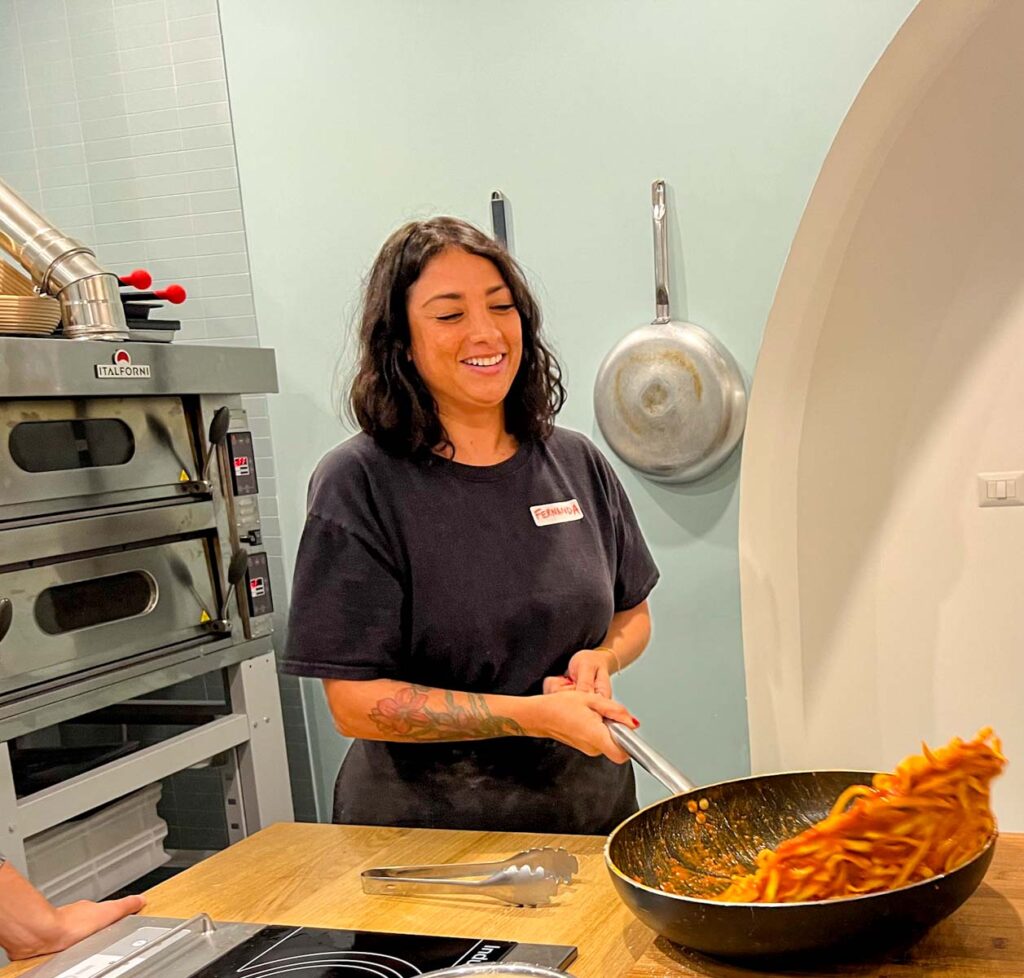 We sipped wine while Fernanda transformed our noodles into a tasty pasta dish. | Image: ©2foodtrippers
Once our pasta noodles were shaped, there were only a couple remaining steps – boiling the pasta and finishing the pasta with sauce. While we’d like to take credit for these final steps, the truth is that we drank wine while our intrepid instructors flipped the pasta in the pan with the sauce.
Some things are better left to professionals and this was one of them. Plus, we were thirsty.
Time to Eat


The best part of our class may have been the last part. This is when we ate the fruits of our labor. | Images: ©2foodtrippers
Is it just us or does pasta taste better when you make it yourself? While this question is debatable, there’s no doubt that the two pastas we made tasted great. But which pasta dish was was the dinner winner?
On one hand, the fettuccine amatriciana burst with the earthy flavor of savory, salty guanciale and sweet tomato sauce. The sauce gripped the fresh pasta like dye to a shirt. On the other hand, the seasonal pumpkin-ricotta ravioli tickled our tastebuds with its sweet sage and butter sauce.
We debated this issue with our fellow classmates while twirling our forks and sipping red wine. And, while most people preferred the fettuccine amatriciana, it’s fair to say that everybody liked both dishes since we all achieved clean plate status.
Full and happy, we somehow found room for peach gelato that Fernanda and Elisa whipped up during the class. And, while that gelato was a sweet ending to a great class, our pasta making journey is far from finished.
Class Logistics
 Making pasta from scratch has its rewards. | Image: ©2foodtrippers
Booking a Rome Pasta Making Class with Devour Tours is easy to do for those who make note of the following logistics:
Class Duration
 Elisa greeted us with a friendly smile at the designated Devour meeting spot. | Image: ©2foodtrippers
We arrived at the meeting point at Piazza Trilussa 15 minutes before the class’s official start time. This gave us time to find our host without feeling rushed.
The class commenced with Prosecco and ended three hours later after a convivial group dinner with our classmates.
Class Size and Accessibility
 Despite our intense expressions, learning how to make pasta is fun. | Image: ©2foodtrippers
The participant limit was 14 at the time of our pasta making class. Devour’s Trastevere state-of-the-art cooking school had ample room and adequate equipment to accommodate our full class.
You can and should address any dietary limitations prior to booking the class as it can can be modified to accommodate vegetarians and pescatarians. It can also be modified for those who don’t eat pork or drink alcohol.
What’s Included
 These were our first ravioli creations but they won’t be our last. | Image: ©2foodtrippers
Our class included all training, tools and ingredients necessary to create two different pastas from scratch. It also included enough food and drinks to make us full and happy.
Cost and Availability
 Learning how to make pasta from scratch was a priceless experience. | Image: ©2foodtrippers
At the time of our Rome Pasta Making Class, the class cost 69€ for adults and 59€ for children between five and twelve years old. These prices are subject to change at any time.
Devour also offers an excellent pizza making class if the pasta making class doesn’t fit into your schedule. We took that class too and recommend it highly.
Another option is to dig into Rome’s food culture during a food tour. We experienced the following three Devour tours:
💡 Frequently Asked Questions
Is it worth it to take a Rome pasta making class?
Yes! Taking a Rome pasta making tour will give you the necessary skills to create authentic Roman pasta dishes in your home kitchen.
What does a Rome pasta making class cost?
Each cooking school sets its own prices. The Rome pasta making class we took cost 69€ at the time of our class. Your best bet is to check company websites for current pricing based on your dates.
How long is a typical Rome pasta making class?
Each Rome pasta making class is different. The class we took was three hours from start to finish Your best bet is to check company websites for details based on your trip dates.
⚙️ Disclosures
Article Updates
We update our articles regularly. Some updates are major while others are minor link changes and spelling corrections. Let us know if you see anything that needs to be updated in this article.
Sponsorship
We thank Devour Tours for sponsoring our pasta making class in Rome.
📍 Pin This Article
 Pin
Pin
 Pin
Pin
Dining and Cooking