
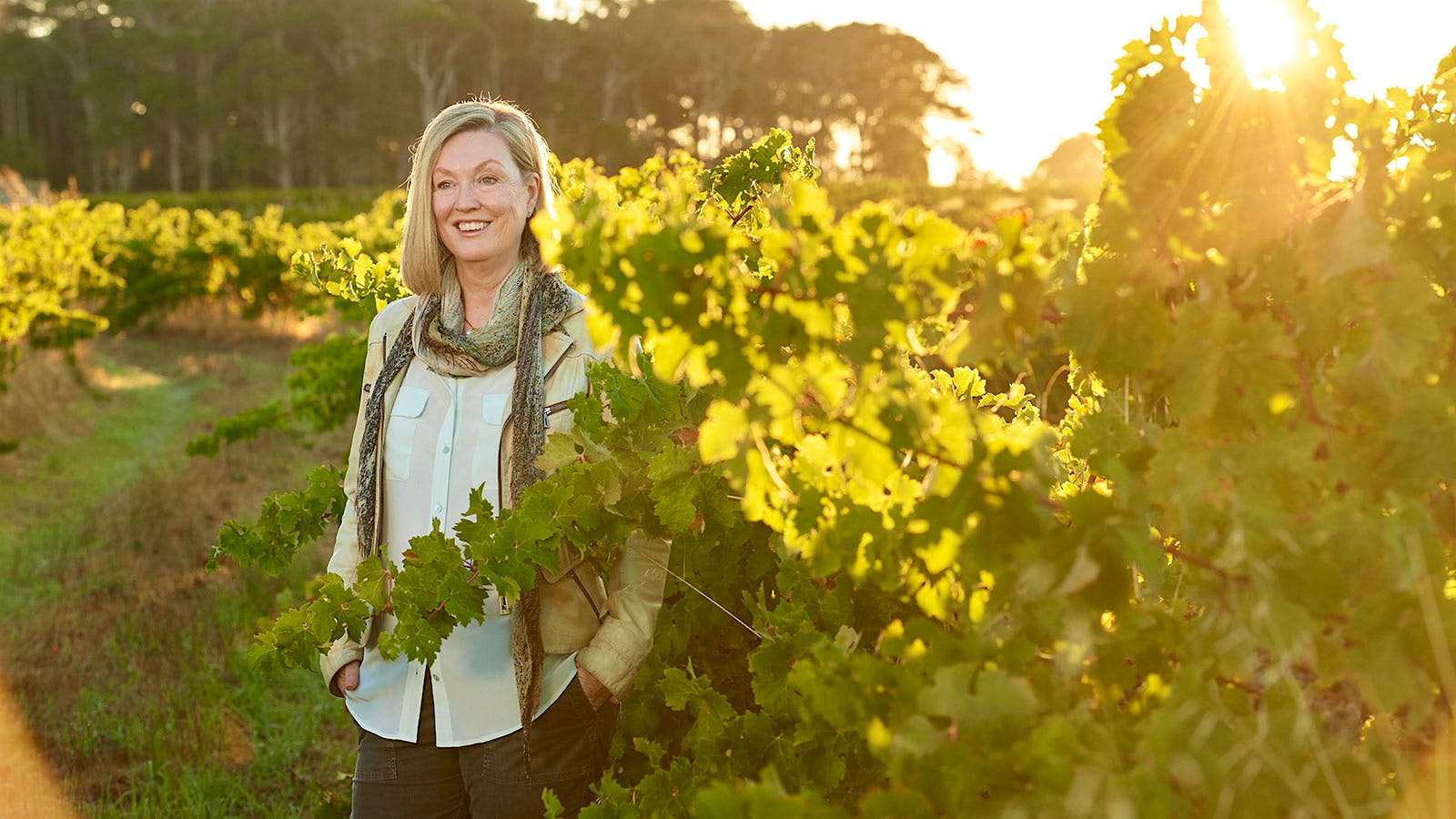
I was delighted when Leeuwin Estate’s Simone Horgan-Furlong visited with me in our Napa office in March. But as we sat down, it occurred to me that harvest was under way at her family’s winery in Margaret River, Australia. She explained that she wakes each morning to photos sent by her family updating her on everything happening back home while she travels. Then she gestured to the bottles of Leeuwin wines she’d brought to taste and discuss.
“I can never get homesick when I travel,” she quipped.
Spending time with her, tasting through four vintages of Art Series Chardonnay and seven vintages of Art Series Cabernet, the winery’s flagship bottlings, made me feel nostalgic for Margaret River. Set along Australia’s west coast on the Indian Ocean, it’s one of the most scenic wine regions I’ve ever visited, with vineyards often framed by towering Karri eucalyptus trees, whose thick trunks and leafy canopies resemble giant broccoli.
Getting there takes some effort. Typically, people fly into Perth, then drive the three hours south to this destination. What I remember most about that journey are the town names we passed, rolling the indigenous rhythms around in my mouth: names such as Waroona, Warawarrup and Binningup.
The names evoke far-flung places, but once you arrive, Margaret River offers an immediate sense of welcome. It’s part wine region, part surf town, and all laid-back. The food and coffee culture are top-notch, but more so, the wines are stunning, with fresh Chardonnays and aromatic Cabernet Sauvignons driving its reputation for quality.
Lay of the Land
Distinctively, the Margaret River region is bordered by the Indian Ocean to the west and the Southern Ocean to the south. This positioning affords it a hybrid of maritime influence and Mediterranean climate. Geologically, Margaret River sits on ancient granite bedrock that is overlaid with gravelly, well-draining, nutrient-poor soils.
Horgan-Furlong’s parents, Denis and Trish Horgan, first discovered Margaret River when they purchased a plumbing business on a farm in 1969. The family vacationed there, Denis was a huge fan of the local surfing. A few years later, Napa vintner Robert Mondavi came into the picture, scouting out properties to purchase for vineyard development.
As Horgan-Furlong tells it, her father had never heard of Mondavi. “He sent his secretary to the library, and she came back with a Time magazine with Robert Mondavi on the cover. Her next stop was to buy the most expensive bottle of wine in the shop.”
![Australia’s Leeuwin Estate in Margaret River.]](https://www.diningandcooking.com/wp-content/uploads/2026/05/int_leeuwin-vineyard-050526_1600.jpg)
Margaret River’s vineyards lie on Australia’s west coast where the Indian Ocean meets the Southern Ocean. (Courtesy Leeuwin)
The two men became friends. “My dad and Mondavi shared a lot of personality traits,” Simone recalled. “They were both dynamic, charismatic, lateral thinkers, very passionate. They were the kind of people who made things happen.” The Horgans founded Leeuwin Estate in 1973.
“Robert imparted advice I still hold dear. One thing he said to me and dad was, ‘You’ve got land capable of producing world-class wines. Find a young winemaker—someone who hasn’t yet formed a style in another region—bring them here, and let them discover what this land can do.’”
That winemaker was Bob Cartwright, who joined in 1979 and spent the next 28 years in their cellar, helping define the elegant style of Leeuwin wines. Phil Hutchison, who arrived in 2010, is currently senior winemaker.
Timeless Chardonnays
The Leeuwin Art Series Chardonnays have earned spots in our Top 100 seven times, including the 2011 Leeuwin Art Series Chardonnay, which ranked No, 5 in Wine Spectator’s Top 100 Wines of 2014.
“You have to be very respectful of the market that loves your wine,” Horgan-Furlong explained. “So there’s never, ever any radical change of style,” she added, while opening bottles of the 2018, 2019, 2020 and 2023 vintages.
While the overall style has been steady over the winery’s lifetime, there has been refinement as the vineyards have matured. The estate vineyard is divided into dozens of small parcels, with Chardonnay blocks planted in 1975 and 1976 forming the backbone of the Art Series bottling today.
“Part of the evolution we’re seeing is in aging vines,” Horgan-Furlong noted. “The first edition of the Art Series Chardonnay was in 1980, from four-year-old vines. Now you’re seeing Chardonnay from vines more than 50 years old. That brings beautiful concentration, depth, and character to the fruit, even at very low yields.”
When I last visited the winery, the winemaking team was refining its barrel program—measuring the moisture of every stave and providing detailed feedback to their coopers. With more consistent barrels, the team was able to focus on elevating other variables in the vineyard and cellar.
Since 2013, they have also incorporated about 20% to 30% whole clusters into the press, adding texture and detail, as it is believed that the resulting juice is less bitter and astringent. The wines show remarkable structure and an impressive capacity to age. Across the vintages of Chardonnay, there’s a throughline of freshness and intensity, often accompanied by savory notes of sesame, both toasted and raw.
Given their consistency, I’m not sure I could reliably place them from youngest to oldest in a blind tasting. They are all integrated and expressive, with only subtle signs of aging. The 2023 is compelling, with aromas of white flowers and fennel threaded with minerality.
Cabernet Time
“There’s definitely been an evolution in our Cabernet since the early days,” Horgan-Furlong said. “We’re in southern Margaret River—a cooler climate—and Cabernet vines take time. They’re now at an age where they’re perfectly in tune, in balance with their environment.”
We tasted a vertical featuring the Art Series 2014, 2016, 2018, 2019, 2020, 2021 and 2022. Margaret River Cabernet often shows herbal, savory notes that keep the wines aromatic and fresh. I typically find bay laurel, sage, sometimes eucalyptus or mint, along with hints of anise or olive.
![The Horgan family at Australia’s Leeuwin Estate.]](https://www.diningandcooking.com/wp-content/uploads/2026/05/int_leeuwin-family-050526_1600.jpg)
Denis and Tricia Horgan, left, now collaborate with their children Simone and Justin on the winery. (Courtesy Leeuwin)
“When we talk about Chardonnay, grapes are picked based on fruit ripeness. With Cabernet, we’re focused on physiological tannin ripeness. It’s all about achieving those beautiful, elegant, elongated, supple tannins, balanced with the fruit and with oak that’s absorbed and integrated in a really harmonious way,” Horgan-Furlong explained.
Much of this work happens in the vineyard. Canopy management is key—ensuring space around the fruit zone, with fewer leaves on the cooler, morning side to open up the vines and promote even ripening while preserving more shade against the stronger afternoon sun. In some cases, the morning side of the vines may even be picked days after the afternoon side.
Horgan-Furlong noted that while the Chardonnays gained recognition early, the Cabernets took longer to reveal their full potential. “In 2002, I remember dad speaking to the winemaking team and saying, ‘Okay, what do we need to do to bring these Cabernets up alongside the Chardonnays?. It meant focusing on lower yields, greater detail, more parcel selection, isolating specific vineyard pockets, and refining oak choices.”
The Cabernets show more variation across vintages. The 2018 stands out for its dusty, Darjeeling tea note, while the 2019 is more fruit-forward and juicy. The 2020 is flashier and fleshier, with black olive and star anise. The 2021 is complex, with notes of toffee and date-nut bread; the 2022 is especially perfumed and elegant.
Family Passion
It’s notable that all of the wines I tasted from Leeuwin were bottled under screwcap. I’ve tasted plenty of aged wines under this closure and it is remarkable to me how they retain their freshness while still showing their age and vintage variation. It was also nice to not worry about crumbly or bad corks.
The Horgan family’s third generation is stepping up to the family business, and Horgan-Furlong makes clear it is a passion project for her family. She shared another piece of advice handed down by Mondavi.
“He said always focus on quality. Don’t make quantities. We are still a very small producer, and we always will be. Our winemaker’s mandate is to make the best ones you can every vintage.”
With the minimal production of the wines annually, and with a track record for offering outstanding to classic quality wines every year, Horgan seems to be following that advice closely.
Leeuwin Estate
Stevens Road
Margaret River, Western Australia 6285
leeuwinestate.com.au
Stay on top of important wine stories with Wine Spectator’s free Breaking News Alerts.
Dining and Cooking