
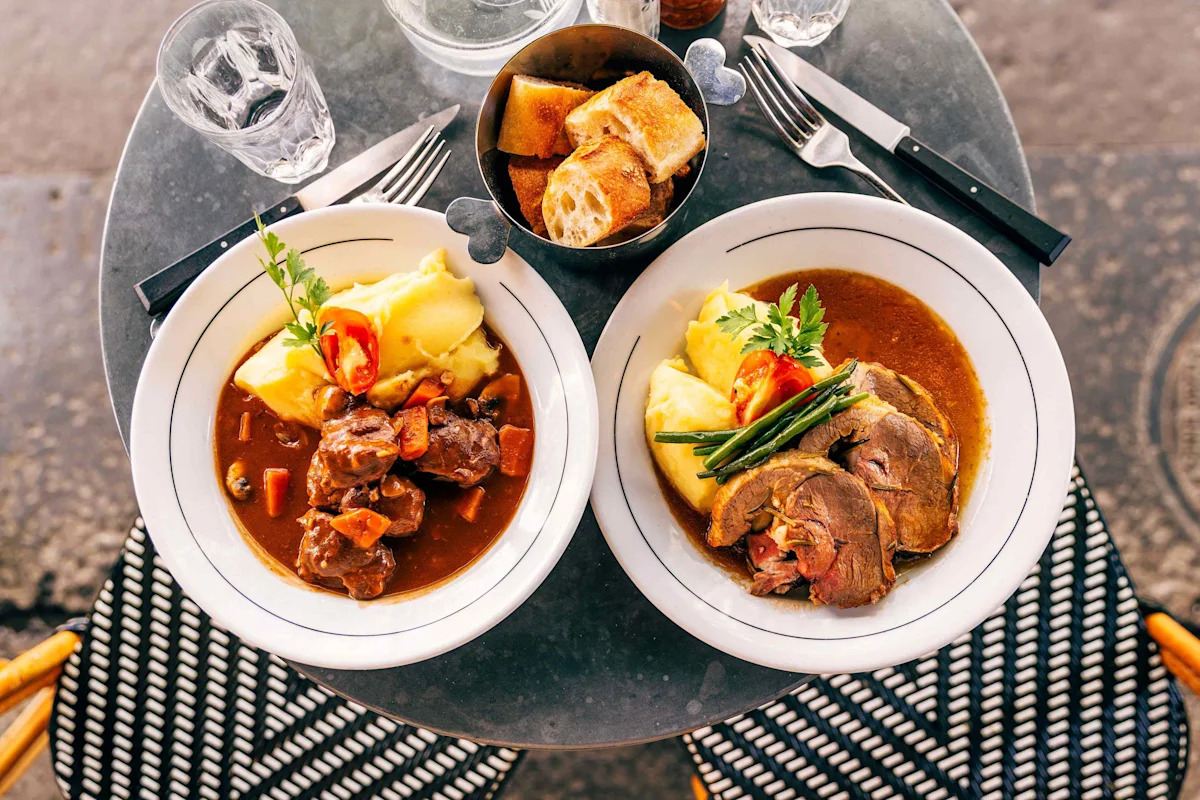
Classic French culinary techniques, like sautéing and flambéeing, are employed worldwide in restaurants and home kitchens. But great French cooking begins with great ingredients. From spices to olives, dynamic specialty products come from every corner of the country.
Related: 28 French Recipes for Summer From Lyon, Provence, and Beyond
If you’re looking to add a little je ne sais quoi to your own cooking, stock up on these staples French chefs reach for time and again.

Small chiles are sun-dried before being ground for Piment d’Espelette.
Credit: Pascale Gueret / Getty Images
Piment d’Espelette AOP
Nearly half of the chefs queried here put this delicate French pepper on their list of must-haves. “Piment d’Espelette is one of my top three essential seasonings alongside fleur de sel and black pepper,” says Lucile Plaza, executive chef at Alain Ducasse’s Benoit in New York City. “I can’t cook without them.”
A Basque chile with an Appellation d’Origine Protégée (AOP) designation, these small peppers are dried in the sun and finished in the oven for a hint of smokiness before being ground into a semifine powder. “It brings the warmth of the sun without the fire of a typical chile, making it perfect for seasoning fish, a lobster sauce, or summer ratatouille,” says Plaza. “At Benoit, we even use it in our traditional cassoulet — but that’s a secret.”
Related: How to Make a Flavor-Packed Cassoulet in Just 1 Day
Fallot Moutarde de Beaune
A complete list of French cooking staples should always include Dijon mustard, but for discerning French chefs, it’s a highly specific one. “While Dijon mustard is a staple on its own, Moutarderie Fallot is the perfection of it,” says Plaza. “It’s certified Moutarde de Bourgogne IGP, meaning the seeds must be cultivated and the mustard produced exclusively in Burgundy,” she says. “They still use stone-grinding methods that preserve the vibrant flavor, which is sharp with a light spiciness — exactly what crisp green lettuce needs.”
It has a beautifully smooth texture that’s perfect for emulsifying dressings. “At home, I love to mix it with fresh shallots, red wine vinegar, and grapeseed oil to get that perfect kick,” says Plaza.

Green peppercorns can be found whole or dried.
Credit: bhofack2 / Getty Images
Green peppercorns
Green peppercorns are the same berries as black and white peppercorns, but harvested before they’ve fully ripened. “This allows for a less spicy and more floral and aromatic peppercorn,” says Paul Magu-Lecugy, owner and executive chef of Rêve Bistro in Lafayette, California. Thought to have been brought to France from Madagascar in the 1960s or ’70s, green peppercorns have myriad uses in French cooking. “They are much softer than black peppercorns and can be left whole in dishes,” says Magu-Lecugy. “We use them dried for our culinary applications, but you can also find them jarred and preserved in brine.” Either way, “green peppercorns are nonnegotiable in the sauce au poivre for our steak frites,” he says.
Related: Rib Eye Steak au Poivre
La Baleine sea salt
Sea salt is essential to French cuisine — and as with Dijon mustard, French chefs swear by one above the rest. “I grew up cooking with La Baleine,” says Laurent Tourondel, executive chef of LT Steak & Seafood at The Betsy Hotel in Miami’s South Beach. “It’s the salt we always had in French kitchens, so it’s second nature to me.”
Harvested in the Camargue region along the Mediterranean coast, “it’s finer; dissolves faster; and has a cleaner, more mineral taste than something like kosher salt, so you don’t get that sharp hit of salt in one spot,” he says. “I use it from start to finish, seasoning proteins, vegetables, and even finishing, because it enhances the ingredient without overpowering it.”
Related: The Different Types of Salt and How to Cook with Them
Huile de Noix du Périgord (walnut oil)
Produced in the Perigord-Dordogne region, Huile de Noix du Périgord is derived from the area’s famed walnuts. “Walnut oil is something I always keep on hand because it brings a completely different depth than a neutral oil or even olive oil,” says Tourondel. “It has this toasted, nutty richness that instantly adds character.” While it can be warmed, “I don’t cook with it, I use it to finish,” he says. “I’ll drizzle it over roasted vegetables, whisk it into vinaigrettes, or pair it with cheese. It’s a small touch, but it instantly changes the flavor of the whole dish.”

Caviar Perle Noir is a beloved French producer.
Credit: Anton Dobrea / Getty Images
Black pearl caviar
While caviar is historically associated with the Black or Caspian seas, it is also cultivated in parts of France, including the Perigord-Dordogne region that is famous for its eponymous black truffles (and the aforementioned walnut oil). Olivier Senoussaoui, executive chef of Loews Atlanta Hotel, suggests thinking beyond luxury dishes for the region’s black pearl caviar, such as Caviar Perle Noir. “I love using caviar on my deviled eggs,” he says.
Related: We Tasted Over 60 Caviars — These Are the 7 Worth the Splurge
Cabécou (Aquitaine goat cheese)
Not to be confused with ubiquitous logs of French chevre, Cabécou is a petite, round goat cheese from France’s Aquitaine region that is aged briefly for a gentle earthy flavor and a delicate rind. “I love to cook with Cabécou,” says Senoussaoui. “I warm it with walnut oil and place it over a salad with local strawberries and toasted walnuts. The best strawberries are also from France.”
You won’t find this young, raw-milk, bloomy-rind cheese in the U.S., but Vermont Creamery’s Bijou makes an excellent stand-in.

Herbe de Provence perfume countless dishes in the south of France.
Credit: aga7ta / Getty Images
Herbes de Provence
“I love herbes de Provence,” says Mehjabin Ahmed, executive chef of New York City’s Provence-inspired Le Petit Village, of this aromatic mix of garigue botanicals including rosemary, thyme, and lavender, among other dried herbs. “We use [it] in many of our dishes including slow-cooked ratatouille and marinade for our lamb chops,” she says. “It adds both a hint of freshness and aroma,” not to mention the layered complexity French cuisine is known for.
Niçoise olives
These small, grayish-purple olives are another staple from the south of France. “They’re both savory and tart,” says Ahmed, who notes that the olives tend toward nutty, earthy, and herbal rather than fruity, with a pleasantly bitter bite. “We of course use them in a tuna Niçoise salad, but also across the menu in various condiments,” she says, “such as a tapenade for grilled branzino and as a garnish for a savory Dutch baby.”
Related: Niçoise Salad
Boeuf de Salers
Salers is a specific breed of cattle that can be found in south-central France, whose care and feeding results in a superior product prized by chefs. “Salers is one of my favorite items to cook with,” says Joël Antunes, chef in residence at 1856 Culinary Residence at Auburn University’s Tony & Libba Rane Culinary Science Center in Auburn, Alabama. “Higher-elevation grazing results in higher-quality, leaner beef,” he says. “I like to use it for oxtail stew alongside a big piece of country bread with cheese, which is a very popular dish in the south of France.”

Fennel pollen (pictured right) is milder in flavor than fennel seeds.
Credit: cheche22 / Getty Images
Pollen de fenouil (fennel pollen)
Like Espelette, fennel pollen is a colorful and flavorful seasoning that French chefs might use to add a final flourish to a dish. Primarily cultivated in Italy, it’s also available in France along the Mediterranean coast, where it’s cultivated from the same plant as fennel bulbs and fronds. It’s milder in flavor, however. “I enjoy using fennel pollen as a finishing element, particularly with seafood,” says Andrea Calstier, executive chef of La Bastide in North Salem, New York. “It brings a delicate, anise-forward aroma and a refined sweetness that complements fish beautifully.”
Related: Italian Chefs Share the Ingredients They Always Keep in Their Kitchens
P’tit Basque (Basque sheep cheese)
On the French side of the Basque region, you’ll find several versatile sheep cheeses that rival Spanish Manchego. “P’tit Basque is one of my favorite regional cheeses,” says Paul Berlotta, chef-owner of Milwaukee’s Bartolotta Restaurants, including its long-standing, French-inspired Lake Park Bistro. A semisoft cheese that’s smaller in format and more delicate than Manchego, “it’s wonderful for dishes such as croquettes, a Basque omelet, and a favorite salad of mine that includes wilted arugula, sautéed porcini, artichokes, and shaved P’tit Basque,” says Bartolotta. “The flavor is mild but still stands out for its unique, nutty character.
Read the original article on Food & Wine
Dining and Cooking