
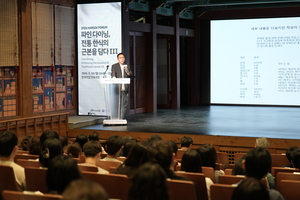
 Chef Lee Jun gives a speech at the 2026 Hansik Forum, held Monday at the Korea House in Seoul. (Korea Heritage Agency)
When chef Lee Jun began studying centuries-old Korean cookbooks for his Michelin two-star restaurant Soigne, he kept returning to one question: Was he holding a piece of history that must be preserved as it is, or someone’s working recipe?
He landed on the second answer, and that conclusion has shaped how the chef approaches traditional Korean cuisine.
“A cookbook is a record left by a cook of the recipes they use,” Lee said at the 2026 Hansik Forum, held Monday at the Korea House in Seoul.
“Tastes change with the times, so a literal interpretation only carries academic meaning. But cooks across eras think alike. None of them set out to make something bad. If the original author came to today, he would revise his own recipe too.”
The forum, organized by the Korea Heritage Agency under the theme “Fine Dining, Embracing the Essence of Traditional Hansik,” was the third in an annual series.
 Lee Gwi-young, president of the Korea Heritage Agency, shares opening remarks at the 2026 Hansik Forum held Monday at the Korea House in Seoul. (Korea Heritage Agency)
Lee Gwi-young, president of the Korea Heritage Agency, opened the program with a call to preserve hansik.
“Korean food is drawing wide global attention and being reinterpreted in many ways. Within that flow, we must preserve the philosophy, aesthetics, history and everyday food culture embedded in traditional hansik at a deeper level,” said Lee during his opening remarks.
Lee Jun’s session drew from cookbooks ranging from “Sanga Yorok (1450),” the oldest he has worked with, to “Eumsik Bangmun (1919).”
His most striking case study came from “Gunhak Hoideung,” which describes a method for grilling meat. The technique calls for skewering the meat, brushing it with a thin paste of oil, soy sauce, liquor, vinegar and flour, then turning it constantly over charcoal until the flour crust can be peeled away.
Lee said his kitchen has used this method for eight years. Soigne dips meat into a seasoned batter made with sherry vinegar, wine, port, salt, and sugar, sears it at high heat, rests it for an hour, then pulls the meat from the batter and finishes it in a pan before service.
“They could not use ovens like Western cooks. The concern would have been how to keep moisture in. You make a protective layer so the inside keeps steaming while the outside takes on the aroma of the grill,” Lee explained.
The research also raised questions about whether a dish can still be called traditional Korean food when its ingredients have changed over time.
“Trying to copy the recipe exactly is meaningless. Ingredients drop out of the canon as people stop using them. The question we should be asking is why they used it then and why we stopped,” he added.
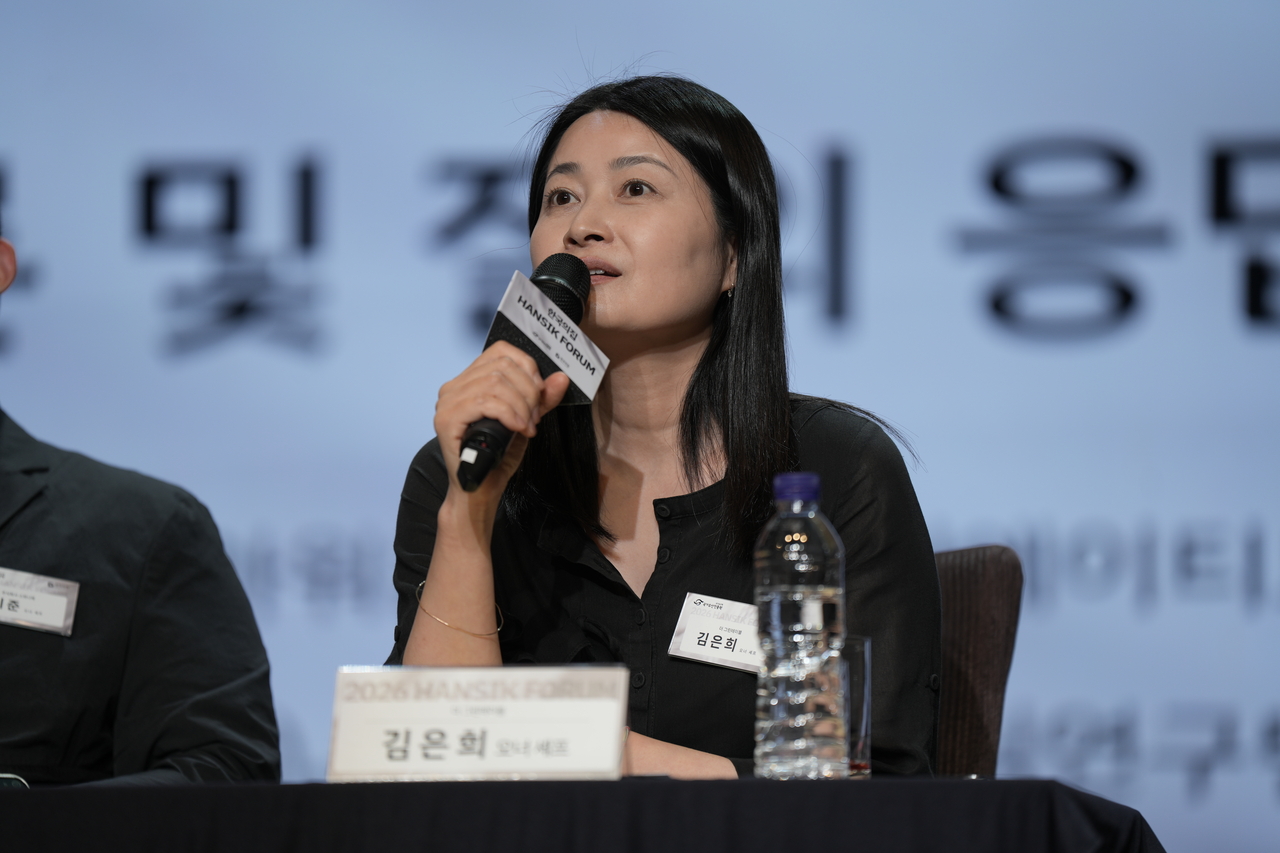 Chef Kim Eun-hee gives a speech at the 2026 Hansik Forum, held Monday at the Korea House in Seoul. (Korea Heritage Agency)
Kim Eun-hee, owner-chef of the Korean-French fine-dining restaurant The Green Table, followed with a critique of how Korean cuisine is being taught.
She suggested standardization of kitchen systems and foundational techniques rather than recipes themselves.
“Hansik education should begin not with taste but with kitchen discipline and complete foundational technique,” Kim said. She said many culinary school graduates arrive in professional kitchens without basic skills in place.
She also prioritizes treating tradition as the root of creativity rather than an obstacle to it.
“Only when the roots of tradition run deep can refined variation grow from them,” Kim said.
“Tradition is not a mounted past behind glass. It is the most powerful weapon Korean cuisine can carry into global markets and the source of its creativity.”
yoohong@heraldcorp.com
Dining and Cooking