
Buckwheat-Mediterranean Grain Blend Ingredients Market
The global buckwheat-Mediterranean grain blend ingredients market is evolving from a niche specialty flour category into a technically engineered ingredient ecosystem supporting clean-label reformulation, industrial bakery automation, and alternative grain innovation. As commercial food manufacturers move beyond basic gluten-free substitution toward premium sensory performance and operational consistency, standardized multi-grain blend systems are becoming increasingly important across bakery, pasta, cereal, and snack production environments. Food processors are no longer purchasing isolated ancient grains solely for nutritional positioning; they are investing in pre-calibrated ingredient systems capable of delivering stable dough hydration, predictable rheology, and scalable manufacturing efficiency, according to latest insights by future market insights.
Get detailed market forecasts, competitive benchmarking, and pricing trends:
https://www.futuremarketinsights.com/reports/sample/rep-gb-32836
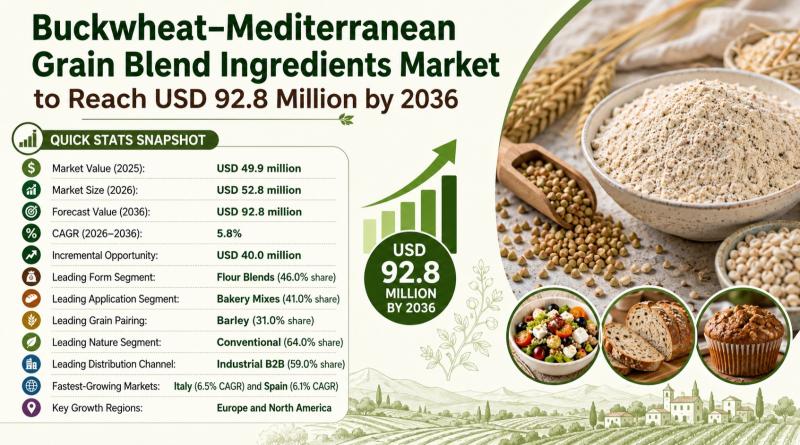
Quick Stats Snapshot
• Market Value (2025): USD 49.9 million
• Market Size (2026): USD 52.8 million
• Forecast Value (2036): USD 92.8 million
• CAGR (2026-2036): 5.8%
• Incremental Opportunity: USD 40.0 million
• Leading Form Segment: Flour Blends (46.0% share)
• Leading Application Segment: Bakery Mixes (41.0% share)
• Leading Grain Pairing: Barley (31.0% share)
• Leading Nature Segment: Conventional (64.0% share)
• Leading Distribution Channel: Industrial B2B (59.0% share)
• Fastest-Growing Markets: Italy (6.5% CAGR) and Spain (6.1% CAGR)
• Key Growth Regions: Europe and North America
Market Size and Forecast: Functional Grain Engineering Becomes Central to Industrial Food Reformulation
The buckwheat-Mediterranean grain blend ingredients market is projected to expand from USD 52.8 million in 2026 to USD 92.8 million by 2036, registering a CAGR of 5.8% during the forecast period. Unlike conventional flour and cereal ingredient categories, this market is increasingly driven by technical formulation requirements rather than broad commodity grain demand.
Key Growth Drivers: Clean-Label Reformulation, Gluten Management, and Industrial Automation
1. Rising Demand for Clean-Label Functional Ingredients
Food manufacturers are accelerating reformulation initiatives aimed at removing artificial dough conditioners, binders, and stabilizers from bakery and snack products. Buckwheat-Mediterranean grain blends provide naturally functional hydration and structural properties that help maintain dough elasticity and crumb stability without synthetic additives.
2. Expansion of Gluten-Free and Ancient Grain Applications
Buckwheat remains strategically important because of its naturally gluten-free profile and strong nutritional positioning. Pairing buckwheat with Mediterranean-associated grains allows formulators to improve flavor balance, texture, and consumer acceptance compared with earlier-generation gluten-free systems.
3. Growth in Industrial Bakery Automation
Large-scale bakery facilities require highly standardized ingredients capable of performing consistently under continuous mixing, extrusion, and automated dough-handling conditions. Precision-milled flour blends help reduce viscosity fluctuations, equipment fouling, and batch rejection risks.
Market Challenges: Allergen Segregation, Supply Complexity, and Processing Constraints
Despite steady long-term growth potential, the market continues to face several operational and technical challenges:
• Managing gluten-control requirements within mixed-grain milling facilities
• Maintaining batch consistency across complex multi-grain systems
• Limited sourcing depth for certain specialty grains
• High capital requirements for segregated processing infrastructure
• Texture instability in alternative-grain bakery applications
• Cross-contamination risks affecting supplier qualification status
Emerging Opportunities: Technical Milling, Extrusion Innovation, and Functional Grain Systems
Several emerging opportunities are expected to influence future market development:
• Precision-milled semolina alternatives for alternative pasta applications
• Advanced extrusion systems supporting clean-label savory snacks
• Dedicated gluten-free milling infrastructure for allergen-sensitive contracts
• Functional bakery systems optimized for industrial proofing stability
• Custom hydration-calibrated grain systems for continuous mixing lines
• Regenerative and transitional grain sourcing programs
Speak to Analyst: Customize insights for your business strategy:
https://www.futuremarketinsights.com/customization-available/rep-gb-32836
Segmentation Insights: Flour Blends and Bakery Mixes Continue to Lead Commercial Adoption
By Form
Flour blends are projected to account for 46.0% of the form segment in 2026 due to their compatibility with automated bakery operations and continuous mixing systems. Food manufacturers increasingly prioritize immediate dispersion, rapid hydration, and predictable rheological behavior during industrial-scale processing.
By Application
Bakery mixes are expected to hold 41.0% market share in 2026 as commercial bakers continue investing in ingredient systems capable of preserving loaf volume and crumb integrity under clean-label reformulation programs.
By Grain Pairing
Barley is projected to account for 31.0% of the grain pairing segment because of its strong sourcing continuity, fiber positioning, moisture-retention functionality, and compatibility with Mediterranean diet formulations.
By Nature
Conventional blends are expected to maintain 64.0% market share as large-scale industrial manufacturers continue prioritizing cost stability, procurement efficiency, and scalable sourcing over fully segregated organic systems.
By Channel
Industrial B2B channels are projected to represent 59.0% of the market in 2026 since most category value remains concentrated in technical premix supply, formulation support, and application-ready ingredient systems rather than direct retail packaging.
Regional Analysis: Europe Leads Technical Milling Innovation While North America Expands Industrial Adoption
High-Growth Markets
• Italy (6.5% CAGR): Strong pasta-formulation demand and advanced semolina-processing infrastructure continue supporting growth across premium ancient-grain applications.
• Spain (6.1% CAGR): Commercial bakeries are scaling whole-grain Mediterranean formulations while prioritizing stable hydration systems for industrial production environments.
• Turkey (6.0% CAGR): Deep domestic milling infrastructure and regional grain-processing capability support cost-efficient specialty blend manufacturing.
• Poland (5.9% CAGR): Regional cultivation networks strengthen sourcing continuity and localized ingredient supply chains.
Mature Markets
• France (5.7% CAGR): Clean-label reformulation pressure across traditional bread production continues driving demand for naturally functional grain systems.
• Germany (5.5% CAGR): Industrial snack manufacturers are standardizing sourcing protocols around extrusion-compatible flour and flake systems.
• United States (5.2% CAGR): Large-scale bakery consolidation and national foodservice distribution networks support adoption of highly standardized ingredient systems.
Competitive Landscape: Technical Processing Capability Becomes the Primary Competitive Differentiator
The competitive environment is increasingly shaped by processing precision, allergen segregation capability, optical sorting infrastructure, and formulation engineering expertise rather than basic agricultural sourcing alone.
Leading participants including ADM, Bay State Milling, Limagrain Ingredients, Healthy Food Ingredients, and Ziegler Organic are strengthening investments in advanced milling systems, segregated production lines, and application-specific formulation services.
Strategic Implications for Industry Stakeholders
• Food manufacturers should prioritize ingredient suppliers with proven rheological consistency and industrial-scale processing reliability
• Investors may increasingly focus on specialized millers with advanced allergen-control and formulation capabilities
• Bakery and pasta producers need ingredient systems capable of balancing clean-label positioning with operational efficiency
Full Report for Detailed Insights: https://www.futuremarketinsights.com/reports/buckwheat-mediterranean-grain-blend-ingredients-market
Future Outlook: From Specialty Ancient Grains to Industrial Food Engineering Platforms
Over the next decade, the buckwheat-Mediterranean grain blend ingredients market is expected to evolve beyond niche gluten-free positioning into a broader industrial food engineering category. As large-scale food manufacturers continue replacing synthetic additives and optimizing automated production environments, demand for technically calibrated grain systems is expected to strengthen steadily.
Executive Takeaways
• The buckwheat-Mediterranean grain blend ingredients market is projected to reach USD 92.8 million by 2036
• Growth is being driven by clean-label reformulation and industrial bakery automation
• Flour blends remain the dominant format due to superior hydration and processing consistency
• Bakery mixes continue leading commercial demand across industrial baking systems
Explore More Related Studies Published by FMI Research
Cow Colostrum Market : https://www.futuremarketinsights.com/reports/cow-colostrum-market
Green Coffee Bean Extract Market : https://www.futuremarketinsights.com/reports/green-coffee-bean-extract-market
Hexane-free Protein Market : https://www.futuremarketinsights.com/reports/hexane-free-proteins-market
Contact Us
Future Market Insights Inc.
Christiana Corporate, 200 Continental Drive,
Suite 401, Newark, Delaware – 19713, USA
T: +1-347-918-3531
For Sales Enquiries: sales@futuremarketinsights.com
Website: https://www.futuremarketinsights.com
About Future Market Insights (FMI)
Future Market Insights, Inc. is an ESOMAR-certified, ISO 9001:2015 market research and consulting organization trusted by Fortune 500 companies. With a global presence across the U.S., UK, India, and Dubai, FMI delivers data-driven insights across 30+ industries and 1200 markets worldwide.
This release was published on openPR.
Dining and Cooking