
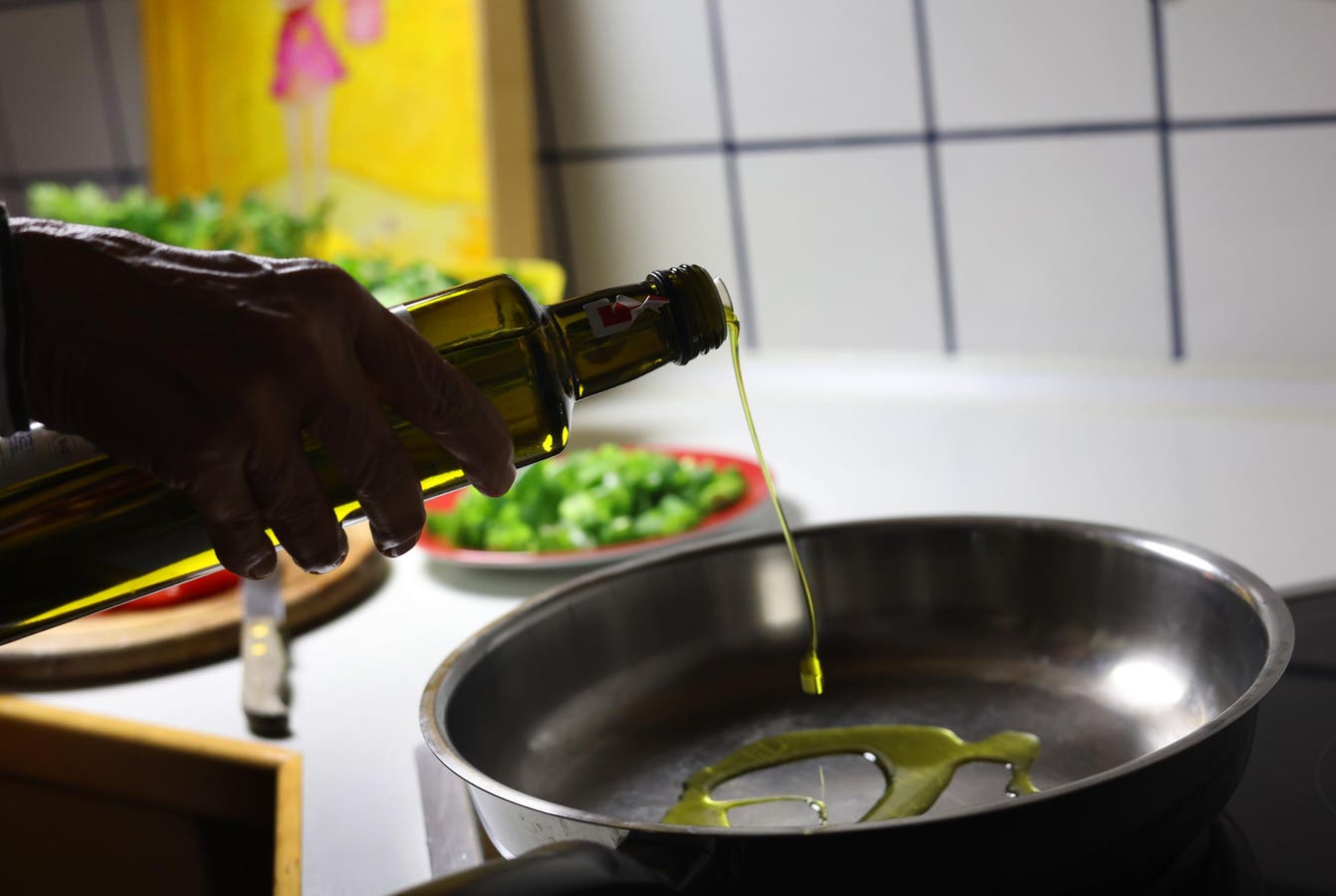
August 2025, Bavaria, Kaufbeuren – A woman pours olive oil into a pan while cooking. (Photo by Karl-Josef Hildenbrand/picture alliance via Getty Images)
dpa/picture alliance via Getty Images
Pick up a bottle of olive oil at your local supermarket today. Chances are it came from Spain, Italy, Tunisia, or Greece — and chances are it is about to get a lot more expensive. The Iran war has just made your pantry staple a casualty of geopolitics, and most American consumers have no idea it is coming.
The United States is now the world’s second-largest olive oil consumer (after Spain) going through roughly 380,000 to 400,000 tons a year. Yet domestic production, concentrated mainly in California accounts for only about 4% of that demand; more than 95% of the olive oil Americans use is still imported. We are almost entirely dependent on the Mediterranean for the olive oil we drizzle on our salads, finish our pasta with, and reach for every single day. Over the past six years, Spain, Italy, Tunisia, and Turkey have been the main suppliers of olive oil to the U.S., collectively accounting for 86% of total imports.
Our food supply chain now runs directly through a war zone and through the economic shockwaves emanating from it.
A war in the Middle East, a 15% tariff on EU imports, and Red Sea shipping disruptions are converging on the U.S.’s most beloved cooking oil — and most shoppers don’t see it coming.
How Energy Costs Impact Food Prices
The Iran war’s most immediate impact is on energy. Brent crude oil prices (as of Friday, March 27, 2026) have soared to $112 per barrel, the historic high of $147 was recorded in July 2008. When the Trump administration’s war on Iran began, all shipping through the Strait of Hormuz was effectively halted, removing roughly one-fifth of the world’s crude oil and gas supply from the market. That chokepoint normally handles about a fifth of the world’s oil and liquefied natural gas shipments, so when it clogs, the whole global food system feels it.
That matters for your olive oil bottle in ways that are not immediately obvious. Oil prices and food prices move in lockstep: Energy affects every stage of the food supply chain, from the fertilizers used in the fields to the trucks and ships that carry food from farms to supermarket shelves.
Thierry Moyroud, CEO Deoleo North America and Latam tells me “supply won’t be short, but costs will rise”
Deoleo
Last Thursday I spoke with Thierry Moyroud, CEO Deoleo North America and Latam, the world’s largest olive oil bottler under the brands Bertolli, Carapelli and Carbonell, who shared with me that the good news is that the current olive crop is significantly better than the two previous ones; and as a result, there should not be any shortages of olive oil. The bad news is that he also shared that due to the cost of crude and the cost of transporting the oil from the EU to the U.S. costs will rise.
Fuel accounts for 50% to 60% of the total operating cost of shipping goods by sea, according to Patrick Penfield, professor of supply chain practice at Syracuse University, as quoted by the Associated Press. Industry analysts say those reroutings to avoid the areas affected by the Iran War add one to two weeks and hundreds of thousands of dollars in fuel costs per voyage, costs that inevitably land in the grocery aisle. Those costs will be passed along to importers, then to distributors, then to retailers, then to the consumer.
The Mediterranean Supply Chain Was Already Under Pressure Before The War
What makes this particularly painful is that the olive oil supply chain was already under tariff pressure before a single missile was fired. On April 2, 2025, the U.S. government announced a 10% tariff on all olive oil imports, followed on April 9 by differentiated tariffs ranging from 11% to 50% for selected countries. As of August 2025, EU olive oil imports into the U.S. are subject to a 15% import tax. American retailers and foodservice operators spent the better part of last year front-loading inventory ahead of those tariffs. Those inventories are now being depleted, and the new shipments bring with them the added tariff expense.
Red Sea, straits and gulfs of the Red Sea, surrounding mountains, numerous cargo ships stranded due to Middle Eastern safety concerns in the region
getty
Container shipping to the Mediterranean from Asia is already disrupted by Red Sea diversions around the Cape of Good Hope, with freight rates remaining significantly elevated compared to pre-crisis levels.
Another reality is climate change. Mediterranean producers have faced their own weather and harvest challenges in recent years. So, the price of olive oil is being driven by these forces: Structurally tight supply, new tariffs, and a war-driven energy price and supply shock.
Why Domestic Production Can’t Fill In The Gaps
California’s olive oil industry deserves credit. The share of California’s olive production that is used to make olive oil has grown rapidly, from about 10% in 2005 to more than 75% in 2022. But it is nowhere near enough to insulate U.S. consumers. Despite the increase in U.S. olive oil production, imports still supply well over 95% of domestic consumption.
ST. HELENA, CA – FEB. 25: Ana Hernandez inspects olive branches as she stand among olive trees from Italy that were brought to St. Helena, Calif. Grove 45 is an olive oil company owned by the mother and daughter team of Ana and Marcela Hernandez (Jessica Christian / The San Francisco Chronicle via Getty Images)
San Francisco Chronicle via Getty Images
California’s olive oil production is an estimated two million to four million gallons annually which is only about 4% of domestic consumption. A sustained period of elevated import prices, driven first by tariffs and now by war-linked energy costs, may give these domestic producers the pricing headroom they need to invest aggressively in expansion. California producers may see an opportunity to steal customers by using this situation to heavily promote their products and offer special pricing as a way to build their brands.
What Can Consumers Expect
Grocery stores are one of the first places consumers will see the effects of higher fuel prices, specifically the produce, meat, and dairy aisles. Olive oil, as a shelf-stable import, may have a slightly longer lag time before prices increase but make no mistake the increases are coming. My projection is that a 25.4-ounce bottle that retailed for $9.99 last year could easily push past $14.99 by the holidays, if conditions persist.
“Rising oil prices have a direct and immediate impact on consumer costs, and not only at the gas pump,” Stephen Kates, financial analyst at Bankrate, told CNBC. “Unlike last year’s higher tariffs, which took months to filter meaningfully into prices, increases in oil prices are quickly reflected. An immediate spike in gasoline prices strains household budgets and also raises the cost of shipping, airline tickets, and products that rely on oil-based inputs.”
The compounding effect is what should worry grocery executives and brand managers most. Pre-war tariffs already added about 15% to the cost of EU olive oil. global trade decisions extend far beyond any single category. Talking about the tariffs, Moyroud told me, “while we continue to make our voice heard, olive oil represents a relatively small segment in the broader political landscape, which can make it challenging to gain the attention this issue deserves…and remain committed to advocating for fair trade policies.” Energy-driven freight surcharges are now layered on top. Retailers who last year tried to absorb tariff costs now have little margin to assume these higher transportation costs without passing them to consumers.
What Retailers And Brands Should Do
Retailers who have not locked in forward contracts on olive oil should be doing so today. Category managers should be identifying second-tier Mediterranean and non-Mediterranean suppliers from other sources including Portugal, Morocco and Argentina in order to diversify sourcing.
Private-label olive oil programs represent a particular opportunity right now. Consumers who traded up to premium imported extra virgin during the health-food boom of the past decade may look for value alternatives as prices rise. Moyroud told me that especially now, “there are numerous benefits of blending olive oils versus single-source. Blending allows for consistent quality throughout the year while making the product more affordable.” He is proud to say that the blend’s country of origin is placed on the label of every bottle of Bertolli.
What to look for on an olive oil label
Bertolli Olive Oil
I would expect to see some quiet reformulation and menu engineering as well. Restaurants and food manufacturers will look for ways to reserve higher-quality extra virgin oils for dressings and finishing while relying more on blends in the back of the house. Smart retailers should be transparent about these changes and help customers understand how to use different oils for different uses in their own kitchens.
How Shoppers Can Save Money On Olive Oil
And for consumers? This is a good moment to buy an extra bottle or two at current prices because of the math of this war, its freight costs, and its tariff overlay points in one direction only – and that’s up! This is not a call to panic-buy as olive oil is perishable and needs to be stored properly at home; rather it’s a little hint to shop smarter. Keep it in a cool, dark place away from heat sources. A pantry or cabinet away from the stove is ideal. Target 57–70°F. Heat and light are the biggest enemies — they accelerate oxidation and turn oil rancid faster. Dark glass, stainless steel, or tin containers are the best. Avoid plastic for long-term storage. Extra virgin olive oil is best consumed within 12–18 months of the harvest date (not the purchase date), and within 30–60 days of opening. It doesn’t improve with age like wine.
Be flexible about brands and origins. A well-made private-label extra virgin from Portugal, Morocco, or Argentina may deliver the same performance as the label you know for several dollars less right now. Taste with an open mind. Many of these emerging country origins have invested heavily in quality and certification, and in blind tastings most shoppers cannot tell the difference.
Save the peppery, high‑polyphenol extra virgin for salads, finishing dishes, and dips, and use more economical refined olive oil or blended olive oils for high‑heat cooking and deep frying. That simple switch stretches your most expensive bottle without changing your diet or your favorite recipes.
That bottle on your shelf is no longer just olive oil. It is a ledger of war, weather, and trade policy. Each pour is a small reminder of how thin the line is between a functioning global food system and a disrupted one. The price increases coming to the olive oil aisle are not a glitch.
My question is whether U.S. shoppers, retailers, and policymakers are paying enough attention to the impact of this war on our food supply before the next bottle of olive oil arrives on our supermarket shelves.
Dining and Cooking