
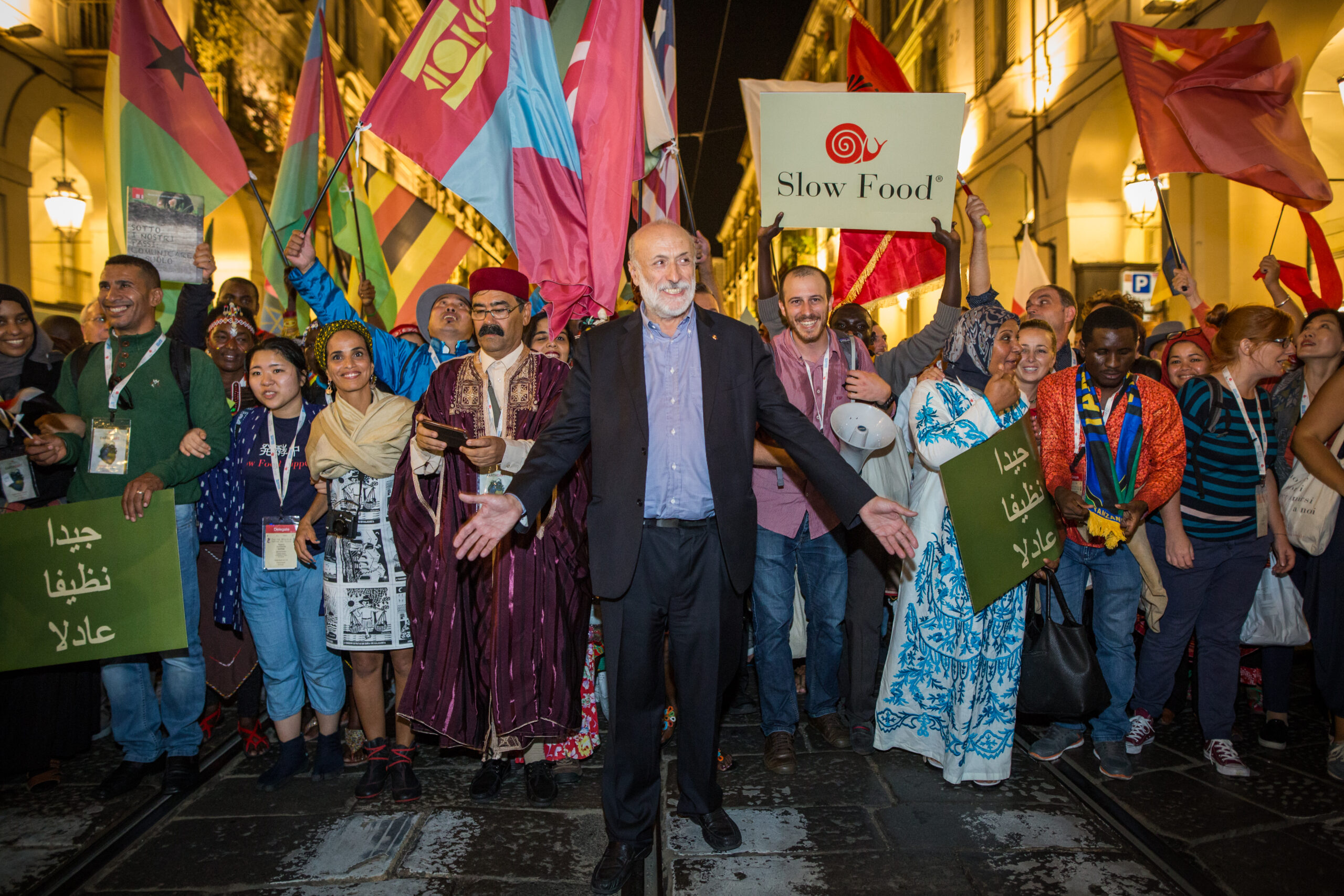
The Slow Food community—together with friends, students, farmers, and partners from across the world—came together to honor Carlo Petrini. But this was more than a farewell. It was a shared recognition: his vision continues to live through a global movement he built from the roots of a small town in Italy into a force for change worldwide.
Food, culture, and responsibility: the core of Carlo’s vision
From Bra to every continent, Slow Food has grown around a simple idea: food is not a commodity, but culture, relationship, and responsibility—toward people, biodiversity, and the planet.
At the heart of the moment were the words of Edward Mukiibi, President of Slow Food, who gave voice to both grief and determination.
“Our hearts are sorrowful, but also full of gratitude for all the seeds you planted on this earth — seeds of humanity, humility, empathy, and care. You made us believe in our power to change the world through food. You made us believe in ourselves and in the power we have to change the world through food. You made us believe that a better world is possible.” “
Mukiibi placed particular emphasis on Africa—central to Carlo’s vision as the continent that holds the future of our planet and where some of the deepest injustices in the global food system persist.
Through initiatives like the Slow Food Gardens in Africa, Carlo helped communities reclaim food cultures, dignity, and agency.
His message culminated in a powerful call to action:
“For the first time in 17 years, I have come to Bra to speak to you without expecting a reply but silence. Dear friends of Carlo and whoever has been touched by his vision, this silence is loud. We need to respond to this silence by working hard to keep Carlo’s vision alive,.” “
They recalled how that lesson became a way of understanding the future: not only to preserve, but to create something lasting and shared.
Their message was clear: this is not about memory, but continuity — building a future where food is good, clean and fair for all, where rights, knowledge, and biodiversity are protected.
“We’re not looking for another leader. There is no way to replace Carlin. But this movement and this university won’t end here. We will take care of the seeds he planted in each of us — and keep spreading them.” “
A portrait of Carlo: humanity, relationships, and vision
This responsibility was echoed by Don Luigi Ciotti, Italian priest and anti-mafia activist, who has long worked on issues of social justice and dignity.He reminished on how Carlo believed that staying silent in the face of injustice is a moral failure. Carlo embodied the opposite—turning food into a tool for justice, responsibility, and change.
At the same time, Moni Ovadia, internationally known actor, writer, and cultural voice, pointed to another essential legacy: Carlo’s ability to create a global “family.” A community united not only by ideas, but by shared values, humanity, and a sense of belonging.
What emerged from today’s commemoration is the urge to continue what he started.
From its deep roots in local communities to its global reach today, Slow Food is a joyful and living movement—one that connects people, protects biodiversity, redresses imbalances in food systems and works toward a future where food is good, clean, and fair for all.
Thank you, Carlin.
The global community you built is here to stay—and it will carry your vision forward.
Dining and Cooking