
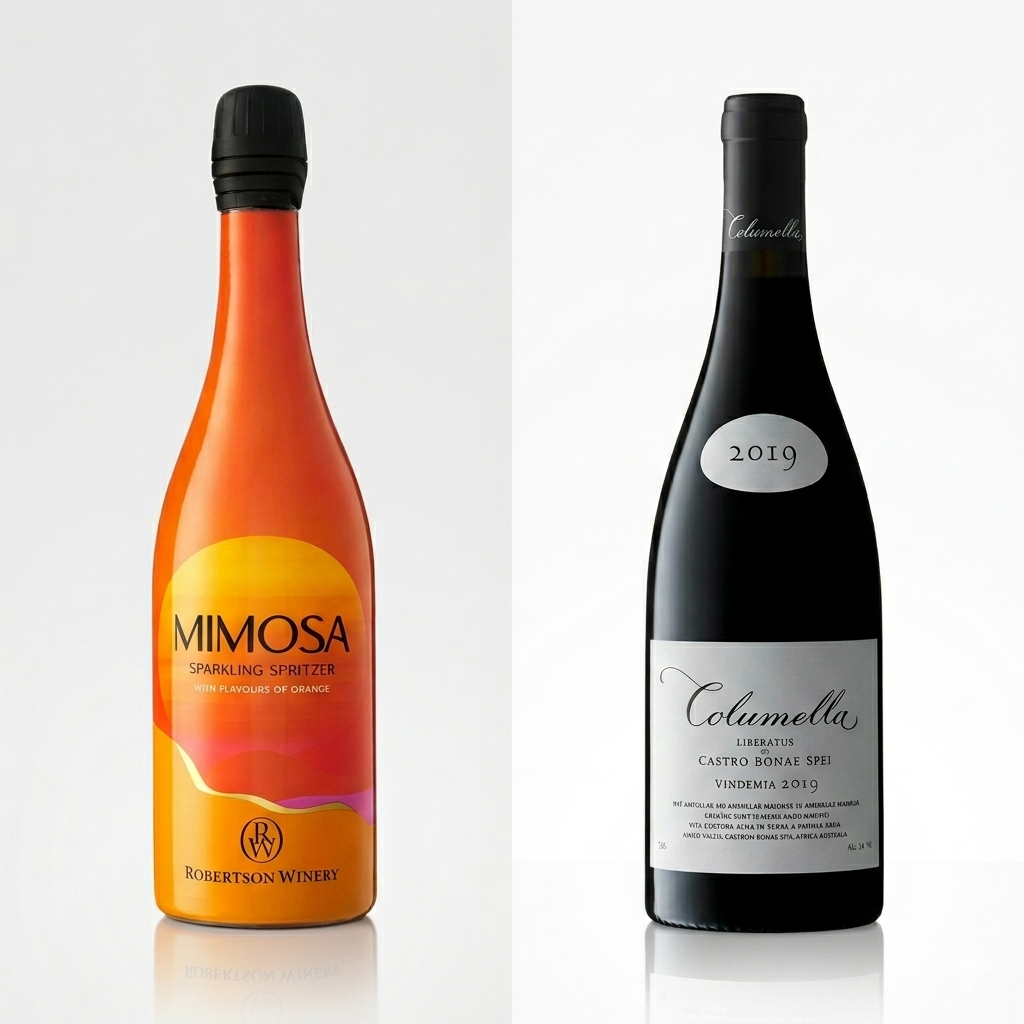
 Day versus night.
South African wine currently finds itself in a curious position. Technically, aesthetically and intellectually, it has probably never been stronger. Economically and psychologically, however, it often appears uncertain of itself. Export volumes fell sharply last year, down 13.8% to 264 million litres, while value declined by a less severe 2.4% to R9.8 billion. The optimistic interpretation is that the industry is moving upmarket. The less comforting interpretation is that South Africa continues to sell less wine than it once did while still struggling to persuade the world – and perhaps itself – that its best bottles deserve genuine fine-wine status rather than merely favourable price comparisons.
This tension increasingly defines the local industry. South African wine has become more sophisticated and internationally fluent while simultaneously appearing more anxious, fashion-driven and self-conscious. It is not so much a crisis of quality as a crisis of confidence.
Part of the problem is structural. The industry now effectively operates in two parallel universes. On the one hand sit the large-volume producers who drive the economics, fill supermarket shelves abroad and sustain the export machine. On the other sits a relatively small cohort of elite producers – the names that dominate discussion, attract international critics, trend on Instagram and shape perceptions of what “serious” South African wine looks like. The Top 20 wineries poll conducted three years ago by Winemag captures this dynamic rather neatly: a relatively small number of producers increasingly control the narrative while the bulk sector controls the volume.
Neither side can entirely survive without the other, but the relationship is uneasy. Fine wine confers prestige on the broader category; large-scale production keeps the lights on. Yet the conversation overwhelmingly gravitates toward the former because culture most often follows concentration of energy, ambition and personality.
That said, the relationship between critical attention and commercial or qualitative success is not linear. Some producers are propelled by constant scrutiny and discussion; others operate largely outside that conversation while remaining commercially robust and critically unheralded. In such cases, success is sustained less by visibility than by distribution strength, long-term reputation, or a deliberate preference for discretion over engagement with the critical ecosystem.
Selectivity, scrutiny and the logic of attention
This brings us to Tim James’s thoughtful reflections on wine criticism and its inevitable selectivity. He is plainly correct that critics tend to focus disproportionately on newer producers, emerging styles and the so-called “new wave”. He is also correct that access matters, that relationships (which is to say degrees of familiarity and mutual dependence) within a small industry are unavoidable and that no critic remotely covers the full breadth of South African wine. The notion that any independent critic could comprehensively and evenly document more than 900 label owners is unrealistic.
But criticism is not census-taking.
A wine critic is not a neutral state archivist tasked with mechanically recording all production in equal proportion. Critics are drawn toward movement, originality and cultural significance. They follow where the conversation appears most alive. The danger is not selectivity itself but opacity about the forces shaping attention.
And yes, there are blind spots. Fashion exists. Some older producers are under-discussed relative to their achievement. But the alternative to selective criticism is not objectivity. It is bureaucracy. Criticism reduced to a mechanistic administrative exercise – exhaustive, dutiful and ultimately besides the point. It is, arguably, why the much-loved Platter’s guide now appears to be nearing the end of a glorious 46-year run.
The truth is that attention in wine behaves culturally, not democratically. The very producers now regarded as neglected establishment figures were often once insurgents who benefited from disproportionate critical interest (Thelema in the 1990s, Vergelegen in the 2000s). Every generation eventually feels the spotlight shifting elsewhere.
Aesthetic convergence and the question of confidence
The bigger issue is not criticism but wine culture itself in 2026. South African wine increasingly risks mistaking aesthetic coherence for intrinsic quality. Fine wine has become not merely a standard but a look, a tone and a set of coded references: lighter extraction, earlier picking, lower alcohol, hipster labels, low-key cellar architecture and the implication that pleasure should remain subordinate to intellectual seriousness.
Some of this evolution has been positive. South Africa has escaped much of the overripe heaviness that once limited credibility. Yet one senses a new orthodoxy emerging just as rigid as the old one. The great flattening of wine style is real. Wines increasingly converge around a globally approved fine-wine aesthetic, and what gets lost is stylistic diversity – including the confidence to be rich, generous or unabashedly pleasurable. Winemag and, indeed, this writer are probably as guilty as anyone, having spent the better part of the last decade rewarding “tension”, “energy” and “drinkability”. But while an especially tasteful Scandinavian chair may photograph beautifully, sometimes a well-upholstered old armchair is more comfortable to sit on – and the same, occasionally, applies to wine.
Pinotage perhaps illustrates this best. The debate is no longer between “good” and “bad” Pinotage but between traditional richness and contemporary transparency. Both camps often caricature the other. Meanwhile, the category itself remains more varied and interesting than either side admits.
Underlying all this is a deeper insecurity. South African wine still struggles to state its case with uncomplicated conviction, forever glancing over its shoulder towards export markets conditioned by decades of faint imperial condescension and low expectations. Praise is gratefully received, but rarely fully believed; criticism is internalised with almost colonial deference. As a result, producers often appear caught between wanting to assert themselves as serious fine-wine propositions and fearing accusations of overreach should they do so too confidently. Even now, South African wine too often seeks validation abroad before fully trusting its own judgement at home.
At the same time, the authority of criticism itself has weakened. Critics no longer compete only with one another but with distributor narratives, influencer personalities, a WhatsApp consensus formed in semi-private exchanges insulated from broader scrutiny, AI-generated recommendations, and the hyper-curated vibe economy of social media. Scores still matter, but attention matters more. Increasingly, personality carries more weight than institutional authority.
In such an environment, criticism inevitably becomes more partial, more subjective and more personality-driven. Perhaps that is no bad thing provided it remains intellectually honest about its limitations and enthusiasms.
The interesting question is not whether bias exists. Of course it does. The more difficult question is whether South African wine still possesses sufficient confidence – commercially, stylistically and culturally – to sustain genuine diversity of thought, taste and ambition without constantly seeking reassurance from fashion, foreign approval or algorithms.
Dining and Cooking