
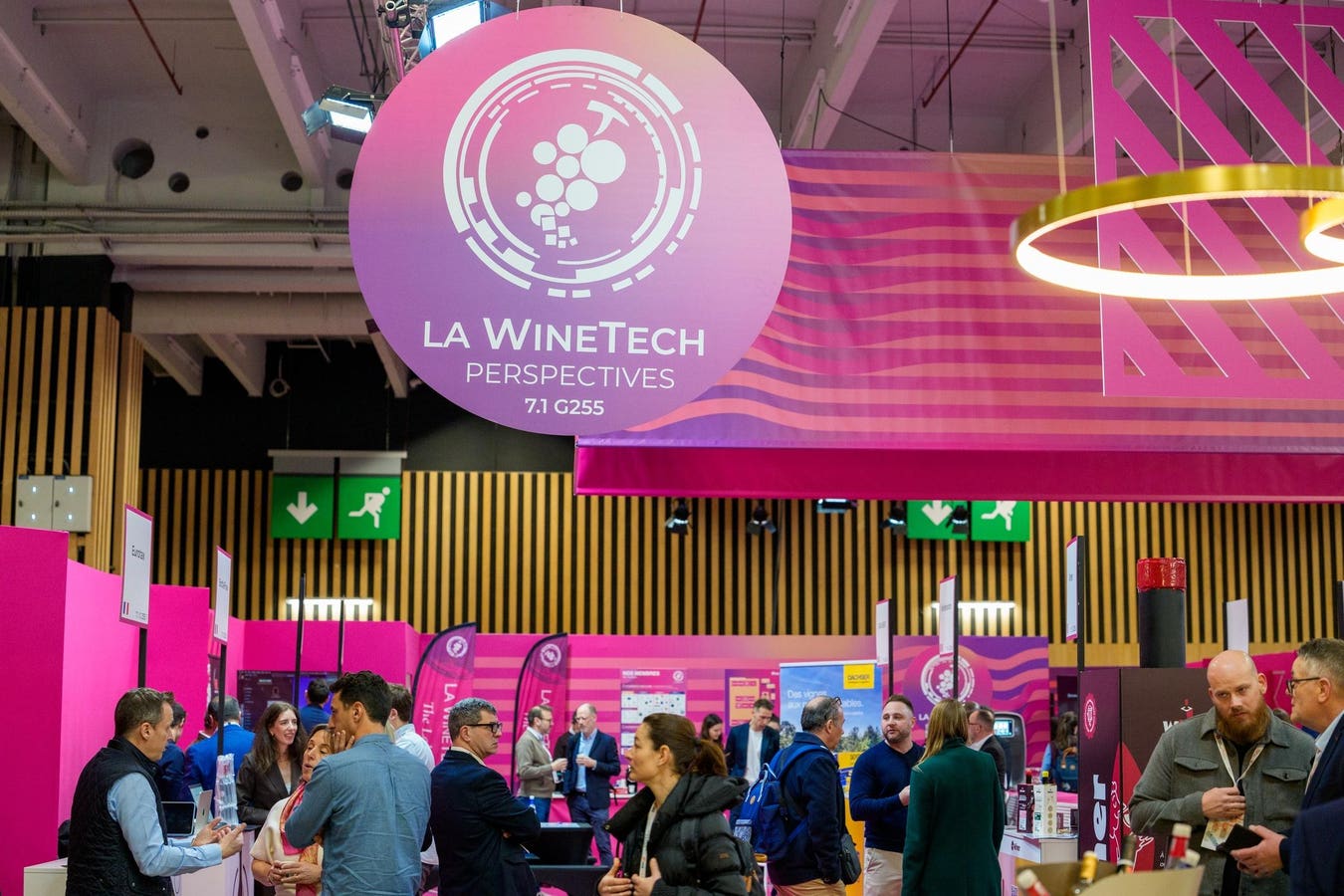
Wine Paris was bright and crowded in 2026.
Frederic SPEZIALE/Courtesy Wine Paris
If you’d asked wine and spirits industry insiders at the start of 2025 how things were going, the answer would be a silent clutch of the head.
Yet by the time Wine Paris rolled around in early February 2026, the mood had shifted.
“Everyone was saying we’re all going to die. We’re all dead. Everything’s done,” said Jaime Araujo, founder of California’s Trois Noix, speaking from behind her booth. “Yes, there’s a structural change happening and it’s global.”
But over the three days of the fair, the halls buzzed with talk of resilience and new approaches that are working. The French government’s regard for the sector was visible from the start—President Macron attended the opening, a signal of how seriously France takes its wine industry.
And in the weeks since, new research has emerged that backs up the talk of green shoots.
President Emmanuel Macron of France opened Wine Paris.
Sébastien D’halloy/Courtesy Wine ParisThe Data Is Starting To Turn
In mid-February, the global equity and research firm Bernstein Group released an analysis saying that “the fever might be starting to break.”
Surveys tracking consumption are showing signs of changes in attitudes to alcohol, particularly around Dry January. “There has been a clear shift in tone in the mainstream press: Dry January is out, Damp January is in,” the report said.
The number of people actually completing Dry January has fallen, from 25% in 2024 to a mere 19% in 2026, across all age groups. Even more strikingly, “more consumers are planning to return to normal drinking patterns post-Dry January than before,” Bernstein went on.
There have also been an increasing number of prominent media figures pushing back against the abstinence trend, from a GQ writer saying he intended to start drinking again, to Bill Maher telling young men to drink more, to a longevity doctor writing an essay about why he’ll never give up alcohol.
The Mood On The Floor
Wine expert Per Karlsson said he’d walked the halls at Wine Paris and asking producers if they were seeing a wine crisis.
“In most cases, people have been guardedly positive,” he said, “Some of them say, ‘I don’t see it at all.’”
Ann Burgaz, founder of The Wineagency, a Swedish importer of premium wine, said that people are definitely drinking better quality wines than in the past and she is seeing more interest in the monopoly, Systembolaget, in testing premium wines. “I think that’s a trend that will definitely grow. We can see that maybe people drink a little bit less, but they drink very good quality.”
An Unexpected Niche Emerges
Chris Indelicato, CEO of Delicato Wines, said that while boxed wine was still doing well for them, they had also discovered that there was a vibrant market for wine in 500ml Tetra Pak cartons. “We’re seeing sales go up. There’s so much life around it,” and it’s being sold through beer channels. “I think the consumer is seeing it’s a great packaging format.”
Which is probably why wines in Tetra Pak were sprouting everywhere, including on the stand of the blockbuster wine XXL — and it turns out it’s because they can be resealed. Producers reported that customers were taking them into cinemas or to football matches, and pouring themselves serves into water or other cups, and then resealing the Tetra Pak and putting it back in their bag.
Previously, some wineries had launched 200ml products in the style of flexible juice pouches, which had failed, because they didn’t realize that what people were looking for was a way to reseal the container.
The Be No area of Wine Paris, dedicated to low- and no-alcohol, was packed.
©Philippe Labeguerie/Courtesy Wine ParisLearning To Go Lower
There was also palpable excitement around the no- and low-alcohol category; while Wine Paris had an entire hall devoted solely to the trend, the real excitement was happening on the stands. Emma Brown, Innovation Manager from Brown Brothers Australia, noted that almost every stand had a no- or low-alcohol category. “Whether the category has matured enough to withstand so many offers will be interesting, but everybody’s giving it a go.”
Brown said that she thought it was more important for the companies to learn how to lower alcohol naturally, rather than to use technological solutions to remove it.
“I’m looking at varieties like Picpoul that can be picked earlier and deliver a pleasant experience, rather than de-alcoholization.” She also said she was interested in the products that were using infusions to compensate for the lack of flavor in zero alcohol products. “I think there’s going to have to be a happy medium in using flavors, to keep the craft that we’re known for, so we can justify being in the wine category and achieve the price points that we want.”
The Buyers Came Back
“Paris has become the meeting place globally,” said Brown. “We’ve had buyers from Korea all the way to Canada coming to meet us here and taste the wines that we have on offer.”
Araujo echoed the sentiment, saying she had returned to Paris for the first time in a long time and she was surprised that she was not only seeing old friends, “but a lot of my American distributors and retailers as well.”
Travis Fuller, CEO of Kilikanoon Winery in South Australia, said “Wine Paris 2026 has been exceeding expectations. “We’ve had very good people through the door, interested in buying and not just tire kicking. We’ve had a lot of Canadian buyers,” as well as buyers from Scandinavia and Brazil. “We’ve even had Italians, though I’m not sure how much Australian wine they’re drinking in Italy.”
Alex Griem, co-founder of CDG Wine Merchants in Wales, who was on the hunt for independent growers, said he had gone to trade shows in the U.K. “where making appointments and getting people to come along to them is like getting blood out of the stone”. By contrast, within an hour of signing up to Wine Paris, “we were just inundated with meeting requests. I think we could have had a meeting every 10 minutes if we wanted to.”
A Deal 25 Years In The Making
Magdalena Pesce, CEO of Wines of Argentina, said the first wineries from Argentina had come to Wine Paris in 2023 to test it out. “It was more like an exploratory thing.”
But she’s found that not only is it easy to come and set up, but it’s also where a lot of business is taking place. Pesce also believes that there are going to be even more opportunities to trade with Europeans in the future, thanks to the Mercosur agreement.
This is a free trade deal between the EU that’s been more than 25 years in the making, involving the four core South American economies of Argentina, Brazil, Paraguay and Uruguay. It moved a significant step closer to reality earlier this month, when the European Commission announced it would provisionally apply the agreement. It means European wines gain improved access to Brazil, where consumer appetite is strong but tariffs have been steep, while Argentine and Uruguayan producers face lower barriers into EU markets.
“I always believe in open markets and making more fair competitive markets. So it will improve for all of us,” said Pesce, adding that the agreement comes on top of a better Argentine economy, with improved inflation and a better macro-economic outlook.
Argentine wines are also taking more shelf space in Canada, as the Canadians look further afield to replace the US wines they’ve removed from their shelves following the Trump tariffs.
“I got a request from three monopolies to visit Argentina last year,” said Pesce, though she added, “I’m not comfortable when you are getting opportunities because someone else is suffering. I don’t think that’s a good way of seeing business.”
Chasing The Next Generation
Wines of Argentina is also looking for new ways to connect with younger consumers, including moving away from wine education and towards being present at music festivals and places where young people congregate. They are also encouraging people to make their own rituals around wine, whether that means putting ice in their wine or using different drinking vessels. “If you don’t have a glass, use another container,” said Pesce.
Araujo says she believes people now think differently about what they put into their bodies. She also thinks that young people just also have a lot more beverage options than previous groups did. She says there is now a deep hunger for things that are local and authentic, and when consumers “see and understand that’s what I do, they respond incredibly favorably.”
Meetings at Wine Paris
Frederic SPEZIALE/Courtesy of Wine ParisNot Everybody Is Celebrating
Not everybody at Wine Paris was positive about the state of the wine sector. Chris Dent, chairman of Murray Valley Winegrowers, pointed to growing unease among Australian producers about pricing pressures at the lower end of the market.
Writing on LinkedIn during the fair, he warned that race-to-the-bottom pricing by some players was undermining efforts to build Brand Australia and create a sustainable pathway forward for the industry.
It’s not just the Australians who are suffering; last year, U.S. wineries lost $1 billion in revenue, leading to a production drop of around six million cases. While the pain has been felt across the sector, the entry-level wines are most severely impacted.
The optimism being heard at Wine Paris may represent survivor’s bias, as only companies that are doing reasonably well can afford to fly to Paris and set up a booth.
The mood will be tested again almost immediately—ProWein, the other great gathering of the global wine trade, opens in Düsseldorf this Sunday.
Expert Karlsson added that the positive side of the crisis is that it might “flush out” some of the more poor quality wines in the industry. “It pushes us to focus more on the quality and on communications with customers.”
The crisis is real, and plenty of wineries won’t be in business by the time Wine Paris 2027 comes around. But, as Araujo said, “A lot of people are still drinking wine.”
Dining and Cooking