
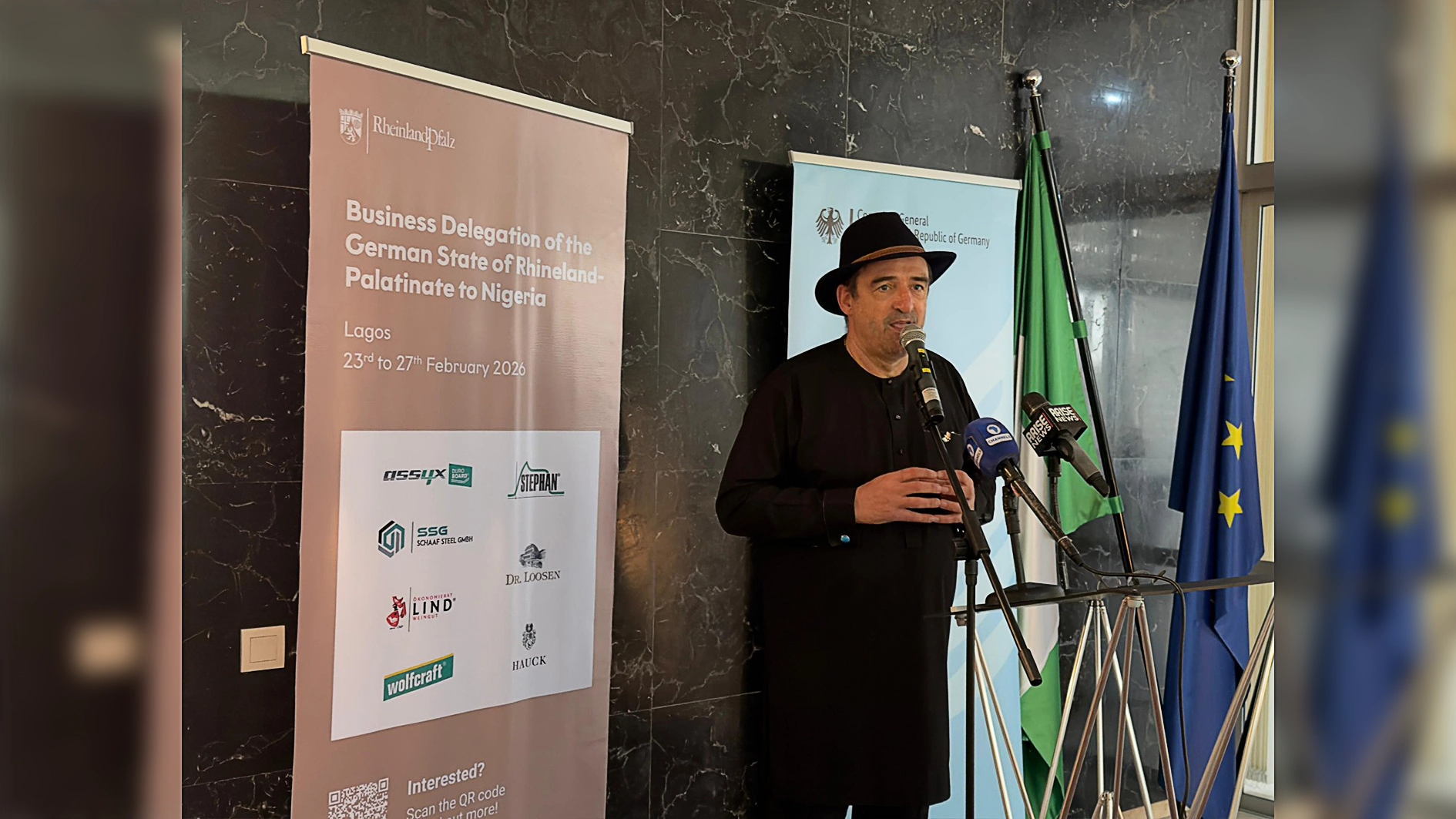
Consul General of Germany in Lagos, Mr Daniel Krull,
Germany has reaffirmed its commitment to deepening economic ties with Nigeria as the Consul General of Germany in Lagos, Mr Daniel Krull, expressed strong optimism about business prospects in 2026 while welcoming a high-level delegation from the State of Rheinland-Pfalz.
Speaking at a press briefing with the delegation, Mr Krull said discussions held in December showed the significant opportunities in the pipeline for both countries, so the need to strengthen economic cooperation.
Krull described Rheinland-Pfalz, southwestern German state, as home to major global industrial players, including automotive and chemical giants such as BASF, as well as one of Germany’s oldest cities, Speyer.
He noted that the state represents a unique blend of tradition and cutting-edge technology.
However, he emphasised that beyond the globally recognised brands, the backbone of German industry remains its small and medium-sized enterprises, often referred to as “hidden champions.”
These SMEs, he said, are highly specialised firms that operate in more than 130 countries worldwide and were well represented in the visiting delegation.
Addressing the structure of bilateral cooperation, Krull explained that Germany favours a bottom-up, business-to-business approach rather than relying initially on formal memoranda of understanding between governments.
He said state involvement could follow where necessary to frame relationships, but that partnerships typically begin at the enterprise level.
Germany’s experience in operating complex industrial systems in real time, he added, provides credibility and value when presenting solutions to prospective partners.
The Head of Delegation and Head of Department for Foreign Trade at the Ministry of Economic Affairs, Transport, Agriculture and Viniculture of Rheinland-Pfalz, Dr Joe Weingarten, said the state, with a population of about four million people, is located along the River Rhine in southwestern Germany and maintains a strong economy with a gross domestic product of approximately 185 billion Euros.
He disclosed that trade between Rheinland-Pfalz and Nigeria currently exceeds 1.5 billion Euros and ranks fourth among African trade partners after Egypt, Algeria and South Africa.
Dr Weingarten highlighted the diversity of the delegation, which included companies from sectors such as construction, machinery, and viticulture.
“Nearly 70 per cent of German wine grows in our state, and there is perspective for the wine market here in Nigeria,” he said.
He said Rheinland-Pfalz has strength in every sector, such as pharmaceutical, machinery, car manufacturing, biotech, but stated that they want to grow in renewable energy.
He emphasised the potential for both economic and political cooperation.
The delegation’s week-long visit includes targeted B2B meetings, engagements with Nigerian companies, and interactions with chambers of commerce.
Dr Weingarten affirmed that this trip represents the first step of Rheinland-Pfalz’s expansion into West Africa.
“We could imagine widening that relation, maybe not only to economic cooperation, but also to political cooperation,” he said.
Dining and Cooking