
Starting July 1, the Town of Leesburg will start earning a share of the county-imposed tax on plastic bags. The anticipated $40,000 in extra annual revenue is required to be spent on environmental programs.
The Board of Supervisors established the 5 cents per bag tax in 2022 with the stated goal of discouraging single-use plastic bags, primarily at grocery stores. While more shoppers may be carrying reusable bags these days, the popularity of plastic bags has not waned. Last year, the county collected $828,500 from the tax, up 7% from the previous year.
Leesburg leaders, supported by a three-year campaign by Del. Marty Martinez (D-29), secured a change to the state law that requires the proceeds of the county tax to be shared with municipalities using the same allocation formula that divvies up sales tax revenue. That change takes effect July 1.
During their June 8 work session, Town Council members reviewed four options for how to use the money:
• establish a pilot food waste composting program for restaurants in the downtown area;
• expand the public food waste drop-off program;
• pay for the annual cost of the Recycling Coach app to help residents learn more about trash disposal and recycling; or
• hold the money for use with larger, one-time projects in the future.
In their discussion, council members lined up behind the recommendation of the town’s Environmental Advisory Committee to expand the public food waste collection.
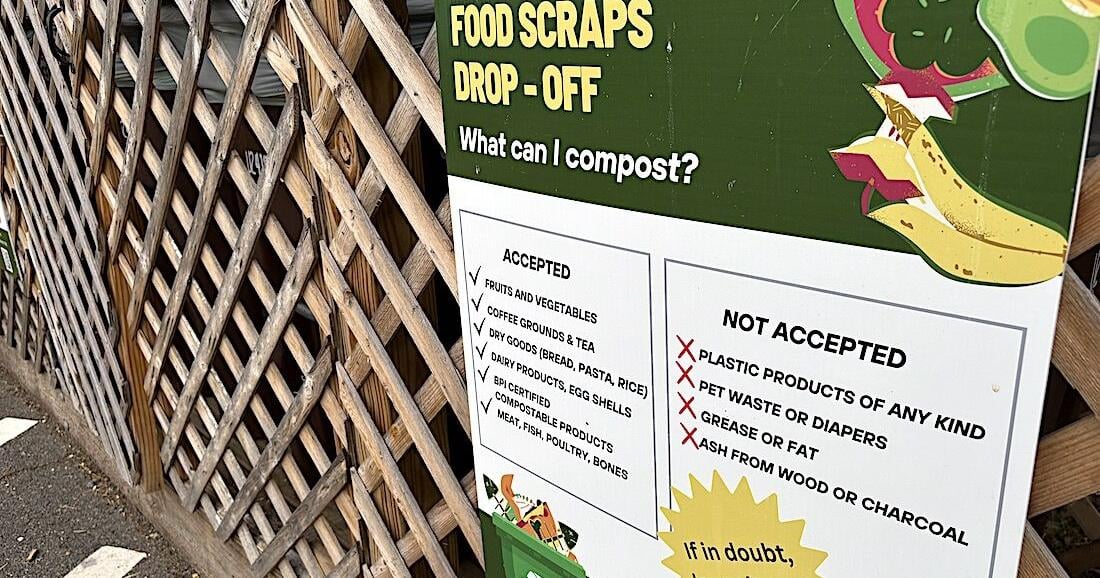
Currently, the town contracts with Monster Organics to operate a collection station at the Liberty Street parking lot.
The service is free to use. Residents may dump food—meats, dairy, and other items not suitable for backyard composting—into bins that are collected weekly for processing.
Deputy Town Manager Keith Markel said the Liberty Steet lot operation is nearing capacity.
“We know there’s a lot of interest from the community. We’ve really seen an uptick in usership there, and our numbers grow every month with the public dropping off food waste,” he said.


The public food waste drop-off site at Leesburg’s Liberty Street parking lot.
Norman K. Styer/Loudoun Now
Under the EAC recommendation, the status of that site would move from a pilot project to a permanent service and the town would establish a second collection station, likely on the eastern side of town. Markel said it could cost $5,000 for construction and then $10,000 in annual operational costs for the two sites.
Council members also showed interest in offering food waste composting to the downtown restaurants, but worried about the complexities involved.
“We know that many restaurants won’t even recycle their glass, so I find it hard to believe that they would take the time to recycle all their food,” Mayor Kelly Burk said.
Burk said she has had requests from residents wishing the public food collection was closer to their homes. “I’ve heard that many times in conversations with people. It’s very popular.”
Council member Nicholas Krukowski noted there could be enough revenue to establish a third collection site in the future.
Markel agreed.
“I think we’ll start that second site and see how well that’s doing,” he said. “If we find that we’re maxing that out, then we may be looking at that third site. So, we’ll just grow it.”
Markel said in the meantime the other funds could be used to cover the town’s $12,000 cost of using Recycle Coach or hold the money for other projects that could be proposed by the Environmental Advisory Committee.
The issue will be brought back before the council more formally as a budget amendment at a future meeting.
Dining and Cooking