

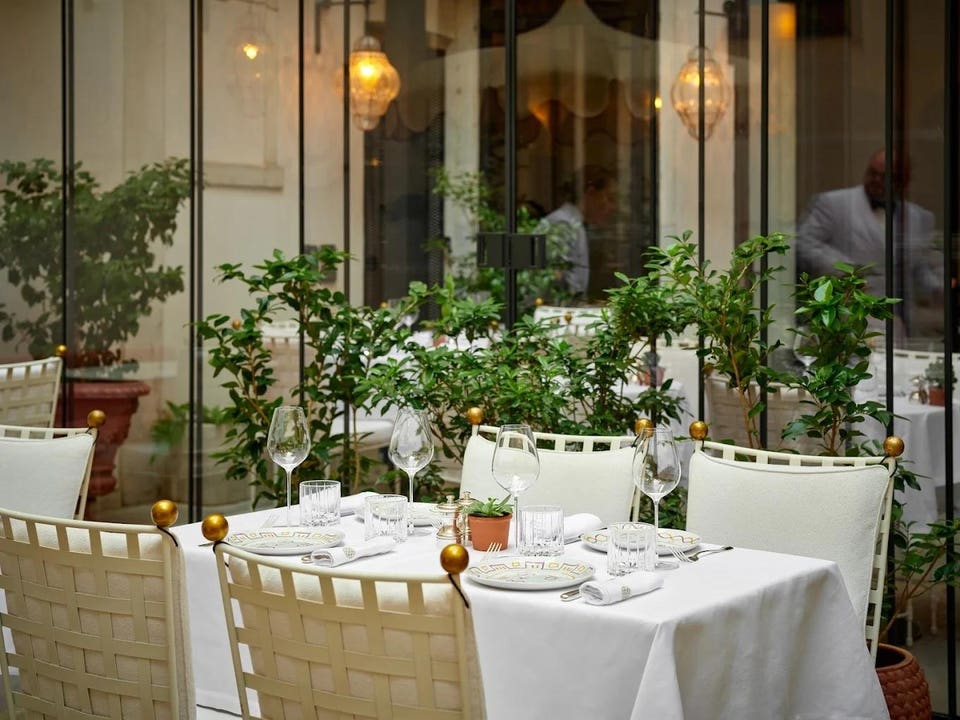
Il Caffè Zeffirino Venezia at Nolinski Venezia.
Julie Limont
Spend enough time in Venice and certain dishes start to feel like home base. Sarde in saor (sardines marinated in a sweet and sour onion sauce) at one bacaro, baccalà mantecato (whipped codfish) at another, maybe a plate of bigoli in salsa or a few rounds of fritto misto from the lagoon, and a Select spritz in hand while you wait for a table. But on those days when you want something a little different, Venice also has a handful of restaurants where chefs are bringing in flavors from well outside the lagoon, often while staying close to what makes Venetian food Venetian in the first place.
Here are 7 non-traditional Venice restaurants locals actually recommend.
Tucked into Santa Croce near the Rialto Bridge, Bacán brings Latin American cuisine to Venice through the eyes of chefs and owners Silvia Rozas and Marco Zambon. “We chose Venice as a place to live before we chose it as a place to work,” they explain. “We wanted to create a place capable of offering an authentic gastronomic experience while maintaining a strong identity.” A standout is Mexican-Style Cuttlefish in Its Ink, cuttlefish tagliatelle with aguachile tatemado, pico de gallo, wild fennel, and corn crumble, inspired by a dish the couple discovered at a market in Mérida. “We were struck by the intensity and depth of the flavors in that sauce,” they recall, so they rebuilt it at home with ingredients from their own region.
There are two tasting menus, a five-course and an eight-course, or you can order à la carte. Don’t miss the cocktails, built around mezcal and other Latin American spirits, with a perfect Michelada included.
Vittoria 1938.
Vittoria 1938
Near the Santa Lucia train station, Vittoria 1938 has been in Elisabetta Pinto’s family for three generations. Her partner, chef Nicolò Trento, runs the kitchen, splitting the menu between “Tradizione” classics like baccalà mantecato and bigoli, and an “Innovazione” side shaped by his travels. “This is a map of my travels but also a journey through time, as Venice was a cosmopolitan port, the center of the spice routes and the meeting of cultures,” Trento says.
A recent trip to Thailand introduced tamarind and galangal into dishes like a lagoon shellfish fish cake with tamarind caramel and peanut butter, and kiaw dumplings filled with shrimp, pork, and water chestnuts in a lemongrass chicken broth. “I would like Venetians to rediscover their childhood memories in their food, but at the same time, to experience the thrill of a window onto the world,” he says.
In Cannaregio, chef Masahiro Homma runs the kind of restaurant every Venetian in the know will tell you to book. Born in Yokohama and raised in Kobe, Homma has spent 14 years cooking in Italian kitchens, and built a menu around what’s known as cicchetti alla giapponese, small plates that lean on the same Rialto market ingredients as Venice’s classic osterie but arrive seasoned with soy and Japanese technique.
Regulars order the fried sarde with soy and onion, agedashi made with fried polenta and crab sauce, horse tataki, eel chirashi, and kakuni-style braised pork belly, alongside handmade gyoza and bowls of udon. For something more guided, there’s a kaiseki-style tasting menu that threads together raw fish, the cicchetti, and a bowl of tsukemen. Don’t skip dessert, the yogurt, caramel, and matcha mousse has become a signature.
Birraria La Corte.
Birraria La Corte
If you need a pizza fix one night, this is the place. The Neapolitan-style pies, soft-crusted and made with stone-ground flour, long-leavened dough, San Marzano DOP tomatoes, and fior di latte d’Agerola, are widely considered some of the best pizza in Venice, including Venetian-leaning versions topped with tuna in saor and salicornia, the crunchy salty green that grows around the lagoon, or with spicy ‘nduja and lagoon honey.
Beyond pizza, the kitchen turns out a seasonal menu rooted in Venetian recipes, simplified and rethought, alongside an extensive craft beer list, on tap and in cans, that sets it apart in a city where wine and spritz dominate. The space, a converted former 19th century beer factory, has a looser, more pub-like energy than most Venetian dining rooms.
Il Caffè Zeffirino at Nolinski Venezia.
BENEDETTI LAURENT
Il Caffè Zeffirino Venezia
Inside the Nolinski Venezia, Zeffirino brings nearly a century of Ligurian tradition to Venice. The Genoa original opened in 1939, and the family, now in its fifth generation, is known for tableside Genovese pesto, made according to time-honored tradition with basil, pine nuts, Pecorino, Parmesan, olive oil, and a hint of garlic, crushed in a marble mortar and wheeled out on a trolley. It’s a must-order, alongside handmade pastas like trofie al pesto, Focaccia di Recco, and a Basil Smash cocktail that riffs on the same flavors.
On the ground floor, Il Caffè Zeffirino is already open, with a patio made for warm weather; the more formal Zeffirino Restaurant upstairs, with a more extensive menu, is set to open in fall 2026. It’s Ligurian rather than Venetian, but it adds old-world Italian formality to the Venice dining scene.
Orient Experience was founded by Afghan filmmaker Hamed Ahmadi, who arrived in Venice as a refugee in 2006. The restaurant is staffed largely by former refugees and asylum seekers, and its rotating menu reflects their own journeys, with dishes from Afghanistan, Iran, and Syria. Diners order family-style, multi-course spreads built around rice, lamb, and vegetable preparations you won’t find anywhere else in the city. Order the kabuli pulao, a fragrant lamb pilaf layered with carrots and raisins, or the qorma kadu, a sweet and savory pumpkin stew that’s become one of the kitchen’s signature dishes.
In Santa Croce, La Zucca’s name (the pumpkin, in Italian) suggests something purely vegetarian. It isn’t. The kitchen is known for vegetable-forward cooking, the pumpkin and ricotta flan is a house signature, but there are standout meat dishes too, like duck breast glazed with orange or rabbit braised with onions in balsamic vinegar — and the vegetable sides are super seasonal and dreamy (asparagus season in the spring is a real treat). It’s a restaurant that draws vegetarians and omnivores alike, less because it’s trying to please everyone and more because the kitchen knows what to do with a vegetable. For something delicious and unique, the pasta with gorgonzola, pear, and pistachio will linger in your mind long after leaving.
***Flags before submission: confirm michelada is still on Bacán’s current cocktail menu, confirm Zeffirino’s fall 2026 opening timeline closer to publication, and verify current hours/pricing for La Zucca and Birraria La Corte if Forbes wants specifics.
Dining and Cooking