
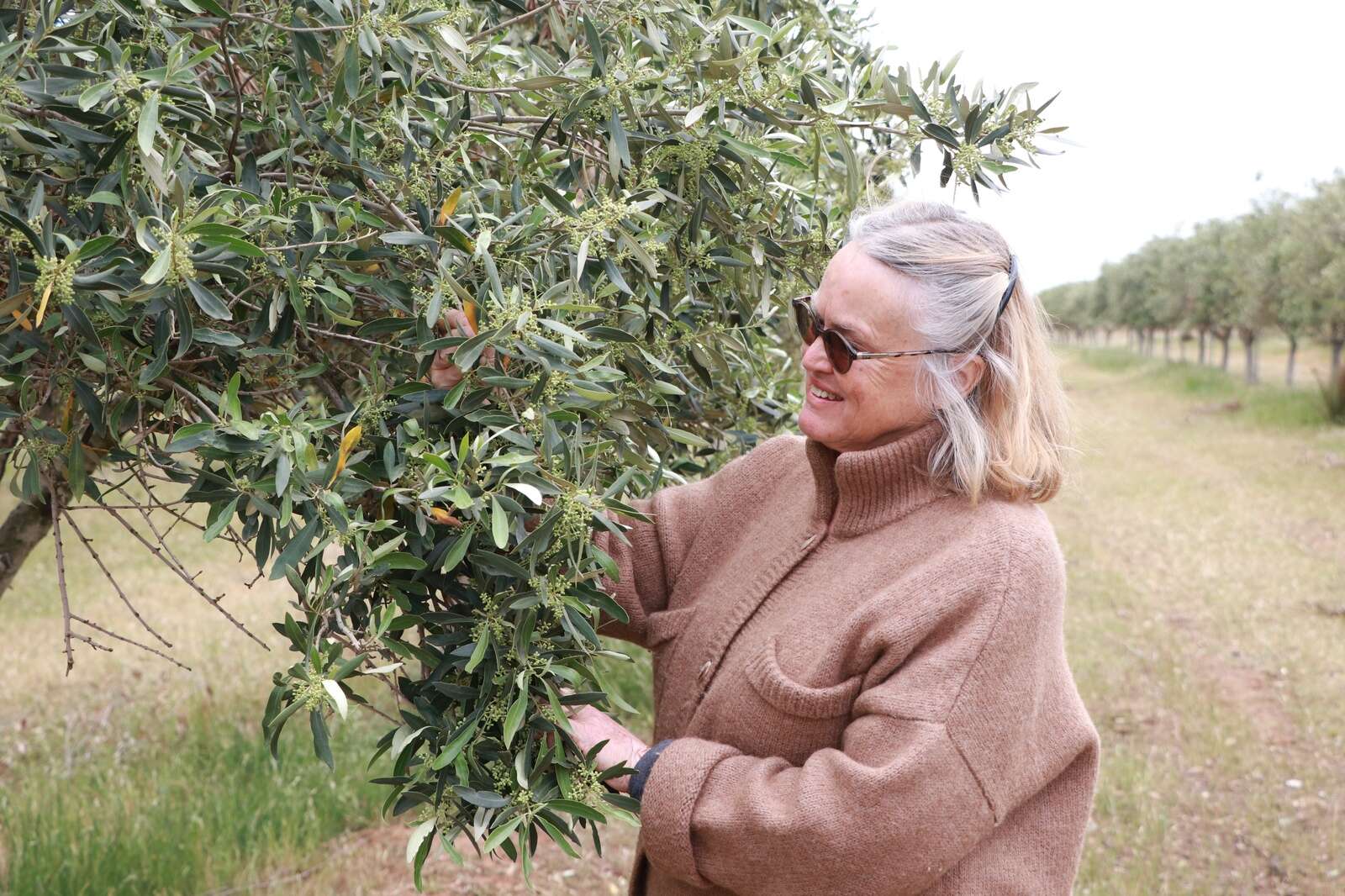
Lisadurne Hill is one of Rushworth’s iconic properties, having remained in Tina and Russ Knight’s family for 150 years.
The 200-hectare property hosts 27,000 olive trees producing both table and oil olives, and has collected numerous accolades over the years, including several gold medals at the Australian International Olive Awards.
Tina Knight said while the season’s lead-up was promising, the final tonnage disappointed.
“Good olives make good oil, and we had great olives,” she said.
The dry spell across northern Victoria’s summer left soil moisture exhausted, limiting the water trees needed to push higher-volume yields.
The Knights were able to irrigate through the dry stretch, softening the blow, but not every grower had that option.
“We irrigated heavily through the summer, but other growers who couldn’t irrigate would have suffered,” Ms Knight said.
She summed up the industry’s season in a single word: patchy.
Recent rainfall has brought some relief, though it arrived too late to alter this year’s yields.
Ms Knight said the rain was nonetheless welcome, giving the trees a solid foundation heading into next season.
The mixed local result sits against the backdrop of a strong 2024-25 nationally.

The 27,000 tree grove has a range of species, including award-winning Kalamata table olives, and high-quality oil varieties like the Favolosa (FS-17).
Australian growers produced more than 113,000 tonnes of olives worth over $141 million last year, according to Fresh Logic and Hort Innovation, with Victoria accounting for around 69 per cent of the total.
Final figures for 2025-26 are yet to be confirmed, but the industry expects the tally to come in lower, a result of both the dry summer conditions and the natural alternate-bearing cycle of olive trees, which tends to produce a bumper year followed by a leaner one.
The shortfall comes at an otherwise opportune moment for Australian producers.
Two difficult seasons in southern Europe have squeezed global supply, with Spain’s harvest halving at its worst point, according to ANZ’s Food for Thought report.
That disruption has pushed prices higher, lifting the value of Australian oil on both domestic and export markets.
For the Knights, the ledger is mixed, but not grim.
Lower tonnage is a business reality, but the quality of what came off the trees is a point of pride.
“Good olives make good oil,” Ms Knight said.
“And we had great olives.”
Dining and Cooking