
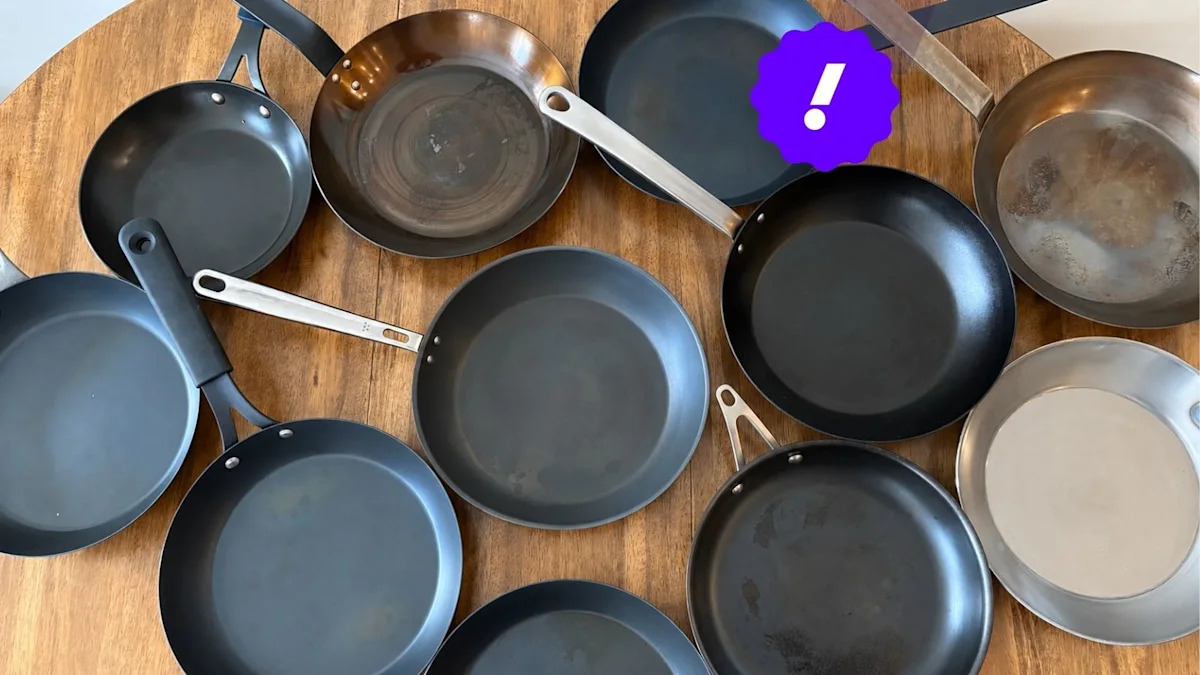
If you’re looking for a pan that holds up to daily use, will last for years and is lighter and easier to maneuver than a cast-iron skillet, give carbon steel a try. A metal alloy composed of both carbon and iron, carbon steel is nontoxic and useful for frying eggs, searing meat and fish, flipping pancakes and more. The best carbon steel pans can practically replace a nonstick skillet — with the added benefit that you won’t have to worry about coatings flaking off.
I’m a graduate of the French Culinary Institute who has tested dozens of pieces of cookware, yet I hadn’t worked with carbon steel pans much before this story. While there is a learning curve, I made sure most of my top picks are pre-seasoned, since seasoning a carbon steel pan can be tricky business (I set off my smoke alarm four times in the process!). In total, I tested 14 carbon steel skillets from a range of brands, evaluating how easily the pans integrated into daily meal prep, how heavy and balanced they were, how the handles felt, and how difficult they were to clean and maintain. After you find the best carbon steel pan for your cookware collection, read up on how to care for it.
Best carbon steel pans of 2026
Lisa Schweitzer/Yahoo
Sizes: 8″, 10″, 12.5″ | Weight: 2 lbs., 10 oz. | Pre-seasoned: Yes | Oven safe: Yes, up to 660°F without silicone sleeve | Induction compatible: Yes | Dishwasher safe: No | Warranty: Limited lifetime
Why it’s great: If you’re looking for instant gratification, this pan is as close to nonstick as you can get right out of the box. It’s pre-seasoned and comes with a coat of protective wax that you wash off before the first use. Add a little oil or butter the first time you cook with it, and you should be good to go.
The first thing I noticed about this pan was its ergonomic silicone sleeve, which makes the handle easy to grip and keeps it cool on the stovetop. After searing skin-on chicken thighs in this pan, I can confidently say that it puts a good sear on meat despite being virtually nonstick. It easily released fried eggs and pancakes, which I ordinarily cook in a nonstick pan.
Minor criticisms: The drawback? You must remove the silicone sleeve when cooking in an oven at temperatures above 425°F and before washing the pan. I can overlook this slight inconvenience, especially given this pan’s performance and moderate price tag, which is only slightly more expensive than our budget pick.
ProsCooking surface is slick right off the batSilicone sleeve makes pan easy to maneuver and handle cool on stovetopFairly lightweightConsCooking surface slightly smaller than others
Lisa Schweitzer/Yahoo
Sizes: 8″, 10″, 12″ | Weight: 2.5 lbs. | Pre-seasoned: Yes | Oven safe: Yes, up to 660°F | Induction compatible: Yes | Dishwasher safe: No | Warranty: Limited lifetime
Why it’s great: Even though this carbon steel pan doesn’t come with a silicone sleeve, its handle is slim enough to grip well with a kitchen towel. This skillet is also a bit lighter than others we tested, making it easy to maneuver. The 10-inch Merten & Storck pan had slightly less cooking space than others, but nicely sloped sides for flipping and tossing.
As with all the carbon steel pans we tested, you should avoid soaking it or putting it in the dishwasher. That said, you can use metal utensils with carbon steel, and overall, it’s pretty indestructible. Durability often comes at a steep price, but this pan’s under 50 bucks, so it’s worth a try if you want to dip your toes into carbon-steel cooking without a big investment.
Minor criticisms: This pan heated so quickly (the iron reacts quickly to changes in temperature) that I almost burned chicken thighs, so watch it closely. Also, like with many pre-seasoned pans, you must wash off the protective silicone coating on the skillet before use. This entails using hot water and a bit of soap and drying it with a kitchen towel. Once that’s done, you’re ready to sear meat and fish, flip pancakes or French toast and fry eggs.
ProsHeats quickly and evenlyLightweight compared to othersHandle is easy to gripAffordableConsCooking surface is on the smaller side
Lisa Schweitzer/Yahoo
Sizes: 8″, 10″, 12″ | Weight: 3.2 lbs. | Pre-seasoned: Yes | Oven safe: Yes, up to 800°F | Induction compatible: Yes | Dishwasher safe: No | Warranty: Limited lifetime
Why it’s great: This pre-seasoned carbon steel pan from Misen impressed me with its nonstick quality right out of the box, which is notable because some other brands’ pre-seasoned pans still require seasoning before use. When using this pan, I kept thinking I can’t believe this isn’t made with a traditional nonstick coating — it’s that slick. Releasing eggs and pancakes was easy-breezy every time.
This pick had the most usable cooking space of any of the 10-inch pans I tried, which helps when you’re cooking for four or more. That you can also use it for high-heat cooking, like searing proteins and quick stir-fries, is a major asset. Plus, the rounded handle looks and feels more modern than many of the carbon steel options on the market.
Minor criticisms: Like all carbon steel, this pan will eventually need to be re-seasoned. Misen recommends applying four to five drops of neutral, high smoke-point oil, such as canola. Then, using a paper towel, buff the oil until the pan appears completely dry with no visible sheen. Heat the pan over medium-high until it starts smoking, then reduce to medium. Continuously wipe away any oil that pools on the surface while moving the pan to ensure even browning. This will take some effort, but you won’t have to do it very often.
ProsLarge cooking surface compared to othersSurface was nonstick right out of the boxEasy to cleanConsThis pan is a bit heavy for its sizePricey
Lisa Schweitzer/Yahoo
Sizes: 8.5″, 10″ (currently out of stock) | Weight: 2.7 lbs. | Pre-seasoned: No | Oven safe: Yes, up to 750°F | Induction compatible: Yes | Dishwasher safe: No | Warranty: Limited lifetime
Why it’s great: This KitchenAid pan is not technically pre-seasoned, but it still blew me away with its slick surface. After the initial use, I seasoned it according to the included instructions, but didn’t find that its surface was any more nonstick than before. The brand attributes this to a nitriding process that seals the surface against water and rust by flooding it with nitrogen atoms and subjecting it to ultra-high heat.
This process creates a seemingly indestructible nonstick pan that isn’t too heavy and works well with high heat — a near-perfect equation for cooking. The pan performed well on all the tasks we tried and cleans easily. I tested the 10-inch version, which is not available at online retailers at the last time I checked, but you can still shop the 8.5-inch size.
Minor criticisms: At $90, this pan is as pricey as a high-quality stainless steel skillet. But if it holds up for many years, as the brand purports it will, it’s a worthwhile addition to your kitchen.
ProsSlick cooking surfaceEasy to clean and maintainRust- and scratch-resistantSeems extremely durableConsMust be seasoned before usePriceyWhat to look for in carbon steel pans
My time spent testing carbon steel cookware yielded these considerations to keep in mind when you’re shopping.
✓ Pre-seasoned vs unseasoned: A factory pre-seasoned pan should be ready to use right out of the box — after you give it a quick wash and dry, of course. These pans arrive with a layer of polymerized oil already “baked” on them to create a nonstick surface. Unseasoned pans require you to do several rounds of seasoning according to package directions. Both pre-seasoned and unseasoned pans will require periodic maintenance in the form of re-seasoning.

I was able to cook and flip pancakes using minimal butter in the top five carbon steel pans tested.
✓ Maneuverability: When it comes to comfort, lighter materials make for nimble cooking, while rounded, elongated handles are easier to grip and hold. Then there’s also the safety factor (some handles heat up when you’re cooking on the range, whereas others stay cool, at least on the stovetop). A few models came with removable silicone sleeves for handles, which we appreciate, but you need to remember to remove them for ultra-high-heat cooking. They should also be removed before washing the pans, so water doesn’t get trapped inside and cause rust.
Advertisement
Advertisement
✓ Maintenance: Carbon steel pans require more maintenance than stainless steel. They should always be hand-washed and dried immediately to prevent rusting and should never be soaked or put in the dishwasher. You will need to season these pans every so often to restore their nonstick surface.
How we tested carbon steel pans
After opening each box, I inspected the pans for any scratches or dings and noted how to care for them. I used each pan to sear bone-in, skin-on chicken thighs and fry eggs. I made pancakes in the top performers and used them for a variety of everyday cooking tasks.

To rank on our list, the pots and pans had to excel in the following tests:
Hot spot test: I monitored how long it took the pans to heat up, if they heated evenly across the cooking surface and whether I could get a good sear on proteins.
Stick to it test: I noted if food stuck to the cooking surface or left stains.
Elbow grease test: I noted how much work it took to clean the pots and pans.
Other carbon steel pans we tested
Made In Seasoned Blue Carbon Steel Pan: This pan comes in 8-, 10- and 12-inch diameters and is oven safe up to a notable 1,200°F. It felt heavy for its size, and the cooking surface was smaller than on some other 10-inch pans we tried. It heated so fast that I almost burned the chicken … twice.
Advertisement
Advertisement
Viking Blue Carbon Steel Frying Pan: This was one of a few pans I tried that’s advertised as pre-seasoned, but comes with instructions to season it. The brand suggests doing that twice before using it, which frustrated me. In the end, the recommended seasoning process wasn’t too laborious and the pan performed well, so I forgave what felt like a bait-and-switch.

Some pans, like this one from Tramontina, were not as nonstick as their pre-seasoned descriptions would lead you to believe.
Tramontina Carbon Steel Frying Pan: A budget-priced option from the brand that won best nonstick pan, this Tramontina carbon steel pan didn’t wow me. The pre-seasoned claim didn’t live up to expectations, and I had to season the pan myself after trying to fry eggs in it a couple of times.
GreenPan x Bobby Flay Carbon Steel Fry Pan: This just-under-$50 pan gave our Merten & Storck pick a run for its money. The pans look and feel almost identical and sell for the same price. This one performed well on all of the cooking tasks, but I liked using the Merten & Storck pick slightly more.
In the category of unseasoned carbon steel pans, I found some easier to work with than others. The Vollrath Carbon Steel Fry Pan and the Winco French Style Carbon Steel Fry Pan were similar in look and feel, though the Vollrath has a welded handle and the Winco handle has rivets. They both required two rounds of seasoning and heated up quickly and evenly. I was able to get a good sear on chicken and eggs released well.
Carbon steel pans we plan to test
There were three unseasoned pans — the DeBuyer Mineral B Carbon Steel Fry Pan, the Mauviel M’Steel Black Carbon Natural Nonstick Frying Pan and the Matfer Bourgeat Black Carbon Steel Frying Pan that we did not carry through the testing process. Their seasoning requirements produced too much smoke for my apartment kitchen, but we plan to test these pans in the future.
Advertisement
Advertisement
We also plan to review the Lodge Pre-Seasoned Carbon Steel skillet. At less than $50, it’s an appealing option from an iconic American brand. We’re hoping it performs as well as our current budget pick.
Carbon steel pan FAQsWhat is a carbon steel pan?
Carbon steel is a cross between stainless steel and cast iron. Like cast iron, it retains heat well, but it’s thinner, so it heats up and cools down faster. It’s excellent for searing and doing any kind of high-heat cooking. It’s naturally nontoxic, practically indestructible and often more affordable than high-quality stainless steel. Just like your favorite cast iron skillet, a carbon steel pan is nonstick if you season it — and it only gets more so with use and time.
Is it healthy to cook in a carbon steel pan?
The experts we spoke with while researching and testing nontoxic cookware shared that materials like carbon steel, cast iron, stainless steel and ceramic are considered reliable PFAS-free options. Also known as per- and polyfluoroalkyl substances, PFAS are chemicals that are still used in the production of some cookware.
“PFAS are often called ‘forever chemicals’ because [they] are very difficult to break down in the environment and can accumulate over time,” explains Krystal Pollitt, associate professor of epidemiology and environmental health at the Yale School of Public Health. “These compounds have been associated with certain chronic health concerns, so switching to PFAS-free cookware can help reduce potential exposure.”
How do you season a carbon steel pan?
To season a carbon steel pan, you need to apply a very thin layer of oil to the surface and buff it dry with a towel, then either heat the pan on the stove or in the oven. Heating the pan causes the oil to bake into the surface, which is a process called polymerization. This process fills tiny gaps in the steel with oil and prevents food from sticking to the surface.
What is the best way to clean carbon steel pans?
You can use warm water and a scratch-resistant sponge or stiff synthetic scrub brush to clean most carbon steel pans. You want to avoid using soap on the pan so as not to dissolve the layers of seasoning that make its surface nonstick. Never soak a carbon steel pan or put it in the dishwasher, as this can cause it to rust.
Meet our expert
Krystal Pollitt, associate professor of epidemiology and environmental health, Yale School of Public Health
Advertisement
Advertisement
Update, June 15, 2026: We confirmed current pricing and availability for all products and added a new FAQ. Our No. 1 pick remains unchanged, but we revised the KitchenAid carbon steel pan to be out our top premium pick.
We received complimentary samples of some products and purchased others ourselves, but we reviewed all products using the same objective criteria.
Dining and Cooking