

The last time I set foot in Wales was in 2000, on a student trip to Cardiff, staying in a youth hostel. Twenty-six years later, I returned as a wine writer, staying at the Grove of Narberth, a luxurious boutique hotel in Pembrokeshire, curious to discover what Welsh wine had to offer.
It took me over seven hours door-to-door to travel from London to Pembrokeshire, where my host, the Grove of Narberth, is located. Upon arrival, I was a bit grumbling about the long journey – until I learned that this is the trip Cathryn Bell, head sommelier at the Grove, regularly makes simply to attend trade tastings in London. As she puts it, nothing comes to Wales. Not even Cardiff. Bristol is the closest hub for wine trade events, but even there, opportunities are relatively limited.

Nothing comes to Wales… not even Cardiff. The splendid isolation of the Grove of Narberth.
Welsh wine scene
That isolation, it turns out, has helped shape the Welsh wine scene. It feels reminiscent of the English wine industry in its early days, before Chardonnay and Pinot Noir came to dominate the conversation. Here, Rondo, Regent, Orion and PIWI varieties such as Solaris and Seyval Blanc take centre stage. More importantly, there is a clear desire to express a sense of place and work with what the land and the warming climate can genuinely offer.
The trade structure is equally in its infancy. The estate model, where producers grow and make wine on the same site, remains rare. Despite rapid expansion, with the number of registered vineyards rising to more than 60 in a relatively short period, domestic winemaking infrastructure has not kept pace.
Wales has only “three and a half” wineries within its borders, says Bell. These are Ancre Hill, White Castle and Mountain People Wine, the latter also offering contract winemaking services for other local growers.
Most Welsh grapes are transported across the border to Halfpenny Green in the West Midlands or Three Choirs Vineyards in Gloucestershire, where they are made into wine on behalf of Welsh growers. Due to their borderland locations, wines produced at both facilities can still qualify for Welsh PGI status.
Bell describes the dominant model as a form of surrogacy: the grower raises the grapes, but the winemaking takes place elsewhere. Not ideal, perhaps, but Bell credits it with sustaining the industry’s early growth. That is now beginning to change, however, as producers such as Velfrey Vineyards look to bring production in-house and take greater control over its wines – even if, in Velfrey’s case, the winery is quite literally housed in the back of a lorry.
Viticulture and wine style

Hebron Vineyard uses an ancient arbustum trellis system, where vines are trained on willow trees, aligning with the natural behaviour of the vine.
This is also where Welsh wine gets interesting: sustainability is not an afterthought; it is built into the way these wines are made. Ancre Hill is certified biodynamic. Hebron Vineyard is the UK’s first regenerative-certified vineyard. Velfrey, while uncertified, follows many organic and regenerative principles and is known for its frequent soil analyses, which support a targeted “spoon-feeding” approach that supplies only the nutrients the vines require.
Artisanal, low-intervention winemaking is thriving alongside a growing interest in PIWI varieties. Rustic in feel, yet forward-looking in outlook, the low-alcohol wines, lesser-known varieties and hands-off approach align well with current consumer trends.

Cathryn Bell, award-winning head sommelier at the Grove of Narberth
Nobody is better placed to assess this than Bell. Welsh by birth, she spent more than a decade working abroad, including in Michelin-starred restaurants in Ireland, before returning home just three years ago. This unique position gives her both the insider’s loyalty and the outsider’s perspective that Welsh wine perhaps needs most right now.
For her, Welsh wine represents “an emerging creativity, perhaps a way of expressing the potential of a heritage that hasn’t been shown before.” When asked for a quick SWOT analysis, she was candid.
Bell sees plenty working in Welsh wine’s favour. Its cool-climate character aligns naturally with the shift towards lighter, lower-alcohol wines, while its cultural heritage gives producers an authenticity that cannot be manufactured. Crucially, she believes the future of Welsh wine lies in embracing that individuality rather than pursuing scale.
Challenges and opportunities for Welsh wine
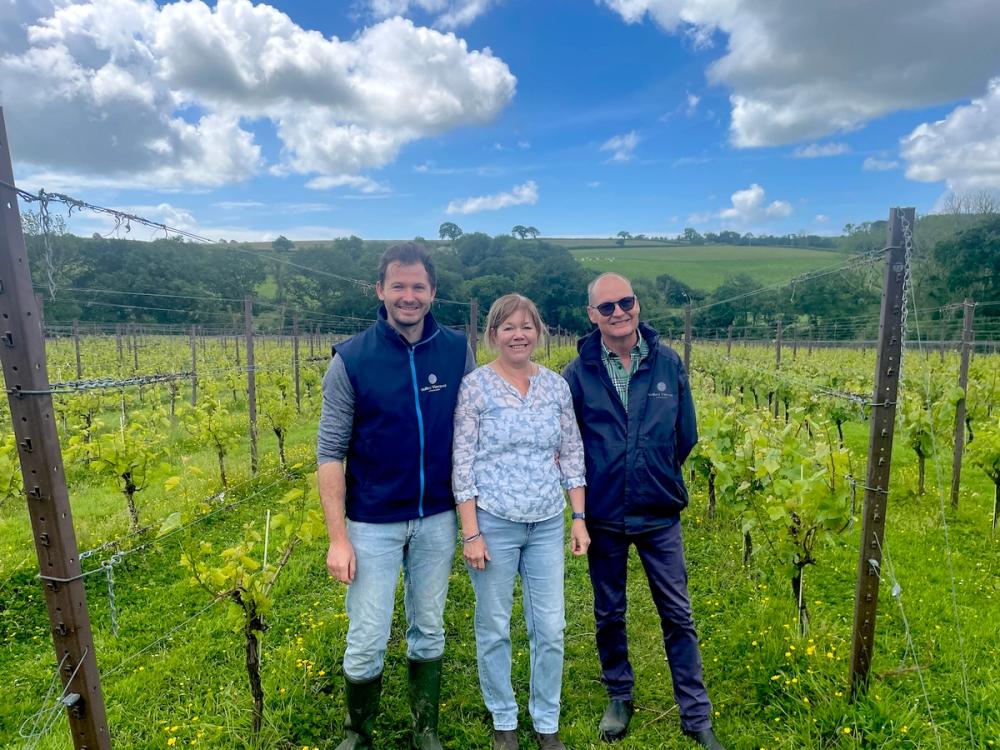
The Mounsey family of Velfrey Vineyard, specialising in traditional method sparkling wine and Solaris.
The realities are less straightforward. Small production volumes make Welsh wines expensive, and a domestic market accustomed to cheaper alternatives is not yet fully convinced. With limited opportunities to expand production and reduce costs, growth remains challenging. Even so, Bell believes the industry’s greatest challenge is not climate or economics but reaching consumers. “The biggest obstacle is how to communicate and market Welsh wine,” she notes.
When asked what Welsh wine brings to an on-trade list, Bell points out: “Welsh wine offers a real point of difference and intrigue.” She recalls one guest who compared the prospect of tasting Welsh wine in a fine dining setting to “putting lipstick on a pig” – which, she argues, only makes the moment of overdelivering all the more powerful.
In a market such as London, where wine lists are already of a very high standard, Welsh wine has a clear place. It aligns with current trends in the on-trade: cool-climate, lower-alcohol styles that are “light on their feet”, and wines with a sustainability and provenance story, particularly from the new wave of producers working with PIWI varieties.
Bell is also clear that this is not a category built for the off-trade, yet. It needs a sommelier to provide the context and story that justify the price. “The best way of showing these wines is through a tasting menu with pairings,” she says, where the wine comes into its own alongside food.

Paul Rolt of Hebron Vineyard – the UK’s first regenerative-certified vineyard.
At the Grove of Narberth, Welsh wine earns its place on the list or it does not appear at all. Bell only lists wines she “loves” and that align with her ethos around sustainability and biodynamic viticulture. For example, she ensures that Velfrey sparkling wine is always available by the glass to maintain a consistent local presence. She also hosts producer events, bringing winemakers such as those from Ancre Hill directly to guests, letting the story be told by the people who live it.
The pairings themselves reveal just how well Welsh wine’s typical profile – low in alcohol, high in acidity and often “slimline” in texture – suits the local table. For Bell, Rondo, which shows a natural affinity for fresh herbs, works beautifully alongside slow-cooked lamb and salsa verde. Solaris, defined by its exotic, high-toned character, finds a natural partner in Carmarthen ham or chalky goat’s cheese. Sparkling wines such as Velfrey, thanks to their salinity and ripeness, cut cleanly through richer dishes such as lobster croustade, while skin-contact wines stand up to the bitterness of a traditional Welsh rarebit. Even laverbread, with its deep umami character, acts as an amplifier for Welsh sparkling wine, filling out the mid-palate.
Welsh wine is still finding its voice. The industry is young, production is small and price points are high. Yet Welsh wine has something that cannot be manufactured: a story that is still being written. For sommeliers looking for a point of difference, that alone is reason enough to pay attention.
Leona De Pasquale’s top five Welsh wines

During this trip, we visited Velfrey and Hebron Vineyards and were joined by Jean du Plessis, winemaker of Ancre Hill at the Pembrokeshire Table Walsh Wine Dinner at the Grove of Nerberth. Here are the most memorable wines from the trip.
Tair Gafr Bink, Vale of Glamorgan, 2023 (Cellar door £20)
Regent and Orion, 9% ABV. Whole-bunch carbonic maceration, native yeast and nine days of skin contact. Expressive notes of stewed redcurrant and strawberry, with a crunchy, vibrant palate and plenty of freshness.
Velfrey 2022 Vintage Welsh Sparkling Wine (RRP£45)
Seyval Blanc and Pinot Noir from the warm, dry summer of 2022. 11.5% ABV, 26 months on the lees, dosage 2g/L. Aromatic on the nose, showing ripe stone fruit and lemon sorbet, alongside a subtle hint of brioche.

Jean du Plessis, winemaker of Ancre Hill.
Ancre Hill Pinot Noir, 2020 (RRP around £30)
Made in concrete egg, foudre and stainless steel. Dark cherry and earthy notes lead into a palate with smooth tannins and bright acidity. Concentrated and generous, with a long, persistent finish.
Hebron Natural Amphora Solaris, 2023 (RRP£35)
Solaris with four weeks of skin contact, minimum intervention. Pronounced herbal notes are joined by guava and yuzu, while the palate is juicy yet fresh, with gentle tannins providing tension and structure.
Hebron Piquette
An experimental project for Hebron. UK producers have been permitted to make Piquette since 2024, and Hebron is among the handful who have started. They use leftover grape pomace from their orange wine, combined with local honey that cannot be potted or sold by their beekeeper friends. It is around 9% ABV, lightly sparkling, citrus-driven and highly refreshing.
Dining and Cooking