
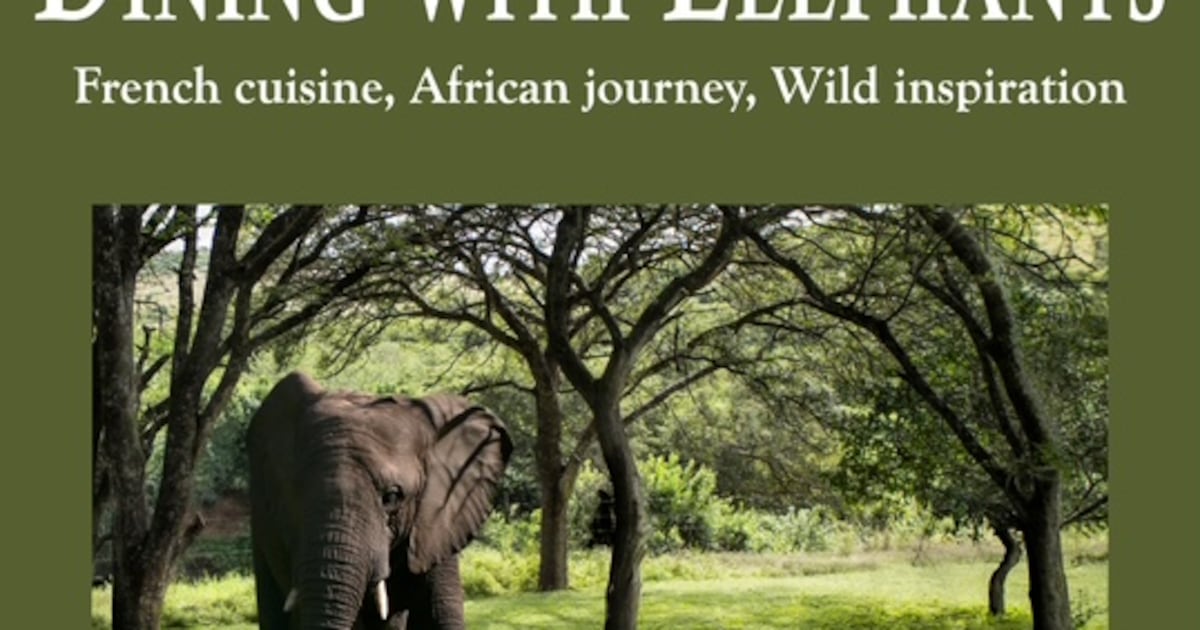
If you are looking for a confusing cookbook, Dining With Elephants might be just the ticket for you.
It features a range of recipes for dishes served to visitors to the upmarket Thula Thula Private Game Reserve in KwaZulu-Natal, many of which are elaborate and most of which follow a French theme.
However, there is also much nonculinary narrative about the reserve itself, which was founded by author Françoise Malby Anthony and her late husband, Lawrence.
We read about the apes and snakes, elephants, rhinos and cheetahs. About the trials and challenges encountered when humans wanted to set up shop in the bush.
I suspect this book would make an ideal souvenir for anyone sufficiently well-heeled to have stayed in this luxury vacation spot, but it is unclear how much demand there will be from a wider public.
The author makes it clear, however, that she thought it was a good idea to write the book (the third, it seems, about the same reserve — an earlier one was written by Malby Anthony and the other by her late husband).
“This is more than a cookbook. It is a love story — to food, to the wild, and to the magic that happens when we choose to live alongside nature. It is about co-existence, sharing space with wild wisdom and discovering humility in the presence of true intelligence,” the author gushes. (And I’ll have some of what she has been drinking.)
“Over 27 years of living deep in the African bush, this book is a collection of true stories — hilarious, heart-stopping, and deeply human. It is a testament to the power of dreams and that passion, vision and perseverance can lead us to our wildest goals.
“It has been, and continues to be, a journey of discovery and survival for all of us, humans and animals alike.
“But above all, it is a love letter — to the animals who welcomed us, to the land that held us, and to the incredible people who made it all possible.”
The recipes cover a good range of dishes, from starters to desserts, from mains to cocktails.
The challenge is that there is no shortage of existing excellent cookbooks featuring South African or French dishes, so the recipes would need to be extraordinary to attract the interest of a true foodie.
So, are they? There was only one way to find out. I cooked a few of them to see how good they were. Some appeared from the photo illustrations to be a bit fiddly to plate, so I opted for a few simpler choices.
First off was a breakfast/brunch dish I have often enjoyed in Tashas, but never tried to cook for myself. I have been an idiot, as the croissant with scrambled eggs and smoked trout was simple to prepare and delicious.
I increased the quantity of trout and applied a squirt of lemon to it, and the recipe worked well. It was so good that I prepared the same thing for my lunch the next day.
I was less impressed, though, with the curried courgette soup, which was bland and uninspiring. Not a super soup.
The final dish I attempted was the very French-sounding blanquette de poulet au vin blanc, a chicken stew in a cream and white wine sauce. I would normally have used veal for a blanquette, but it is hard to source in South Africa, and chicken is easy to find and a lot cheaper.
The dish was tasty, but not impressive. Cooking it was a lot of work, as was shopping for the extensive list of ingredients; I won’t bother again.
To be honest, a good braai or a simple boerewors roll would bring me more pleasure after a day of game-watching than this creamy concoction, but I do understand the need to offer something elaborate to guests in a luxury lodge.
While I was not overwhelmed by two of the three recipes I tried, I did enjoy an anecdote about a bunch of pretentious guests.
I had once attended a South African food and wine evening at a Brussels hotel when I was astounded to hear a bunch of Belgian diners refusing to try the excellent South African estate wines that were on offer. Malby Anthony reveals that there are also South African idiots with a similar ignorance of wines from their own country, which, after all, once produced one of Napoleon Bonaparte’s favourite tipples (the iconic Vin de Constance sweet wine, which has been resurrected by the alchemists at Klein Constantia Estate).
She writes: “I’m proud to serve only South African wines and méthode champenoise sparkling wines … but not everyone shares my enthusiasm.”
Soon after the lodge opened, she welcomed a group of guests who demanded only French Champagne and French wine.
“‘Demanding’ was actually a bit of an understatement. I tried to explain, very politely, that we served some of the best South African ‘champagnes’. In fact, in a blind tasting, I told them that even as a French person, I wouldn’t be able to tell the difference. I wanted to praise South African winemaking talent and stand up for the local brilliance …
“They were all South Africans themselves, who had apparently already enjoyed a few beers and several spirits, so let’s just say their palates had been through a bit of a workout by then.”
They were promised French Champagne for breakfast, which had to be hastily sourced from the local bottle store and was clearly past its best.
“When I saw the colour of the liquid, my heart sank. A rockhopper darkish yellow. Definitely not normal. And then I noticed there were no bubbles. A bubbly without bubbles.
“But our guests loved it. Phew! By the third bottle, they were positively glowing. Laughing, clinking glasses, praising the ‘exquisite taste’ of this French delicacy.”
I have really mixed feelings about Dining With Elephants. It is an acceptable cookbook, but not one to which I will return, and it does have some interesting narrative as well.
So, I am afraid that, for me, it is a book that belongs more on the coffee table than in the kitchen.
Business Day
Dining and Cooking