

If our road trip had a catchphrase, it would most certainly be: This can’t be right. My mom—who harbors a deep mistrust of Google Maps—and I kept repeating it as we crawled up and down steep, narrow roads in our Alfa Romeo (the only automatic at the airport car rental) through Portugal’s Douro Valley. When I first got the assignment to explore this mountainous wine country with its trim, terraced vineyards descending in impossibly well-kept rows, I was admittedly nervous about driving hundreds of miles in a country rife with roundabouts and Portuguese road signs. So I did what any respectable middle-aged adult woman would do: call her mom. “It will be an adventure,” I reassured her, adding that half the fun would be finding these remote wine hotels run by locals channeling their generous old-world grandmothers. “I’m flying coach to Europe,” she said. “It will be…something.”
The plan was to fly into Lisbon, where we’d stay a night at Verride Palácio Santa Catarina, a historic 18th-century town house once owned by a count. (Trying to find it while navigating Lisbon’s disorienting, hold-your-breath alleys was not the softest landing.) The next morning, we’d cross the 25 de Abril Bridge and head east toward Spain for the two-hour-plus drive to São Lourenço do Barrocal in Alentejo. Here is where some of Portugal’s best argones reds and ports are made, thanks to the region’s warm, dry climate and its prehistoric landscape of cork trees and giant rock outcroppings, which have a way of making you turn off Spotify and just be reverent.

The Douro’s trademark sloping vineyards.
Sivan Askayo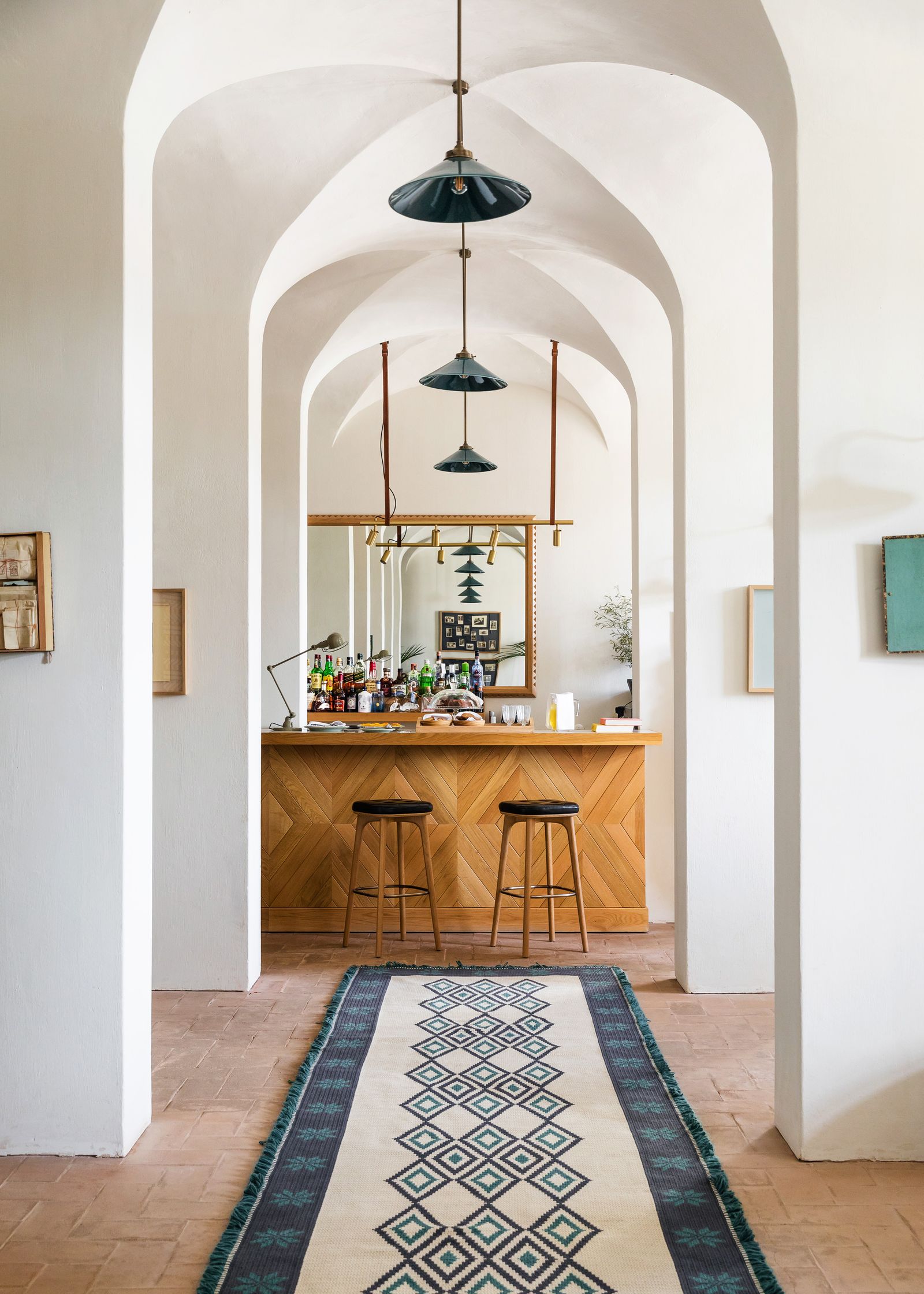
The bar at São Lourenço do Barrocal.
Ash James
Our trip through the Douro (or Duero in Spain) really started on day three, two hours north across the Spanish border at Hacienda Zorita, a Small Luxury Hotels of the World property and 14th-century former Dominican monastery (that once hosted Christopher Columbus), now a wine hotel and organic farm. It’s 10 minutes from Salamanca, the Bologna of Spain, known for its cured meats and historic university. We barely made it there for the tasting, which started at 5 p.m. sharp and was helmed by a sommelier I can only guess is forced to wear a top hat. “I love this place!” said my mom, who dug the more composed Napa vibe here. We nodded our heads studiously when Top Hat talked about the various syrah and tempranillo tinta baroccas we tried, which were more biting compared to the smoother, easy-drinking reds we’d been downing across the border in Portugal. But it was the vineyard’s rosé cava that we wanted seconds of.
Being our typical American selves, we skipped breakfast and hit the road early to make the two-hour drive along hills of olive groves and tiny whitewashed houses to Casas do Côro, a family-run vineyard-hotel built into a medieval citadel. “Is she out of her mind?” my mom said as one of the 30 people who live in Marialva motioned vigorously for us to make a turn onto a road that appeared to be a sidewalk. We eventually found the hotel among the almond trees, though not before I may have nudged the bumper of our sweet ride against a medieval stone wall. After we recharged with espressos on our balcony watching white-haired ladies inch along with canes, we toured the vineyards with the owner’s son, who spoke little English and whipped around the tapered roads in a shockless white van. In one particularly pretty spot, he took a picture of us in front of the vines as the sun slid behind the mountains, and I felt grateful we hadn’t talked ourselves out of coming here together. Traveling as a grown-up with your parent in a strange place never feels urgent, but with the potency of 100 Sunday dinners, it should. It’s memory making on nitrous.
Dining and Cooking