

Sunset streaks the sky above the blue-domed church, staining its whitewashed walls the colour of a cosmopolitan cocktail. At the foot of the hill, 200 metres below, the Aegean Sea has turned bronze.
It’s the kind of scene that attracts thousands of tourists at a time on Santorini. Yet, in Chora, the capital of Serifos island, 68 nautical miles away, there are only a handful of people looking on. As dusk descends and silhouettes Chora’s hilltop windmills, the fairy lights festooning the streets blink on, coaxing more visitors out of hiding. There’s still plenty of space, though. Even on the rooftop terrace of Gaidaros cocktail bar, which overlooks the island’s entire southwest coast, I have no trouble finding a table.
Serifos is one of the stops on a Variety Cruises voyage around the Cyclades, Dodecanese and Peloponnese, taking in parts of southern Greece and its islands that don’t often feature on cruise itineraries. Over eight days, we’ll be stopping at five islands and two under-explored spots on the mainland. While the itinerary does take in Santorini, the size of Variety’s ships (the vessels it uses in Greece accommodate fewer than 50 guests) allows us to land before the larger boats and spend time exploring before the hordes arrive.
This cruise also has a wine theme, which means I’m taken even further off the usual tourist trail to explore wineries, meet makers and taste wines. Evenings onboard are filled with multi-course dinners and yet more wine tasting, led by bon vivant wine expert Tim Clarke. Top-ups continue long into the night as he talks us through each glass’s chemistry, geography and history.
 The cruise explored the varied world of Greek wines (Photo: Provided)
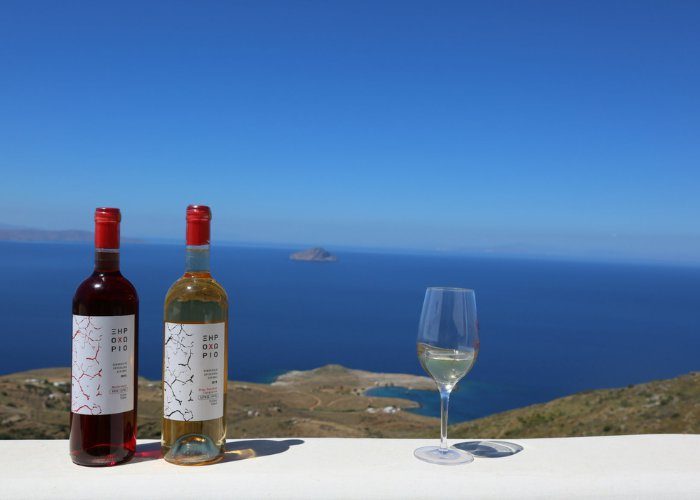
On Serifos, before returning to Chora for sunset, I visit a winery sequestered at the end of a serpentine dirt track, in the otherwise empty hills of the island’s north. The two boxy, whitewashed buildings of Chrysoloras crest a hilltop, surveying 2.5 acres of neatly combed vines and leagues of the Aegean Sea beyond. I find a spot on the suntrap terrace and taste wines made from rare indigenous grape varieties like serifiotiko. All around me, the hills are still. No cars, no people, no commotion. Just the buzz of bees loop-de-looping above crates of freshly picked grapes. It feels like I have the whole island to myself.
There’s a similar sense of isolation on Samos, the most easterly island we visit, overlooking Turkey’s Turquoise Coast and the city of Kuşadasi. Whilst Samos’ beaches are becoming more popular with tourists, we head to a winery in a completely crowd-free part of the island. Squirrelled away in the oak and olive tree-clad hinterland, Vakakis produces wines with names inspired by Pythagoras, Samos’s polymath son, after whom Pythagoreio port – from where we’ve just come – is also named. Under the shade of a long-armed olive tree, I try Theorem, which is made from muscat and has hints of lychee, and Pentagram, which is almost Sprite-like with lemon and lime, in between bites of plump cherry tomatoes and locally made cheese.
 Vineyards on the islands used Greek grape varieties (Photo: Provided)
On the way back to the ship, we stop at a middle-of-nowhere hillside restaurant called Orizontas, where floor-to-ceiling windows look out over the unpeopled foothills of Mount Ampelos and the sea beyond. I dig into plates of heritage tomato and carob rusk salad, aubergine with roasted onion and balsamic vinegar, and chickpea puree with roasted beetroot. Accompanied by a glass of muscat and those views, dining doesn’t get much better.
The most jaw-dropping scenery of the cruise is to be found on Tinos, however. It may be one of the easiest islands to reach by ferry from Athens, but the island is more rural – and certainly less popular with international tourists – than neighbouring Mykonos. My observation point is – where else? – another winery, called Volacus. From here I take in the softly sloping countryside scattered with giant boulders, a scene like something from a Flintstones film set. While scientists suggest they could have been left behind by a long-gone sea, Greek mythology has it that the meteor-like rocks are remnants of a fierce battle between the Olympian gods and the giants who sought to overthrow them. The more sips of peachy malagousia and appley assyrtiko wines I have, the more I can imagine titans clashing here.
While one part of Tinos is awash with myths, much of the island is dedicated to a different set of beliefs. The island is flecked with more than 750 churches, and the Church of The Virgin Mary Evangelistria, in the capital of Tinos Town, is a major Orthodox pilgrimage site. It shelters an icon of the Virgin Mary that’s said to have healing powers. A red carpet, a few hundred metres long, leads from the port to the church and I witness pilgrims crawling painstakingly up it on their hands and knees, beseeching a miracle.
 The ship can get into smaller ports (Photo: Provided)
There’s a palpable sense of tradition and history on the mainland, too, with some of Greece’s most fascinating historical sites to be found on the Peloponnese peninsula, in the southwest. Scooped into a hillside on the sea-facing side of a 200-metre-tall rock island off the south coast of the peninsula, Monemvasia is invisible from the mainland. It was once a single-entranced fortified city known as the Gibraltar of the East, due to how difficult it was to conquer. Today, its walled web of cobbled streets and terracotta-topped buildings brims with bijoux cocktail bars, barista-led coffee shops and boutiques.
Among the olive and orange groves of the Peloponnese’s northeast corner, close to where Hercules is said to have killed a lion with his bare hands, is the Unesco-protected archaeological site of Mycenae. Mentioned in Homer’s Iliad, it was one of Ancient Greece’s superpower cities, and during a tour, I trace the remains of city walls so thick the Romans thought they’d been built by a cyclops. My footsteps echo in beehive-shaped tombs, while in the extensive museum I’m amazed by the ancient mirrors, writing tablets and even eyebrow tweezers on display.
My guide tells me the population of Mycenae in the 14th century BCE was 30,000 – a hefty number, but still lower than the number of tourists that could be staying on Mykonos tonight. Suddenly, I feel grateful to be exploring Greece away from the crowds.
How to do it
Variety Cruises’ eight-day Wines of Greece Cruise next sails from Athens on 5 September. From £4,130 per person, including daily wine tours and onboard tastings. British Airways, easyJet, Ryanair, Wizz Air, Aegean Airlines and Sky Express all fly to Athens. varietycruises.com
Dining and Cooking