
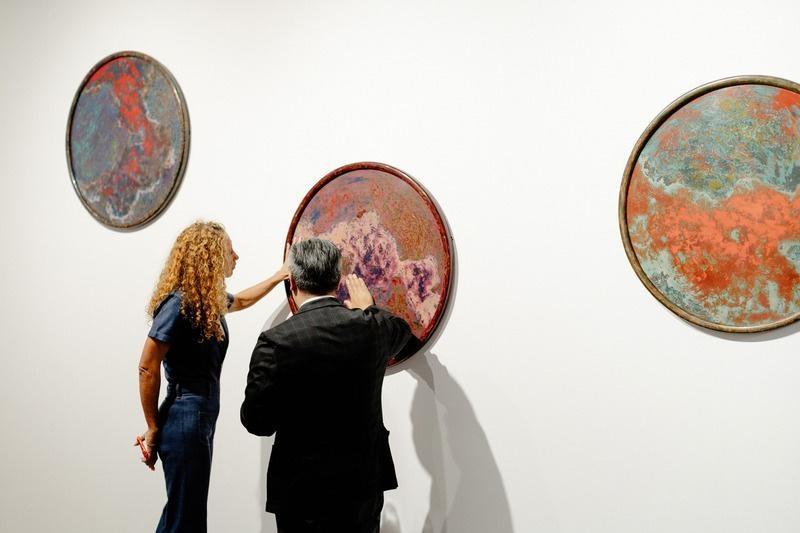
Ingrid Bertrand, the wife of Gérard Bertrand, and Anthony Phuong in front of Vietnamese artist Lê Thúy’s Celestial Body 1 – 2 – 3, 2025, cotton, sawdust, mud, mother-of-pearl, gold and silver leaf, mineral pigments and lacquer resin on wood, 80 x 10 cm
Photo Soufiane Zaidi. Courtesy of Chateau L’Hospitalet.
The Little Prince has long transcended literature to become a universal language. Eighty years after its first publication in France by Gallimard—three years after the New York edition—Antoine de Saint Exupéry’s timeless tale finds a new expression in “One Rose, A Thousand Worlds”, a traveling art exhibition organized by Anthony and Ziwei Phuong of A2Z Art Gallery. After debuting at the gallery’s Paris space from February to April 2026, the exhibition has journeyed south to Gérard Bertrand’s Château L’Hospitalet wine resort in Narbonne, where it is on view through October 10. Bringing together works by Shiori Eda, An Xiaotong, Danhôo, Sepand Danesh, Tran Trong Vu, Lê Thúy, Jihee Han, Takashi Hara, Émeric Chantier, Alain Delsalle, the duo Laurence Graffenstaden, Wai Ming Lung, Jono Toh, Florian Song Nguyen, Bùi Công Khánh, Ai Wai, David Cohen and Rero, the exhibition demonstrates how Saint Exupéry’s humanist message continues to inspire artists across cultures and generations.
Florian Nguyen, Derrière Les Yeux no. 1, 2026, 47 x 33 cm
Photo courtesy of A2Z Art Gallery
Its arrival coincides with the unveiling of Gérard Bertrand’s new Kosmos red and white wines paying homage to Antoine de Saint Exupéry this year. Crafted from carefully selected biodynamic parcels across his estates, the cuvées translate the pilot-writer’s enduring themes of connection, harmony and the invisible into the language of wine, reinforcing Château L’Hospitalet’s ambition to become a place where art, nature, gastronomy and culture converge into a singular experience. The link between Saint Exupéry and wine is, in fact, older than many realize: at the age of four and a half, the very first book he ever read was a brochure explaining how wine was made, discovered at the bottom of an old wooden chest filled with yellowing catalogs and pamphlets—an unlikely first reading that captivated him even though he understood virtually none of it. I sit down with Gérard Bertrand to discuss the links between Saint Exupéry, biodynamic wine and contemporary art.
Laurence Graffensttaden, On ne voit bien qu’avec le cœur, 2025, mixed media (cellular staining, graphic painting and acrylic), 120 x 100 cm
Photo courtesy of A2Z Art Gallery
You are bringing the exhibition “One Rose, A Thousand Worlds” to Château L’Hospitalet until October 10, 2026. Why was it important to extend this artistic tribute beyond A2Z Art Gallery in Paris and anchor it in your wine estate and resort in Narbonne?
The Little Prince is a story about a very small planet and a very big universe, about the fact that beauty exists everywhere, if you know how to look. When I think about Château L’Hospitalet, I think about exactly that: a place where the Mediterranean light falls differently, where the garrigue perfumes the air, where the vines have roots that go deep into ancient limestone. It is a living work of art in itself! Bringing “One Rose, A Thousand Worlds” here, with these extraordinary international contemporary artists, each of them reinventing The Little Prince through their own eyes, heart and technique, felt like the most natural extension of what Kosmos is trying to do. Making this exhibition available to all at Château L’Hospitalet from June to October is our way of saying: come, slow down, look and let the essential reveal itself.
Kosmos Homage to Antoine de Saint Exupéry is described as “an artistic gesture” as much as a wine. Can you walk us through the process of conceiving and developing the cuvées to translate the poetic and philosophical universe of Antoine de Saint Exupéry into biodynamic wines?
Antoine de Saint Exupéry was a man who understood, more than anyone, that what truly matters cannot be seen with the eye alone. And biodynamic viticulture, at its core, is exactly that kind of practice: an act of observing, of taking care of the soils, the ecosystems, the rhythm of the moon, the sun, the planets. So Kosmos was born from that shared conviction: that the greatest things we create in life are those that connect us to something larger than ourselves. We worked parcel by parcel across all our estates, asking ourselves with each selection: does this vine, this soil, this energy belong in a wine that aspires to the universal? Just as a writer chooses each word with intention, we chose each parcel with the same sense of responsibility. The result is an artistic gesture, yes, but also a deeply human one.
Gérard Bertrand Kosmos Day Homage to Antoine de Saint Exupéry at the Lutétia Hotel in Paris
Photo courtesy of Gérard Bertrand
What concretely differentiates Kosmos Homage to Antoine de Saint Exupéry from your other wines—from the selection of biodynamic parcels to the blending process—and how does this dialog between terroirs echo Antoine de Saint Exupéry’s vision of unity and human connection?
What makes Kosmos truly singular is the ambition of the blending itself. We selected the finest biodynamic parcels from across our châteaux and estates, terroirs of completely distinct characters, distinct soils, distinct personalities. For the white, we brought together eight grape varieties; for the red, 10. We didn’t do this for the sake of complexity. We have searched for a point of balance that none of these terroirs could reach alone. Antoine de Saint Exupéry wrote that the greatness of a profession is, above all, to unite people. I think about that constantly when I approach blending. The blender, like the writer, is searching for complementarity, for the moment when diversity becomes unity, when differences become harmony. Kosmos is, in that sense, a direct translation of my understanding of Antoine de Saint Exupéry’s vision into the glass.
Antoine de Saint Exupéry wrote that “what is essential is invisible to the eye”. How does this idea resonate with your own approach to biodynamic viticulture and your pursuit of balance between soil, ecosystems and cosmic influences?
That sentence, for me, could be the most essential description of biodynamic viticulture, except that it was written by a pilot, not a winemaker! What we do in biodynamics is fundamentally an act of faith in the invisible. The health of the soil microbiome, the influence of lunar cycles on the plant’s sap, the energy that passes between the vine and its ecosystem—none of this can be seen, measured in a conventional laboratory or proven to a skeptic in 10 minutes. And yet, every time I taste a wine from a vine that has been farmed this way for years, genuinely, patiently, with full respect for the living world around it, I taste the sense of the place it’s coming from: France. The essential is indeed invisible to the eye. But it reveals itself, completely, to the palate and to the heart.
Alain Delsalle, Dessine-moi une étoile 3, 2026, oil on canvas, 35 x 27 cm
Photo courtesy of A2Z Art Gallery
Why did you choose chef Arnaud Lallement of three Michelin-star L’Assiette Champenoise to conceive a four-hand dinner themed “Under the Stars” alongside chef Laurent Chabert of L’Art de Vivre at Château L’Hospitalet, which was held on June 5, 2026?
Arnaud Lallement is, in my view, one of the great humanist chefs of our time. His philosophy is, at its core, a philosophy of honesty and of depth. He cooks to move you. And that sensibility is exactly what this evening demands. The concept of a “Conversation with the Stars” is a celebration of a sincere, sensitive gastronomy, deeply rooted in the living. Between chef Arnaud Lallement and chef Laurent Chabert, as they are cooking together, the conversation is also fluent. They both consider that cooking is about emotion, the right taste, respect for the product, for the land, for the moment. When these two chefs met for a four-hand dinner in the courtyard of Château L’Hospitalet, with Kosmos wines, we were all in conversation with the stars.
Château L’Hospitalet has increasingly positioned itself as a cultural destination. How do you see the intersection of gastronomy, biodynamic wine, contemporary art and Antoine de Saint Exupéry’s legacy creating a holistic experience for visitors?
I have always believed that wine, at its greatest, is never just a drink. It is a way of experiencing place, time, culture and human creativity all at once. When visitors arrive at Château L’Hospitalet this summer, they will walk through an exhibition of contemporary art inspired by one of the most universally beloved books ever written. They will sit at a table where two exceptional chefs have brought together the finest products of land and sea, paired with wines made in full harmony with the living world. Each of these elements alone is beautiful. Together, they create something that I think is very rare: a total experience that touches the intellect, the senses and the soul simultaneously.
Rero, Untitled (LOVE IS A WORD…), 2026, The Little Prince book (Sanskrit version) and letters embedded in resin, 37 x 46 cm
Photo courtesy of Rero
More broadly, how do the humanist values embodied in The Little Prince—responsibility, connection and the search for meaning—inform not only Kosmos, but your long-term vision for wine as a cultural and philosophical medium?
The Little Prince teaches us that we are responsible for what we have tamed. When you farm biodynamically, you enter into a relationship with the living world that carries genuine responsibility. You are accountable to the soil, to the vine, to the ecosystem, to the future. You cannot take shortcuts. And in return, the terroir and the biodiversity give you truth. Kosmos, in that sense, is the fullest expression of everything I believe wine can be: a bridge between the earth and the cosmos, between the individual and the universal, between the visible and the invisible. Antoine de Saint Exupéry showed us that the most important journeys are interior ones. I like to think that with every bottle of Kosmos, we invite people to begin that journey.
Dining and Cooking