

North Coast wine grape growers are heading into the 2026 harvest weeks ahead of a typical season with a lighter crop, while continuing to navigate market uncertainty, vineyard removals and upheaval in the U.S. wine distribution system.
Christian Klier, who brokers grape purchase deals across Napa, Sonoma, Mendocino and Lake counties for Novato-based Turrrentine Brokerage, said warm spring weather has accelerated grape development.
“We’re running about two to three weeks ahead of the normal average year. Things are a bit early,” Klier said.
But the Central Coast is even further advanced, with sparkling wine producers already beginning harvest because grapes for sparkling wines are picked at lower sugar levels than fruit destined for table wines, he said.
Multiple days of rain and high winds during the late spring bloom disrupted fruit set in many North Coast vineyards. Blocks pruned earlier in the winter were flowering during the storms and suffered more shatter, a condition in which berries fail to develop within grape clusters.
The weather has left several key varieties with reduced yields. Napa County Cabernet Sauvignon, Sonoma County Chardonnay and Sauvignon Blanc across the North Coast all appear lighter than last year, Klier said.
He noted the smaller Sauvignon Blanc crop follows an unusually large 2025 harvest for the white grape. It was the only major varietal to see tonnage growth in the North Coast last year.
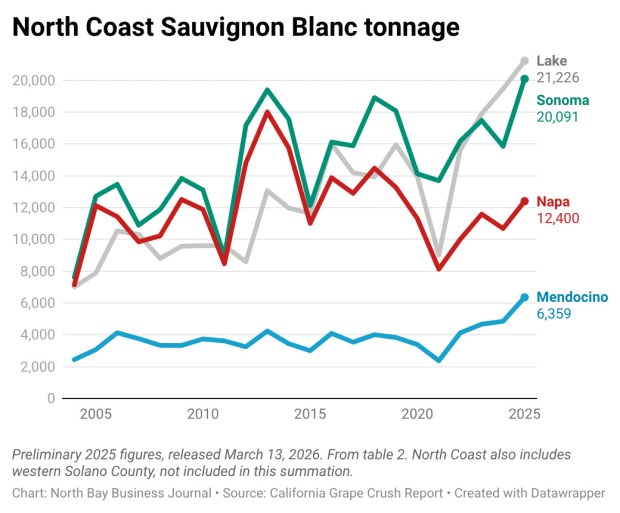 Preliminary 2025 figures for North Coast Sauvignon Blanc tonnage from the California Grape Crush Report released March 13, 2026. (Jeff Quackenbush / North Bay Business Journal / Datawrapper)
“It tends to be alternate bearing, so you have a big crop one year, the next year tends to be a quite a bit lighter crop. That seems to be playing out this year in all regions in the North Coast,” he said.
The reduced crop is helping ease several years of oversupply, prompting some wineries to return to vineyards seeking additional grapes after realizing contracted tonnage may fall short.
“We have seen an uptick,” Klier said of grape pricing, adding that some wineries are offering stronger contracts to encourage growers to farm vineyards through harvest rather than abandon fruit.
The downturn also continues to reshape vineyards. Klier estimated that growers removed between 1,500 and 1,800 acres of Cab in Lake County’s Red Hills this year. In Sonoma and Mendocino counties, many family growers instead are reducing or suspending farming operations while waiting for demand to recover.
Klier also pointed to disruptions in national wine distribution following changes involving major wholesaler RNDC as another obstacle to sales. Some producers’ inventory remains in transition in former RNDC warehouses, awaiting return or shifting to new wholesalers, such as Reyes Beverage Group, which late May acquired portions of the struggling distributor.
“If the consumer doesn’t have access to the wine at the retail level, then they cannot buy the wine,” he said.
One of the growers adapting to the changing market is Obsidian Wine Co., which farms about 83 acres of vineyards in Carneros and roughly 150 acres in the Red Hills of Lake County.
Co-owner Peter Molnar said the company is approaching the season cautiously as wineries remain hesitant to commit to fruit despite inventories that, in some cases, suggest they could return to more typical production.
“You know how it is with uncertainty. The safest thing to do is to say ‘no,’ and I think we’re a little bit on that cycle,” Molnar said.
At Obsidian, fruit set has been weak this year, particularly for Cab and Pinot Noir. Molnar described the smaller crop as a “natural correction” after years of oversupply, although one that still reduces growers’ revenue.
To reduce expenses while preserving vineyards for the future, Obsidian has explored “mothballing” portions of its Red Hills acreage by scaling back farming rather than removing vines altogether. Molnar said the winery, which produces tens of thousands of cases annually, is trying to balance short-term economics with maintaining vineyards that can quickly return to full production when demand improves.
He said recent distribution disruptions have added another layer of uncertainty.
“The industrial wine complex is not collapsing, but it’s certainly going through a major shift,” Molnar said. He expects smaller, quality-focused wineries to help carry the industry through the transition.
Jeff Quackenbush joined North Bay Business Journal in May 1999. Reach him at jeff@nbbj.news or 707-521-4256.
Dining and Cooking