


Dr Martin Juneau, M.D., FRCP
Cardiologue, directeur de l’Observatoire de la prévention de l’Institut de Cardiologie de Montréal. Professeur titulaire de clinique, Faculté de médecine de l’Université de Montréal. / Cardiologist and Director of Prevention Watch, Montreal Heart Institute. Clinical Professor, Faculty of Medicine, University of Montreal.
See all articles
The significant contribution of wine to the positive health effects of the Mediterranean diet
Numerous population studies have clearly shown that adherence to the Mediterranean diet is associated with a significant reduction in the risk of cardiovascular disease and premature mortality. This diet can be defined as a traditional eating pattern, characteristic of populations living in the Mediterranean basin during the 1950s and 60s (but, unfortunately, much less so today). Key characteristics of the Mediterranean diet include its relatively high fat content due to the abundant consumption of extra-virgin olive oil, the high consumption of vegetables, fruits, nuts, legumes, and grains (primarily unrefined), and the moderate consumption of fish and seafood as a major source of protein. Consumption of red and processed meats is very low, as is that of butter, unfermented dairy products and desserts.
Is alcohol an essential element of the Mediterranean diet?
Another distinctive characteristic of the Mediterranean diet is the moderate consumption of wine, generally around one glass per day with meals.
This presence of a source of alcohol in a diet meant to promote good health has become quite controversial in recent years; a number of studies have suggested that the molecules generated as a result of alcohol metabolism increase the risk of several cancers and could therefore potentially counteract the cardiovascular benefits associated with moderate alcohol consumption, including red wine. In other words, could the positive effects of the Mediterranean diet on lowering the incidence of cardiovascular disease and reducing the risk of premature death be even more pronounced in the absence of alcohol? Several indicators suggest that this is not the case and that the type of alcohol (wine) and the way it is consumed in the context of the Mediterranean diet (moderately and during meals) seem to mitigate these negative effects of alcohol, and on the contrary, contribute to the beneficial effects of this diet.
1) Wine as the main source of alcohol.
Thanks to an ideal climate for viticulture and the cultural legacy of Greek and Roman civilizations, the inhabitants of Mediterranean countries consume alcohol primarily in the form of red wine. In the 1960s, for example, the French and the Italians consumed on average over 110 litres of wine per person, and even though these consumption levels have declined drastically in recent years (80 litres of wine per person in 1987 and around 46 litres per person in 2020), they remain higher than in most Northern and Eastern European countries, where beer and spirits are the main sources of alcohol.
This preferential consumption of wine may contribute to a certain “Mediterranean paradox” regarding alcohol-related mortality (Figure 1). Indeed, although the total amount of alcohol consumed by the inhabitants of the Mediterranean basin is similar (and even in some cases higher) to that of most European countries (Figure 1A), the mortality attributable to this alcohol consumption is significantly lower (Figure 1B).
 Figure 1. Relationship between total alcohol consumption (A) and mortality attributable to alcohol (B) on the European continent in 2016. Adapted fromWorld Health Organization (2021).
This possibility is also suggested by some studies that have compared the impact of different types of alcoholic beverages on the risk of cardiovascular disease and premature mortality. For example, a study presented at the last American College of Cardiology Scientific Session reports that moderate wine consumption reduces the risk of death from cardiovascular disease by 21%, while moderate consumption of spirits, beer, or cider was associated with a 9% increase in this risk. It has also been observed that, compared to red wine, the consumption of spirits or beer is associated with an increased risk of cardiovascular events, liver cirrhosis, accidents, and premature death.
Another study showed that for an equivalent amount of alcohol, the increased risk of mortality was much less pronounced among red wine drinkers (Figure 2), especially when consumption is moderate, that is, around 200 g of alcohol per week, which corresponds to approximately two drinks per day. It is therefore highly unlikely that red wine, as consumed within the framework of the Mediterranean diet, could interfere with the benefits conferred by this way of eating and could even, on the contrary, contribute to its positive effects.
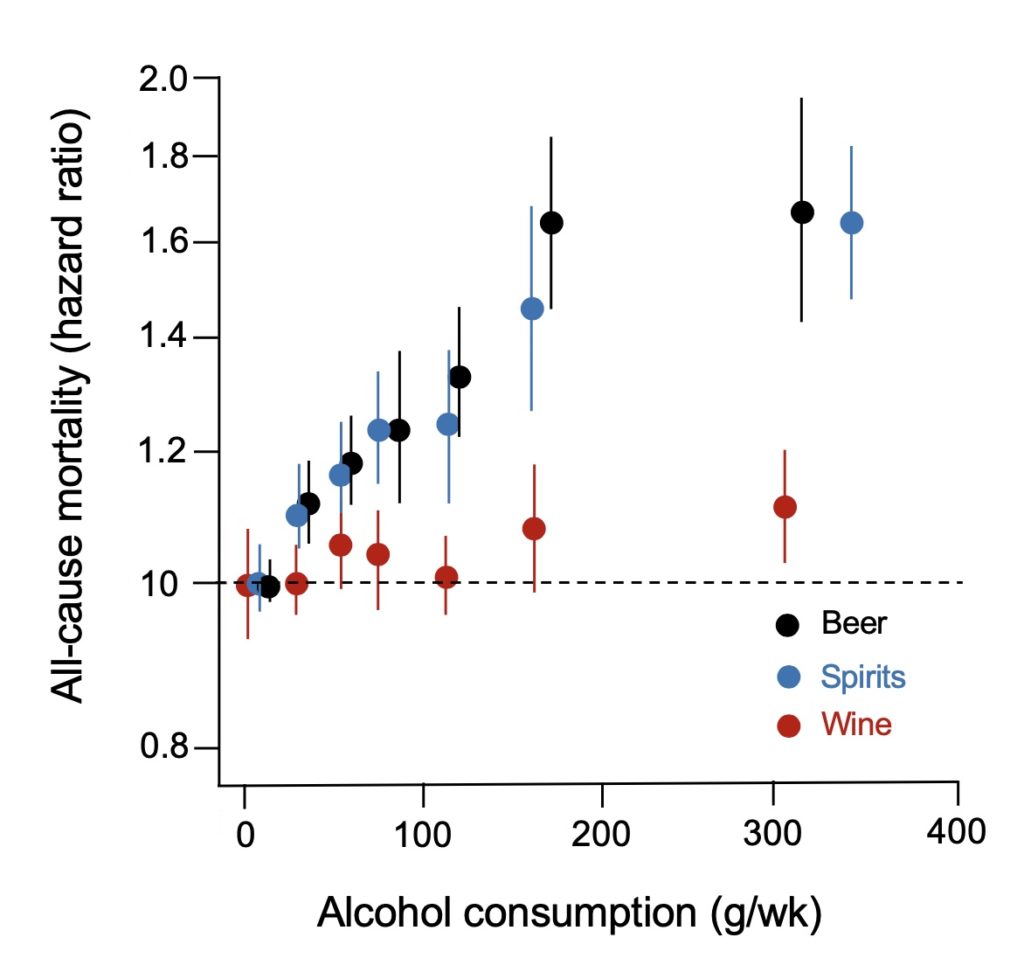 Figure 2. Comparison of increased mortality risk associated with the consumption of different types of alcoholic beverages. Note that in this study, mortality risks are established using light drinkers (not abstainers) as the reference group, which eliminates the benefits usually observed for small amounts of alcohol (see our article on this topic). The data clearly show, however, that for an equivalent amount of alcohol, the increased mortality risk is much lower among wine drinkers. From Wood et al. (2018).
2) The context in which alcohol is consumed.
A characteristic of the Mediterranean diet is the distribution of alcohol consumption in small amounts throughout the week, generally in the form of wine with meals. This is important because it is well established that alcohol is particularly harmful when consumed in large quantities over a short period of time, such as in episodes of binge drinking. For example, for the same total amount of alcohol, the reduction in the risk of myocardial infarction is much more pronounced for people who drink small amounts regularly (2 or more days per week) than for those who consume this amount on 1 or 2 occasions, in both men and women. People who spread their alcohol consumption over several occasions also have a lower risk of all-cause mortality, suggesting that the negative effects of alcohol on other parameters unrelated to cardiovascular health (such as cancer and liver cirrhosis) can be greatly mitigated by distributing alcohol consumption.
The same is observed for regular, moderate alcohol consumption with meals, with a significant decrease in the risk of all-cause mortality among those who consume alcohol moderately in this food context (Figure 3). The conviviality of meals, in the spirit of the Greek symposium (sym-posium means “to drink together”), is an essential characteristic of the Mediterranean diet and makes meals special times of sociability and relaxation, another factor that may contribute to the benefits of alcohol.
 Figure 3. Association between alcohol consumption pattern and all-cause mortality risk. Note that the positive effects of moderate alcohol consumption (200–300 g per week, or 1–2 drinks per day) on mortality risk are only observed when consumption is spread over several occasions and with meals. Adapted from Ma et al. (2021).
3) Wine, an important element of the Mediterranean diet.
In some epidemiological studies that assessed the individual contribution of the different elements of the Mediterranean diet, moderate wine consumption alone was found to be responsible for approximately 25% of the reduction in all-cause mortality associated with adherence to this diet.
This importance of wine was recently highlighted by an analysis of data collected in the Spanish prospective studies PREDIMED and SUN. In this study, researchers calculated the level of adherence to the Mediterranean diet using a score (from 0 to 14) that reflects the number of diet elements adopted by the participants. Two main groups were identified: those with weaker adherence to the diet (score of 0 to 9) and those with stronger adherence (score >9 to 13). To assess the contribution of wine, each of the two groups was subsequently divided into two subgroups: one consisting of participants who drank little or no wine (an average of 10 mL per day, or less than one glass per week), and another who consumed it regularly in moderation (an average of 170 mL per day, or about one glass).
Unsurprisingly, the comparison of the different groups clearly shows that adherence to the Mediterranean diet is associated with a greater reduction in the risk of premature mortality (Figure 4). The key finding of the study, however, is that this reduction is significantly increased by the inclusion of moderate wine consumption, with the mortality risk decreasing by 23% to 33%. The study also shows that wine has no positive effect on mortality risk in itself if it is not consumed as part of the Mediterranean diet, confirming that the overall context in which moderate alcohol consumption occurs plays a crucial role in its health effects (Figure 4).
 Figure 4. Impact of moderate wine consumption on the reduction of premature mortality risk attributable to the adoption of the Mediterranean diet. Data are from 10,554 individuals followed for an average of 22 years. Note that the reduction in mortality risk observed in those most closely adhering to the Mediterranean diet (23%) is even more pronounced (33%) in moderate wine consumers (175 mL on average, or less than 2 glasses per day). Adapted from Martinez-González et al. (2026).
In short, it seems increasingly clear that wine stands out from other types of alcohol due to its positive effects on health. However, it is important to keep in mind that the reduced risk of cardiovascular disease and premature death associated with wine consumption is likely not due to wine itself, but rather to its synergistic effect with a Mediterranean-style diet, rich in fruits and vegetables, legumes, and nuts, which uses olive oil as a major source of fat and is characterized by moderate meat consumption.
Dining and Cooking