
Health and wellness have become a huge part of culture these days. We all want to take better care of ourselves, right? But for as much information as there is out there about healthy eating, there’s just as much misinformation. In r/AskReddit, someone asked, “Nutritionists of Reddit, what are some eating habits that are popularly believed to be healthy but are actually not?” The responses from these experts helped break down some common health myths, and honestly, I found them to be pretty surprising. Here’s what they said:1. “Just a friendly reminder that ‘nutritionist’ is not a real title. We are all nutritionists if we say we are. If you want accurate information on nutrition, a registered dietary nutritionist RDN is a good source.”
—LaundryGranola
2. “I used to think eating between 2 and 3 pounds of seeds was the healthy way to go because I read a book called Eat Like A Bird: No, Really, but after a few years of such a seed-heavy diet, I developed some pretty bad colon problems.”
Anatolii Savitskii / Getty Images
3. “Any fat-free diet. They get rid of the fat and load it up with tons of sugar just to taste good which is equally not good for you.”
—AmandaD404
Related: “15 Health Warning Signs You Should Never, Ever Ignore”
4. “Eating a version of the food that is lower in fat, i.e., peanut butter vs. peanut butter that is 25% less fat, is not always a good decision. Why? To maintain the taste in the lower-fat version of peanut butter, the manufacturer will add more sugar. Depending on the individual’s purchasing, this might not be the best choice. Always go for the most natural version of a product. You can’t go wrong with nature.”
—vanessax0x
5. “‘Cleanses’ are not good for you. There is some evidence to suggest that occasional fasting (24 hours) every so often may be good for you [1], however, doing these juice cleanses where people drink nothing but cucumber water or juice for a week or two can be severely damaging.”
Howtogoto / Getty Images
6. “Not a nutritionist, but have Celiac. You’d be amazed at how many people don’t actually get tested for Celiac before starting the diet. And the diet is REALLY bad for you. Almost all the gluten-free versions of food have tons of added sugar to get the flavor right, and less nutritional value than their gluten counterparts.”
Thai Liang Lim / Getty Images
7. “Carbs are not something that should be villainized and are your ideal source of energy that the body needs long term.”
—duckman398686
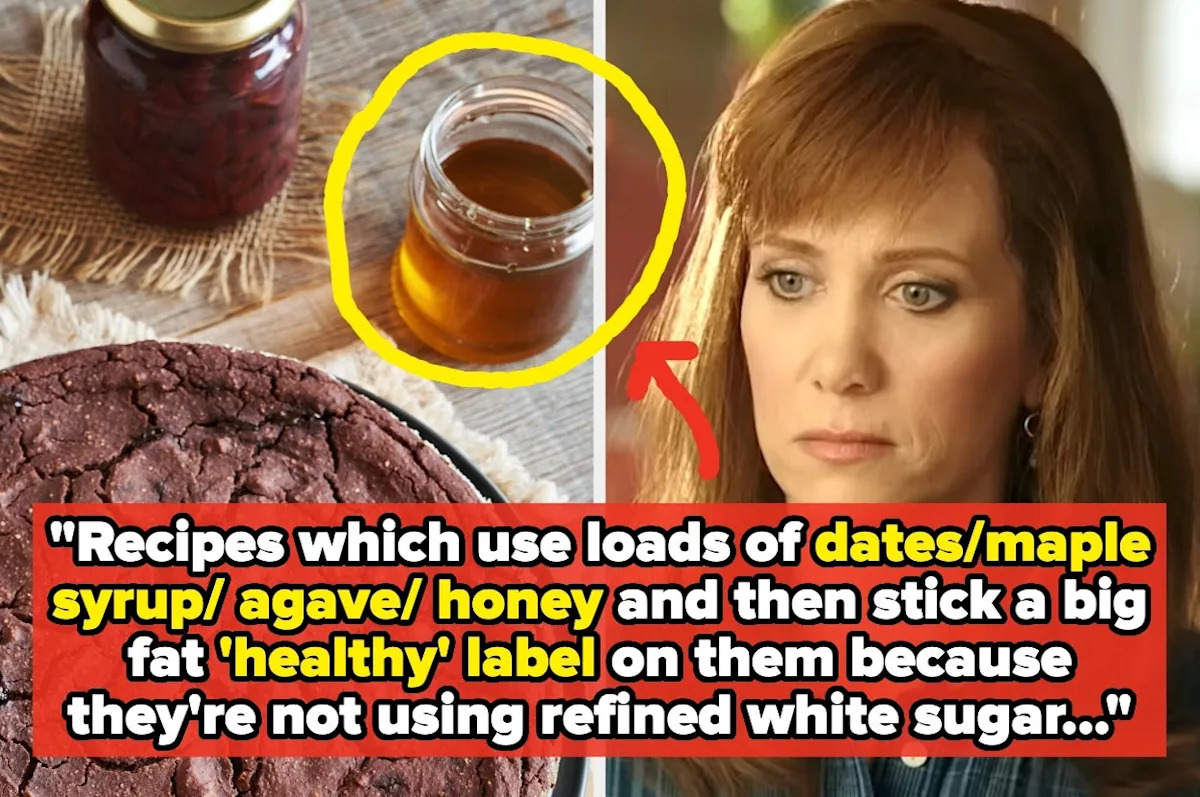
8. “Recipes which use loads of dates/maple syrup/agave/honey and then stick a big fat ‘healthy’ label on them because they’re not using refined white sugar — it drives me insane!”
Madeleine_steinbach / Getty Images
Advertisement
Advertisement
Advertisement
Advertisement
Related: “Most Women Were Taught This One Thing And Now We’re Paying For It”
9. “Avocado is fine. The portions that people eat is not. It is very calorie dense. When people are going home and eating two whole avocados a day, they’re doing themselves no favors.”
—ALLST6R
“Same with hummus. Yeah, it is healthier than ranch dip, but not if you eat a whole tub at a time.”
—BobSacramanto
10. “I’m a dietitian in a weight loss center, and 75% of my time is just telling people what they heard is wrong. Eating several small meals all day long doesn’t keep your metabolism up. Eating breakfast doesn’t ‘get your metabolism going.’ If your metabolism isn’t going, that means you are dead. Tilapia is not terrible. Gluten is not terrible. Dairy is not terrible. Nuts are high in calories that people should be mindful when eating them, though if you can lose weight and keep them in your diet, that’s fine too. Staying at a healthy weight is very important for your health.”
Nemke / Getty Images
11. “The Ketogenic diet isn’t a high meat, no fiber diet where you eat bacon and sausages fried in liquid cheese. The amount of protein required on a ketogenic diet is the same as any other diet, and carbs aren’t 0g but rather 25-50g per day, depending on your requirements to get into ketosis. You can (and should) consume lots of fiber: green leafy vegetables, cruciferous vegetables, low sugar fruit (e.g., strawberries, cucumber), and a balance of healthy fats (walnuts, ground linseed, olive oil). You can even go vegan; it’s no problem, however, the source of protein will simply be low-carb (e.g., the tempeh I buy at the supermarket has almost no carbs, or pea/hemp protein powder).”
Katja Forster / Getty Images
12. “The whole you need 1-2 grams of protein per pound of body weight is bullshit. You’ll see .8g-1.2g protein per pound of body weight a lot too. This is also wrong because it’s 0.8-1.2 protein per KILOGRAM, not per pound. If you’re going by pounds, it should be .35-.6g protein per pound of lean body weight. Even highly competitive strength-based athletes start seeing significant diminished returns after .77g of protein per pound of lean body weight.”
Karl Tapales / Getty Images
Related: “Doctors Reveal The Overlooked Symptoms That Could Save Your Life”
13. “Most studies now show that, for somebody who is doing regular strength training, they want to have about .8 per pound or at least 120 per day as protein stimulates muscle protein synthesis by itself.”
“There’s a very good article with much more up to date sources on it.”
—PM_ME_GLUTE_SPREAD
14. “Granola. It has so much sugar and fat.”
—ratsrule67
15. “Some yogurts have as much sugar as a can of coke.”
Kodchawan Jirattawevut / Getty Images
Advertisement
Advertisement
Advertisement
Advertisement
16. “Drinking the juice of fruits without eating them, you get carbs, but zero fiber.”
—AnubisOS
17. “Coconut oil is not good for you to eat. It’s just saturated fat. Olive oil, on the other hand, is mostly monounsaturated fats and is generally good for you and supports brain health. Coconut oil is not the fancy superfood that marketing would have you believe.”
—piobeyr
18. “You need both Omega-3 and Omega-6 fats in your diet. The reason that Omega-3 are pushed so much is partially because we tend to lack them and have Omega-6 in excess in our diets.”
Nadzeya Haroshka / Getty Images
Related: “22 Nurses Share Their Wildest Gynecology Stories”
19. Protein and creatine supplements, commonly used by athletes, bodybuilders, and powerlifters, should be consumed carefully. People tend to think that more is best, so they consume two or three times the recommendation, but over consuming these products will not make you stronger. You will simply gain more weight (not necessarily muscle), and over time, you will destroy your kidneys.”
—deleted
20. “Tea. I don’t know when everybody and their grandmother decided tea was magical, but it’s not. There are no cleansing teas. There are no mood-changing teas. Tea’s nutritional value is equivalent to water, barring undeniably negligible amounts of micronutrients, which give it its flavor. All other effects are purely psychosomatic. If it works for you and helps you drink more water and cut down on soda or sugary, creamy coffee (caffeine is not inherently harmful as many people believe), that is awesome! But it’s just hot leaf water.”
—deleted
21. “Ignore everything written on food packaging except for the ingredients and other legally required nutritional information. Everything else on food packaging is marketing bullshit, put there solely to increase sales. Especially the name of the product and tag-lines like ‘protein power’ and ‘all-natural,’ and my personal favorite, symbols on the back like ‘certified.’ There are hundreds of ‘organizations’ who ‘certify’ complete bullshit, so make sure you look them up and research. In many countries the word ‘organic’ is legally meaningless. Again, if it is not legally required to be on the packaging, then it is a sales tactic.” Arcady_31 / Getty Images, Marharyta Kovalchuk / Getty Images22. And finally, “My gf is becoming a registered dietitian, and I thought I should mention that there is actually a substantial difference between nutritionists (which OP said in the post) and dietitians. Dietitians need an undergraduate degree and go through a rigorous internship before taking an exam to become registered. On the other hand, nutritionists need NO education, and literally anybody could claim to be a nutritionist based on their own random internet findings. Essentially, dietitians are a legitimate part of the healthcare team while nutritionists are not. I know it seems very nitpicky, but any dietitian you meet will HATE it if you call them a nutritionist. Just thought I should share.”
Xavier Lorenzo / Getty Images
Alright, what do you think of these health misconceptions? What are some health myths that surprised you? Let us know in the comments! Or, if you prefer to remain anonymous, you can fill out the form below!
Your daily brain workout: If You Can Get Through These Word Chains, Your Brain Literally Works Differently Than Everyone Else’s
Also in Health: “Doctors Are Admitting The 33 Dumbest Reasons Patients Ended Up In Their ER”
Read it on BuzzFeed.com
Dining and Cooking