
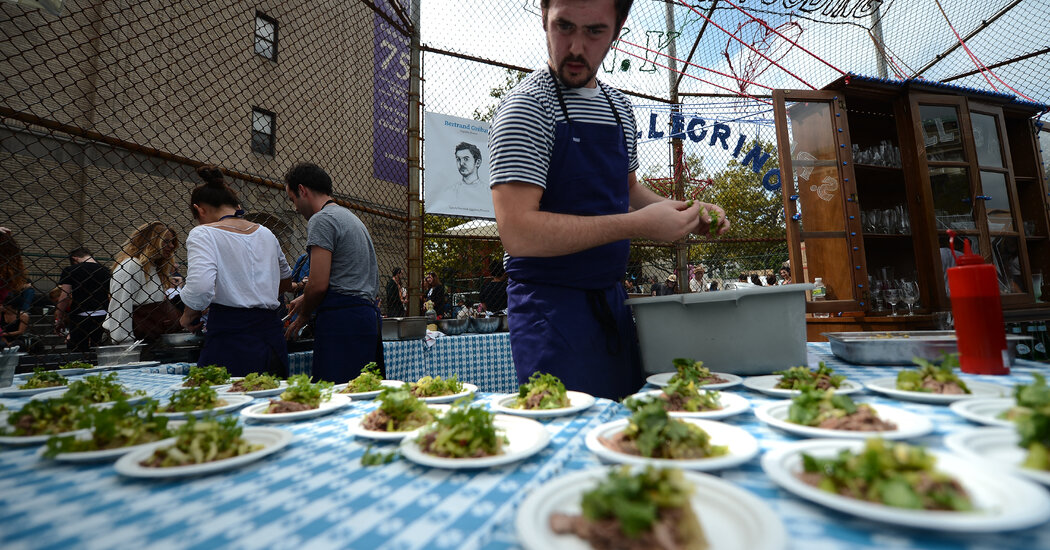
Bertrand Grébaut, the influential French chef whose acclaimed restaurant Septime bridged the gap between formal haute cuisine and traditional bistro fare, died on Thursday in Paris. He was 44.
Théophile Pourriat, his business partner, announced the death on the restaurant’s Instagram page. Mr. Grébaut learned last fall that he had cancer and had scaled back his activities.
The two men opened Septime in 2011, naming it after the tyrannical restaurateur character Monsieur Septime, who was played by Louis de Funès in the 1966 film comedy “Le Grand Restaurant.”
The restaurant arrived at a time when some leading American chefs were experimenting with farm-to-table offerings in casual settings, but French restaurants were largely stuck in their old ways.
Mr. Grébaut belonged to a generation of young chefs in France who decided to shake things up. He chose a neighborhood in the 11th arrondissement on the Right Bank that was a bit off the beaten path for tourists and many Parisians used to the well-known restaurants, brasseries and cafes of the Left Bank.
“Moving there was a no-brainer,” Mr. Grébaut said in an interview, adding that he had trained at upscale Left Bank restaurants “serving people who didn’t look like me.” He loved his new neighborhood, where he said he found “energy,” “creative freedom” and “a more open-minded and activist population.”
Septime featured a minimalist look of polished concrete floors and rough wooden tables, with a vibe more Scandinavian than French.
It immediately catapulted to fame, garnering praise for the way it had created dynamic French cuisine with a limited menu outside the confines of expensive white-tableclothed dining rooms.
Never an easy restaurant to get into, Septime became more difficult to book after it was awarded a Michelin star in 2014. (Beyoncé got a table.)
“In France, change is often met with resistance, but Bertrand was a pioneer,” said David Lebovitz, the Paris-based American cookbook author who lives on the same street as Septime. “I remember eating at Septime when it first opened, and I knew right away that he had the talent and gravitas to do the right thing at the right time. He combined proteins and vegetables and herbs in ways that changed the trajectory of French cooking.”
Mr. Grébaut was born in Paris on Dec. 5, 1981, to Christian Grébaut, a corporate executive, and Catherine Arteau-Grébaut, an art historian.
Initially, Mr. Grébaut did not plan to become a chef. But he had always loved good food. “My mother cooked a different dinner every night, and part of my family are winemakers in the Bordeaux region,” he once said.
In high school, he became passionate about graffiti — which he said he engaged in illegally in Paris — and enrolled at Penninghen, a Paris art school, to become a freelance graphic designer. He found that world boring, he said.
He and Mr. Pourriat, a teenage friend, were sharing an apartment and would explore Paris restaurants together. “We thought about nothing but food,” they wrote in a book published on the 10th anniversary of Septime. “We talked about it day and night.”
Mr. Pourriat began working as a waiter, while Mr. Grébaut enrolled in the Ferrandi Paris culinary school. Though he was at first terrified, he soon excelled.
His internships were challenging. His first one, at the Hotel Scribe, “was in an old-school kitchen brigade where I was spoken to rudely and assigned the most menial tasks,” he recalled in an interview. “I came very close to quitting, but I gritted my teeth and pushed through.”
Mr. Grébaut was transformed by a stint with the chef Alain Passard at L’Arpège, the three-star Michelin restaurant devoted to vegetable-oriented cooking.
“It’s where I learned the most and where I realized that I had more affinities with a fruit and vegetable-oriented cuisine than the technical cuisine that you often find in luxury hotels,” he once told an interviewer. He added, “My vision of my profession is one of pleasure and not of brash spectacle.”
In an interview, Mr. Passard said, “He was so curious, always, always, always, with both fantasies and poetry in his creations. He had a passion for nature, for the seasons. I would dare to call him a visionary.”
From L’Arpège, Mr. Grébaut became the chef at L’Agapé, which earned a Michelin star in 2009 while he was working there. Then, seeking inspiration, he and his partner, the chef Tatiana Levha, traveled in Asia for several months.
Septime came after that as “the kind of restaurant where we would want to eat as customers,” he said.
After its success, he and Mr. Pourriat created La Cave Septime, which specialized in high-quality natural wines; the walk-in seafood bar Clamato; and the pastry shop Tapisserie, famous for its chocolate-caramel and fleur de sel tartlets, maple syrup tarts and apple cakes, all in the same neighborhood.
In 2018, they opened the inn and guesthouse D’une île, in a converted 17th-century farmhouse they restored in the Perche region.
Mr. Grébaut resisted the star status of so many chefs and avoided social media and brand licensing. In an interview, he once gave the following advice: “I encourage the public and clients to restart taking pleasure in the moment shared around a table and stop consuming photos.”
Mr. Grébaut is survived by Ms. Levha; their two children, Anna and Roman; and his mother. Ms. Levha and her sister Katia run Le Servan, a bistro, and Double Dragon, which highlights Asian cuisine.
In announcing Mr. Grébaut’s death, Mr. Pourriat said that the establishments would remain open, except for a three-day pause for a funeral.
Dining and Cooking