

SINGAPORE – In the iconic 1961 film Breakfast At Tiffany’s, protagonist Holly Golightly (played by actress Audrey Hepburn) finds a sanctuary in Tiffany & Co.
The film begins with her munching wistfully on a danish in front of the luxury jeweller’s Manhattan store, following, presumably, a walk of shame. Hepburn does not physically return much to the store – nor does she actually eat breakfast inside it – yet her association with the American brand was forever sealed.
The movie sold a dream of aspiration and elegance to young girls everywhere. Never mind that when Golightly eventually finds her happily ever after, she leaves not with a piece of Tiffany jewellery. It is what the store symbolises for her – a happy place in times of loneliness and self-doubt.
And it is precisely that emotional connection and notion of refuge that Tiffany & Co wants to provide, according to president and chief executive Anthony Ledru, particularly with its newly revamped flagship store at Ion Orchard.
After a months-long renovation, the triplex boutique reopened in June with rooms dedicated to watches, fine jewellery, engagement rings, high jewellery and more. On its top floor is the first Blue Box Cafe in South-east Asia.

The facade of Tiffany & Co’s Ion Orchard triplex store.
PHOTO: TIFFANY & CO
Sharply outfitted in a navy suit, the Frenchman settles into an armchair in a private salon in the high jewellery section of the store. Exclusive to VICs – or very important clients – the room, fashioned like a gentleman’s library, is concealed from the rest of the boutique.
The triplex is a “lighthouse at the intersection of exceptional art, craft and hospitality”, he tells The Straits Times in an exclusive interview.
“There’s only one thing that makes us win: You have to have beauty as your North Star. Everything that we do has to have beauty. We ask: ‘Do we offer our clients something they won’t find anywhere else?’”
Ties that bind
Founded in 1837, Tiffany & Co has an unlikely history with Singapore.
One of its star designers, legendary French jewellery designer Jean Schlumberger, was documented to have visited the city. Undated photographs taken by Luc Bouchage, his life partner, showed visits to the Singapore Botanic Gardens and Raffles Hotel.

The Singapore Botanic Gardens by Luc Bouchage.
PHOTO: THE JEAN SCHLUMBERGER & LUC BOUCHAGE COLLECTION
New York City-based Schlumberger, whose career was synonymous with the brand, “was just a pencil” – more artist than jeweller, says Ledru.
It was quite unusual for a jewellery brand to rely on an individual, but Schlumberger’s artistry was worthwhile, Ledru adds. He dreamt “in a way that you cannot achieve if you stay in New York”.
Tiffany could have been successful focusing on just its domestic market, but chose to participate in world fairs in Paris, winning the top prize for high jewellery in the late 19th century, says Ledru, who was appointed to helm the brand after it was acquired by French luxury conglomerate LVMH in 2021.
Likewise, Schlumberger did not stay much at home. He spent more than six months a year travelling, drawing inspiration from all corners of the globe – from his second home in Guadalupe, a French island group in the southern Caribbean Sea, to North America to Asia.
He frequented South-east Asia, particularly Singapore, Cambodia and Thailand. Given Schlumberger’s fascination with nature, Ledru reckons he was probably taken with Singapore’s rich wildlife.
“I had a long run this morning after landing and hearing the birds was just incredible,” he says, recalling how on a trip to the city 15 years ago, work on Marina Bay Sands and Gardens by the Bay was just starting.
“Everything grows here in probably a matter of months. If you were to stop life in Singapore, I think it would become a forest in a year. His source of inspiration was fauna and flora, the colours, the green.”
He estimates that the undated photographs of Schlumberger in Singapore had been taken in the 1970s or 1980s.

The Raffles Hotel by Luc Bouchage (left). A 1991 advertisement Tiffany & Co ran (right) in The Straits Times to announce the opening of its Raffles Hotel store.
PHOTOS: THE JEAN SCHLUMBERGER & LUC BOUCHAGE COLLECTION, TIFFANY & CO
Not long after, in 1991, Tiffany & Co opened its first store in Singapore at the Raffles Hotel as part of the hotel’s $160 million facelift and extension. Schlumberger died just a few years before, in 1987 – but he would have probably liked to see it, adds Ledru somewhat ruefully.
The Raffles Hotel opening was a landmark occasion for the brand, then privately owned. It was one of the first international luxury jewellery brands to enter the Singapore market, following players such as French jeweller Cartier.
What did the company see in the market then? “It was the only place to be,” says Ledru matter-of-factly. “It was the centre of connection between Singaporeans, I imagine, and business people from all over the world. It was the best outlet possible.”
Strategy to elevate
Before it closed in 2017, the store was a feat, a sprawling 2,000 sq ft boutique that signalled Tiffany’s faith in Singapore at the end of the early 1990s recession in the US. The clientele then was likely mostly locals, he figures.
Past reports recount that the store carried a variety of products – from clocks and pens to baby gifts, handbags, scarves and fragrance. And taking prime spot was sterling silver, crafted into an array of home accessories and fine jewellery.
The Ion Orchard boutique no longer carries these categories, but this is merely the brand’s show of moving with the times. “(These are) part of our history, but we are returning to the best years of Tiffany,” Ledru says, referring to the 19th century, as well as the 1960s to 1990s.

Anthony Ledru, president and chief executive of Tiffany & Co, at the brand’s Ion Orchard store on July 6.
ST PHOTO: GAVIN FOO
Those years were “a world of sophistication and exclusivity”, he adds. Back then, clients would receive a blue book – a high-end jewellery catalogue first published in 1845 – that showcased gold, diamonds, Schlumberger designs and high jewellery.
“Our founder (Charles Lewis Tiffany) had one saying: ‘Beautiful design makes a beautiful life.’ Beautiful design creates uniqueness and we went back to unique designs – the world of Schlumberger, Bird on a Rock,” he says, referencing the designer’s 1965 creation of a bird perched on a precious stone that has become a house icon.
Bird on a Rock is one of six Icons or product lines – the others are Lock, T, Knot, HardWear and Sixteen Stone – that are interpreted across fine and high jewellery for today’s customers.
Tiffany has in the past adapted its product strategy to global market performance. It once leant into corporate gifting and, in times of recession, emphasised affordability and mass merchandising.
These days, however, the brand is eyeing high-net-worth clientele – by way of a stronger focus on high jewellery and creating “objects our VICs would like to acquire”.

Jewellery on display at Tiffany & Co’s Ion Orchard store on July 6.
ST PHOTO: GAVIN FOO
High jewellery has been the fastest-growing category in the last five years, in Singapore and globally, says Ledru.
“The share of high jewellery in Singapore is one of the highest in the world, not just for Tiffany. Some markets are more about the stones, less about design; Singapore is both.”
And so the brand has responded by giving VICs what they want, in terms of “unique stones and narratives”. The house acquired a rare selection of 35 pink argyle diamonds and the Tiffany Muzo Emerald, regarded as the finest emerald sourced from the Muzo mines of Colombia.
Where it differs from other jewellery houses is in how it themes its annual high jewellery collection, named Blue Book after that seminal catalogue, around its history.
It most recently honoured American horticulturalist and heiress Rachel Lambert “Bunny” Mellon, one of the wealthiest women in the world in the 1960s and a muse of Schlumberger, who introduced him to New York’s high society.

Bunny Mellon and Jean Schlumberger.
PHOTO: OAK SPRING GARDEN FOUNDATION/LUC BOUCHAGE
The 2026 Blue Book collection by chief artistic officer Nathalie Verdeille was built around the theme Hidden Garden, drawing references from Mellon’s gardens at her Oak Spring estate in Upperville, Virginia, and the pieces she commissioned with Schlumberger during their friendship. Prices for high jewellery start at five figures.
“It’s all about elevation,” Ledru says.
Did this new strategy arise from the LVMH acquisition?
“What I will say is you need to have a lot of resources to really make that transformation a success. You have to acquire the best stones in the world, invest in workshops, build stores that are at a different level and create experiences for your clients.
“That’s what LVMH is bringing to the table – but frankly, it’s a strategy I think I would have followed, being part of LVMH or not.”
Tiffany played at both ends of the price spectrum for some time, he clarifies, but that was confusing for clients. “We still have products below $1,000 or $500 – but you can’t be everything for everyone.
“We have an average retail price that is much higher today than what it used to be five years ago – because there is craft and uniqueness in design. I believe we made a clear choice to focus on who we are and it’s been doing quite well for us the past few years.”

Tiffany & Co ambassadors Anne Curtis-Smith and Win Metawin at the reopening of the Ion Orchard store.
PHOTO: TIFFANY & CO
Building Landmarks
The last part of its elevation strategy is building beautiful stores modelled after The Landmark, its flagship store at the corner of 57th Street and Fifth Avenue in Manhattan. The store, established in 1940, reopened in April 2023 after extensive renovations that lasted nearly four years.
The blueprint for future stores, The Landmark is a towering 10-storey building with a dedicated high jewellery floor and a penthouse with four private salons open only to VICs. It also houses a workshop where visitors can watch master artisans handcraft jewellery behind glass.
“Stores for us are cultural destinations. They are the ultimate reincarnation of the brand and where you can really establish an emotional connection,” says Ledru.
Most of the artworks in the Ion Orchard store are bespoke, adds Ledru, who had a hand in selecting them. These include a sculpture by American artist Daniel Arsham – whom Tiffany has collaborated with since 2021 – and a painting by English artist Darren Almond.
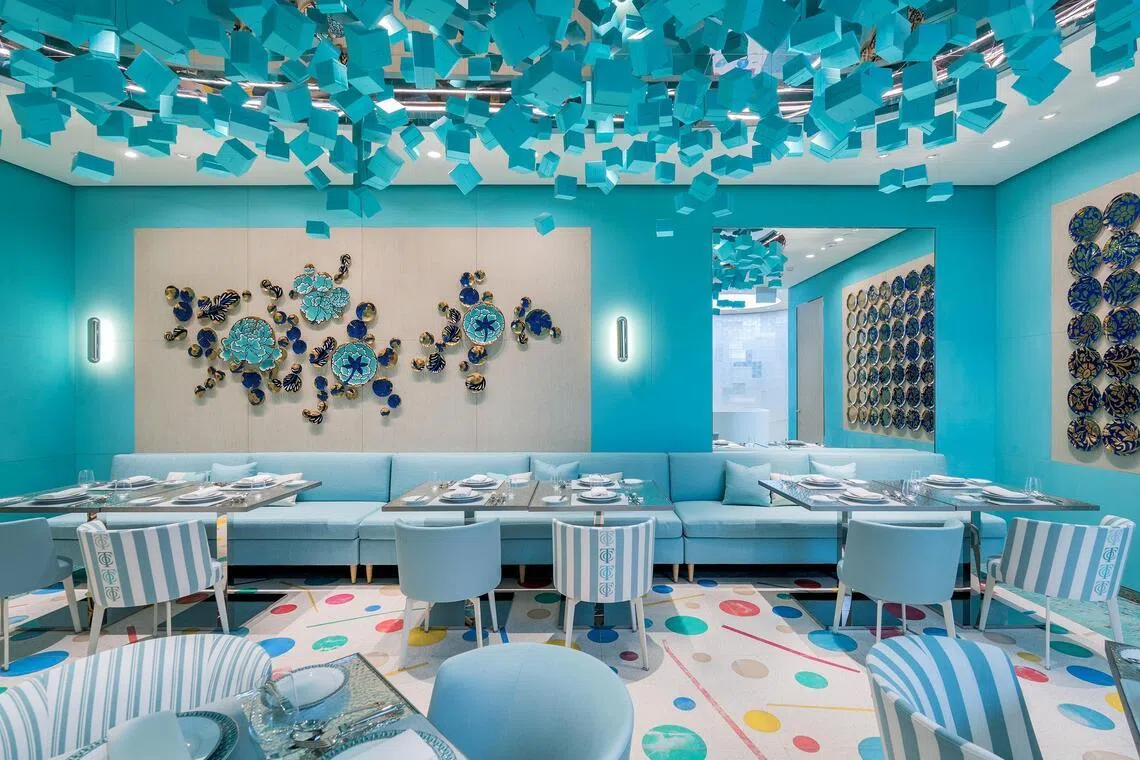
Blue Box Cafe at Ion Orchard Singapore.
PHOTO: TIFFANY & CO
The Landmark in New York also houses a Blue Box Cafe, run by French chef-restaurateur Daniel Boulud.
Singapore’s Ion Orchard store is home to the first Blue Box Cafe in the region, which will open in mid-July. Chef-owner Julien Royer of three-Michelin-starred Odette at the National Gallery Singapore was chosen to head the endeavour.
“We didn’t pick him because he is French,” says Ledru, who described the menu as “very localised, but with a touch of the West”. “We picked him because he is the best chef in Singapore, the most successful.”
Dishes include Confit Yellow Chicken ($48), an interpretation of chicken rice cooked claypot-style; Alaskan Spot Prawn “Dumpling” ($34), which reimagines a ravioli elevated with prawn noodle broth; and Tiffany Burger ($34).
The highlight will surely be the Breakfast at Tiffany’s set, available from 10am to 11.30am, at $78 a person.
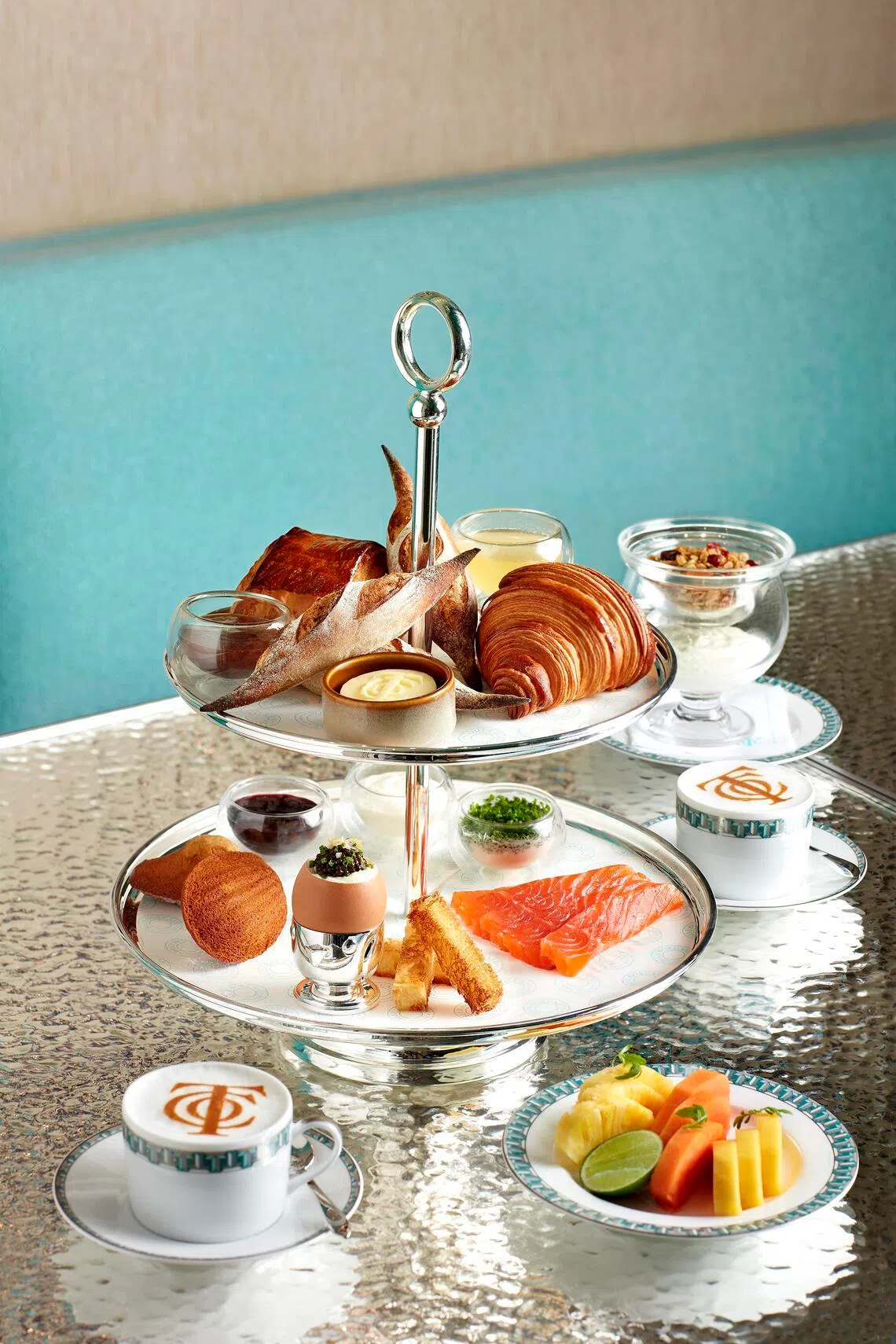
Breakfast at Tiffany’s at Blue Box Ion.
PHOTO: TIFFANY & CO
Served on a two-tiered silver stand are seasonal fruit, housemade granola, a coffee and croissant breakfast comprising viennoiseries and baguettes, smoked trout, as well as Oeuf a la Coque: soft-boiled eggs with a dollop of Oscietra caviar.
For afternoon tea, there is a Tea at Tiffany’s set ($98 a person, from 2.30pm to 5.30pm) – comprising tea sandwiches, potato millefeuille with caviar and creme fraiche, a wagyu cecina roll, and pastries and cakes served on three tiers.
Ledru expects the cafe to be an “extraordinary daily destination”, sitting in between a high-end restaurant and day-to-day cafe. “You don’t go to Odette every day – you might, not sure if you have the time and the appetite; but better to preserve it for exceptional reasons. The Blue Box Cafe is something you can do several times a week.”
“Some may just have lunch and not visit the store. I believe that if we do our job the right way, they will spend time in the store – because there is storytelling in the cafe. You have breakfast, lunch and dinner every day – that’s three opportunities to connect with your client,” he adds.

Anthony Ledru believes Tiffany & Co’s Blue Box has an edge over other luxury cafes as dining with the brand is part of its DNA.
ST PHOTO: GAVIN FOO
Asked if he sees the cafe – part of a booming trend of fashion brands opening designer cafes – as the answer to sluggish retail, Ledru replies: “We’re the only jewellery brand with a cafe and we’re legitimate because it’s part of our DNA. Almost everyone wants to have breakfast at Tiffany’s.”
Cafes, he adds, allow the brand to bring another dimension and level of connection with the clients.
“When you share a moment of life – talking about hobbies, your kids, your job – it goes beyond just talking about jewellery and a retail transaction. If you really want to establish trust, what’s better than sharing a meal?”
With a wink, he adds: “Remember what Audrey Hepburn said: Nothing bad can happen at Tiffany’s.”
Dining and Cooking