
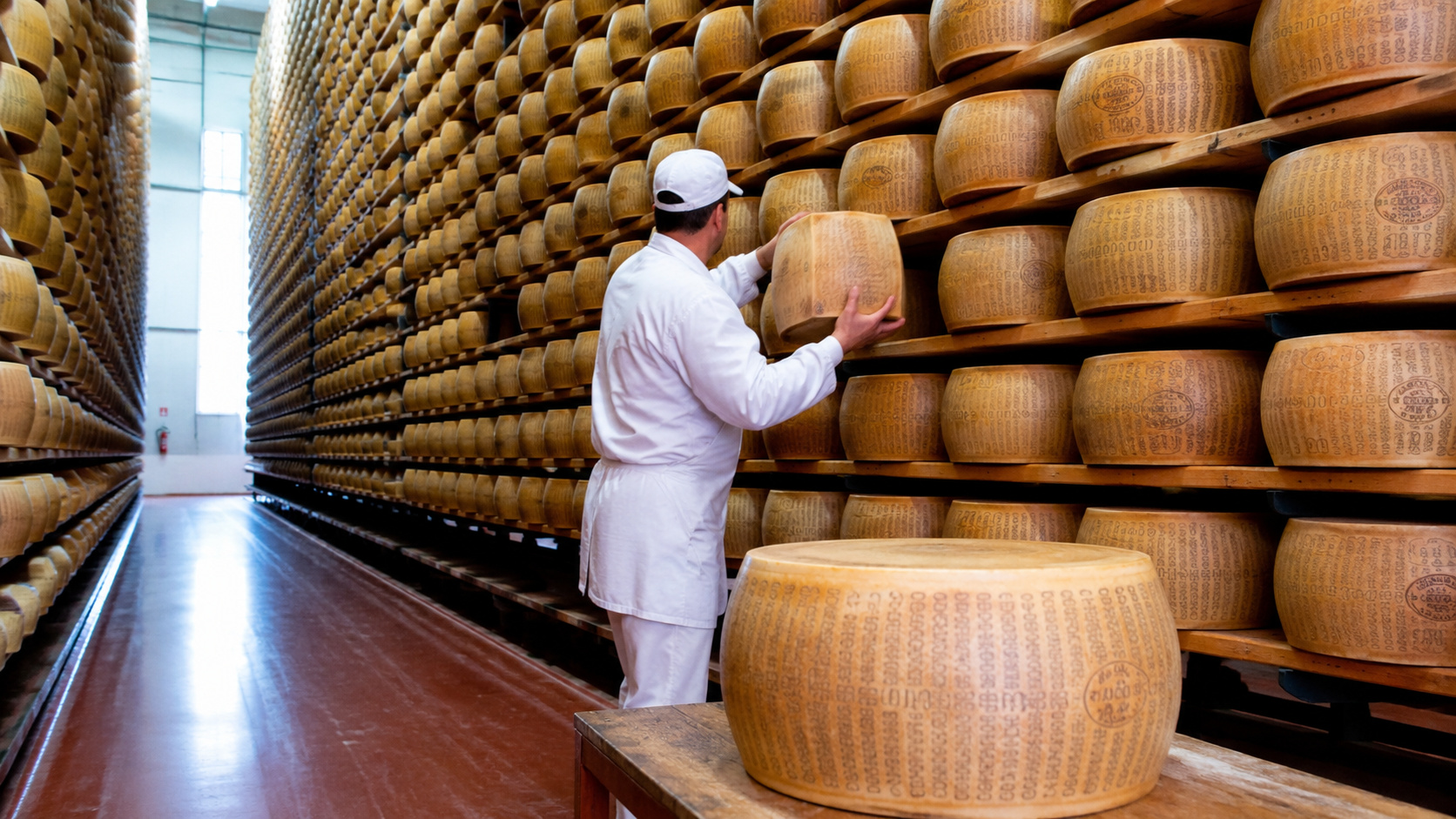
Extreme heat reduces milk production, pressures cooling costs, and threatens one of Italy’s most well-known food traditions
The heatwaves recorded in Italy are directly affecting the production of the traditional Parmigiano Reggiano.
Temperatures above 40 °C cause cows to eat less, lie down more, and produce less milk.
This combination worries producers, manufacturers, and warehouse managers responsible for aging the cheese.
ARTICLE CONTINUES BELOW
See also
Buying a piece of land in the countryside has become one of the best businesses in Brazil: the price of rural land has skyrocketed, rising by 113% in five years, becoming an increasingly coveted asset for producers and investors.

An old farmer arrived with little capital and a few belongings, traded coffee for durian, and became a billionaire with a 13-hectare orchard.

Rural tourism has become one of the fastest-growing segments in Brazil: instead of tearing down history to plant, families in the countryside open their gates and profit by welcoming visitors who seek nature and the peace of the countryside.

Brazil trains only 53,000 technology professionals per year, but the market needs 159,000, and this gap creates a deficit of 106,000 talents per year in a sector that accounts for 6.5% of the GDP.

The Parmigiano Reggiano industry generates approximately 4.5 billion euros per year and supports thousands of jobs in Italy.
Reuters, in a report published on July 13, 2026, showed how extreme heat has started to pressure the entire production chain.
Heat above 40 °C reduces milk production by up to 10%
About 50 years ago, farmers in the Emilia-Romagna region would open barn windows only during summer nights.
Currently, these same windows remain open 24 hours a day.
This measure helps protect cattle from the record temperatures hitting the region.
According to Nicola Bertinelli, president of the Parmigiano Reggiano Consortium, the heat affects the quality and quantity of milk.
Cows spend more time lying down during the hottest periods.
The animals also reduce their food intake.
In this scenario, milk production can drop by up to 10%.
The impact is concerning because Parmigiano Reggiano uses only three ingredients:
Raw cow’s milk;
Salt;
Rennet.
Any reduction in milk supply directly interferes with the production pace.
 Dairy cows receive water misting in a barn, a measure used to reduce the effects of extreme heat on animal welfare and milk production.
Lack of rain compromises grass and hay production
Authentic Parmigiano Reggiano can only be produced in five Italian provinces.
Most of these areas are located in Emilia-Romagna.
The cows must consume exclusively grass and hay grown within the authorized region.
Prolonged periods without rain therefore represent another threat to the production chain.
According to Bertinelli, the lack of water prevents proper grass growth.
The absence of grass hinders hay production.
The problem also reduces the amount of milk available for cheese production.
Fans and misters drive costs up
Producers have installed fans and water misting systems to lower the temperature inside the barns.
These measures help protect the animals during the hottest days.
However, the continuous use of the equipment significantly increases electricity consumption.
Expenses have also risen in the warehouses where the wheels remain during the maturation process.
Parmigiano Reggiano needs to age for at least 12 months.
Some wheels remain stored for three years or more.
The facilities need to maintain controlled temperature and humidity throughout this period.
More than 500 thousand wheels are stored in climate-controlled warehouses
More than 500 thousand wheels of Parmigiano Reggiano are stored in two large specialized warehouses.
The stock is valued at over 300 million euros.
The warehouses are operated by Magazzini Generali delle Tagliate, a unit linked to the Credito Emiliano bank.
The structures are located in the provinces of Reggio Emilia and Modena.
According to director Giancarlo Ravanetti, daily energy consumption increased by approximately 30% during the heat peaks of 2026.
The company modernized the refrigeration systems and boilers to improve energy efficiency.
The insulation of the buildings also received improvements.
Renewable energy generation was expanded to reduce pressure on costs.
Technology and tradition protect the quality of the cheese
The climate-controlled warehouses became collectively known as the Bank of Parmigiano.
These facilities combine modern technology and traditional inspection methods.
Each wheel undergoes rigorous quality controls during the maturation process.
X-ray examinations help identify possible internal defects.
Experts also tap small hammers on the pieces and analyze the sound produced.
The sound evaluation allows detecting flaws that may arise during aging.
Ravanetti states that human work remains essential to ensure the final quality of the product.
Exports represented more than half of sales in 2025
Exports accounted for more than 50% of global sales of Parmigiano Reggiano in 2025.
The United States remained the main international market for the Italian cheese.
According to Paolo Ganzerli, international sales director of GranTerre, more intense climate events could further increase costs.
Longer heatwaves could also affect the quantity and quality of milk.
GranTerre recorded consolidated revenue of 1.87 billion euros in 2025.
The rise in temperatures can affect producers, manufacturers, exporters, and consumers.
What could happen to Parmigiano Reggiano in the coming years?
Parmigiano Reggiano has existed for more than 800 years and represents one of Italy’s most well-known food traditions.
The heatwaves show that even processes preserved for centuries can face difficulties in the face of extreme temperatures.
Producers now need to balance tradition, technology, and rising costs to maintain production.
Ganzerli summarized the sector’s concern with a direct statement:
“We don’t want to be the last generation to eat this cheese.”
Do you believe that technology will be able to protect Parmigiano Reggiano or could extreme heat permanently transform this Italian tradition? Share your opinion!
Dining and Cooking