
Feed Intake Down in Dairy Cows… Milk Production Drops by Up to 10%
Cheese Storage Facilities See 30% Surge in Electricity Use Amid Heatwave
Concerns are growing that the production of Parmigiano Reggiano cheese, commonly known as ‘Parmesan cheese’—a key ingredient in pasta and pizza—may be disrupted due to the heatwave sweeping Europe. As droughts and damage from pests and diseases intensify from the effects of climate change and El Niño, a state of emergency has emerged across the global agriculture and livestock industries.

The photo is not related to the specific content of the article. Pixabay
View original image
Milk Production Drops, Cooling Costs Surge… Red Alert for Cheese Production
On July 14 (local time), the UK’s Independent and Reuters reported that production is facing significant challenges due to the extreme heat in Italy’s Emilia-Romagna region, the primary production area for Parmigiano Reggiano.
The main ingredient of Parmigiano Reggiano is milk. This cheese is produced only in five designated regions, including Emilia-Romagna, and the dairy cows must be fed grass and hay harvested from these same regions.
According to the local environmental agency, last month recorded the second-hottest June since 2003. At the end of the same month, the flow rate of the Po River, which runs through the area, plummeted from about 1,000㎥ per second to below 300㎥ per second in just two weeks. The ongoing heat and lack of rainfall have also led to difficulties in producing hay, which is essential for feeding cattle.
Nicola Bertinelli, president of the Parmigiano Reggiano Consortium, stated, “If it doesn’t rain, the grass doesn’t grow, and we can’t produce hay. As a result, it also becomes difficult to secure the milk required for cheese production.” It is known that when temperatures exceed 40 degrees Celsius, dairy cows eat less feed, causing milk production to drop by up to 10%.
Production costs are also rising rapidly. A representative from Magazzini Generali delle Tagliate (MGT), a cheese storage warehouse operator, commented that during the peak of the heatwave, daily electricity consumption was about 30% higher than usual. With both cooling and raw milk production costs soaring, some in the industry have expressed concerns that “we may be the last generation to enjoy cheese.”
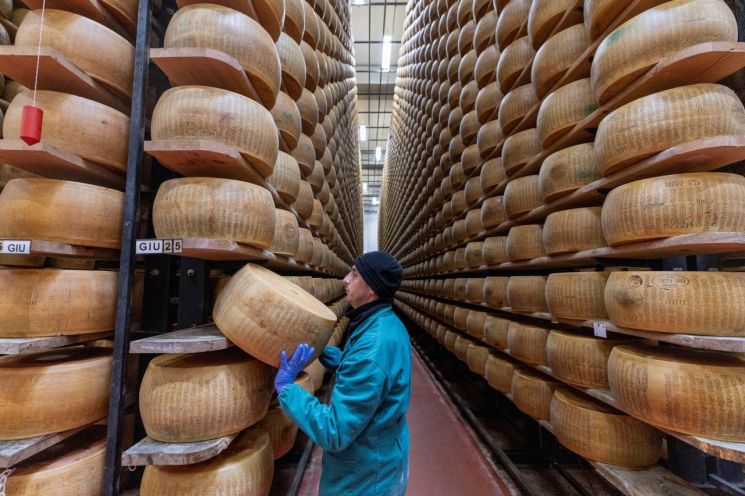
An employee managing Parmigiano Reggiano aging in an Italian cheese storage. Photo by Reuters Yonhap News Agency
View original image
From Rice to Coffee and Cocoa… Global Food Production Falters
The combination of climate change and El Niño is putting global food production at risk. In a report published last month, the US National Oceanic and Atmospheric Administration (NOAA) announced that El Niño has already begun this year. Sea surface temperatures in the tropical Pacific are now more than 2 degrees Celsius higher than average, with a 63% probability of developing into a ‘super El Niño.’
El Niño refers to a phenomenon where the sea surface temperature in the equatorial Pacific remains at least 0.5 degrees above average for several months. When this temperature deviation exceeds 2 degrees, it is referred to as a ‘super El Niño’ or ‘Godzilla El Niño.’
The impact of El Niño is already being felt in many places around the world. In June, India—the world’s largest rice exporter—experienced monsoon rainfall about 40% below average. Southeast Asia is also expected to see reduced palm oil production and declining coffee and cocoa harvests due to drought.
Hot Picks Today

“KOSPI Faces Record Volatility Amid Doubts Over Semiconductor-Only Dominance”
Italy’s UniCredit Bank has projected that if an extreme El Niño occurs, global agricultural output could decrease by up to 14.3%, resulting in economic losses of 342 billion dollars (about 508 trillion won).
This content was produced with the assistance of AI translation services.
© The Asia Business Daily. All rights reserved. Unauthorized AI training and use prohibited.
Dining and Cooking