
Breadcrumb Trail Links
Travel GuideTravelTravel International
The highlights of the country’s scenic North Island aren’t always the ones you expect
Published Jul 13, 2026 • 5 minute read
 New Zealand’s scenic Huka Lodge, with its lawns rolling down to the Waikato River is where Queen Elizabeth II stayed not once, but four times. Photo by George ApostolidisArticle content
Reviews and recommendations are unbiased and products are independently selected. Postmedia may earn an affiliate commission from purchases made through links on this page.
The mist comes first. Curling off a fast-moving river into air thick with fern and towering cypress, it gives the whole scene a prehistoric quality, as though something brontosaurusy might emerge from the far bank at any moment. Standing on the veranda of Huka Lodge in my bathrobe, tea in hand, I decide this is the most exquisite morning view I’ve ever had.
I bet the Queen of England would have agreed. Elizabeth II stayed here four times, and with its manicured lawns rolling down to the Waikato River, the hidden dining nooks, the general sense that the world has been tastefully muffled, it’s not hard to see why. Balmoral, it is not. But it is, unmistakably and only, New Zealand.
Article content
Article content
Advertisement 2
This advertisement has not loaded yet, but your article continues below.
Article content
 Morning mist coming off the Waikato River at Huka Lodge. Photo by Jody Robbins
New Zealand has a way of doing that — pairing things that shouldn’t work together but somehow do. Wild and refined. Adrenalin and stillness. I’d come to the North Island chasing wine and outdoor adventures. What I found was that New Zealand doesn’t make you choose between what you came for and what finds you. It hands you both.
Two amazing day trips out of Auckland
My trip begins, as many good things do, with a boat and wine. Waiheke Island sits 35 minutes by ferry from downtown Auckland, and the crossing through water so turquoise it looks artificially enhanced, allows me to decompress after my 13-hour Air New Zealand flight.
The island has no traffic lights, four villages and 27 boutique wineries spread across 92 square kilometres.
“We drink all the wine we produce here — with your help,” says Grant, my guide from Ananda Tours. The island, rimmed with white sand beaches, runs three degrees warmer than the mainland with less rainfall. We day-trippers and the grapes love it.

Travel Time
Thanks for signing up!
Article content
Advertisement 3
This advertisement has not loaded yet, but your article continues below.
Article content
At Casita Mira, a Mediterranean-inspired lunch arrives alongside a flight of wines, and by the third glass, that transpacific flight feels like someone else’s problem. New Zealand produces just 1.5 per cent of the world’s wine, and Waiheke produces a disproportionate share of reasons to stay for another round, but I need to move on. There are kiwis to find.
Spotting kiwis, those adorable flightless birds found nowhere else on earth, in the wild ranks among the world’s top wildlife experiences. How requires some local knowledge, which is why I find myself an hour north of Auckland in Tawharanui Regional Park, with Auckland and Beyond Tours.
After 40 minutes of walking under a half moon, the trail lit by our red flashlights, we hear rustling in the bush. I catch a glimpse of that telltale, long, curved beak probing deep into the soil before it scurries into the undergrowth. We’re rewarded with four more kiwi sightings, each one resembling a large grey chicken going about its business.
Advertisement 4
This advertisement has not loaded yet, but your article continues below.
Article content
A volcanic landscape that’s very much alive  Visitors soak in mineral-rich geothermal pools at Polynesian Spa in , where steaming springs overlook Lake Rotorua. The spa draws on two natural mineral sources long prized for their therapeutic properties. Photo by RotoruraNZ.com
The next day, I move onto Rotorua, which announces itself with a warm, eggy undertone, a reminder this landscape is very much alive. This is the North Island’s geothermal heartland, and for the Māori people who have lived here for centuries, it’s never been merely a backdrop. It’s a living system, a source of healing, a story told in steam and mud and sulphur-infused mineral water that returns to the earth at the end of each day.
Getting above the forest floor  Mount Tarawera near Rotorua is best viewed from a helicopter. Photo by Graeme Murray
The best way to take it all in, I’m told, is from above. So, I hop into a Volcanic Air helicopter. En route to the Tarawera caldera, the pilot banks low over a waterfall pouring straight out of the middle of a cliff face — lava blew through it and water now flows where rock used to be. We land steps away from the epicentre of that violent 1886 eruption and hike around the scoured basin, the red and grey basalt deposits, a sharp contrast to the emerald forests surrounding Rotorua.
Advertisement 5
This advertisement has not loaded yet, but your article continues below.
Article content
With Canopy Tours, I’m able to explore the forest through an adrenalin rush. I clip into a harness and zip line through a restored forest of theatrical proportions. Guide Jake Hickman stops us at a rimu tree (red pine), approximately 1,000 years old, and explains how, without natural predators, New Zealand’s trees developed what he calls “natural gigantism.” With abundant sunshine and rain, they grow to a scale that makes the forest feel like something from another era.
 Visitors can walk among the treetops with Rotorua Canopy Tours. Photo by RotoruraNZ.com
That scale deepens at The Redwoods of Whakarewarewa Forest, an elevated walkway weaving through six hectares of California redwoods planted in the early 1900s. They grow 10 times faster here than in their native California, and walking among them on swaying suspension bridges, the forest floor far below, I feel like I’m on a Jurassic Park movie set.
As the light fades, I venture into a cave tucked in the same forest. Thousands of glow-worms cast blue-green bioluminescent light across the rock and cave ceiling, twinkling like a planetarium. I walk out blinking, the redwoods rising around me in the half-dark, and stand there longer than I need to, not yet ready to leave the magic.
Advertisement 6
This advertisement has not loaded yet, but your article continues below.
Article content
 The glow-worms cave is the latest attraction at Redwoods Treewalk in Rotorua, New Zealand. Photo by RotoruraNZ.com
Rotorua is best known for its geothermal activity. There are geysers that blow mineral-rich water skyward, mud pools that bubble at the surface and thermal waters that the Māori have used for centuries.
On successive nights, I hit the spas. Wai Ariki, owned by the local iwi (tribe), offers a multi-sensory therapeutic experience based on centuries-old healing practices. After a blessing invoking the gods, the water and the idea that healing moves inward as much as outward, I move through saunas, geothermal pools and a mud room, where I lie on a heated bed as geothermal clay dries before being steamed away. I emerge wrung out in the best possible way.
Back to the river for one last thrill 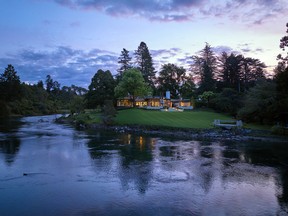 Huka Lodge at sunset. Photo by George Apostolidis
My last few days unwind at Huka Lodge, set on 16 acres along the surging Waikato River. What began as a fishing camp in the 1920s has grown into one of the world’s most celebrated wilderness lodges.
Fly fishing on the Waikato is something of a rite of passage here. Guide Ollie Jones from Chris Jolly Outdoors teaches me to cast, and though I’m no threat to the trout, I begin to understand why anglers fly in from around the world. New Zealand has only around 20 fish per kilometre of river compared to 1,000 in North America, making landing one a real achievement.
Advertisement 7
This advertisement has not loaded yet, but your article continues below.
Article content
 Screaming along the rapids of Huka Falls with Hukafalls Jet. Photo by Epic Shot
Then comes one final shot of adrenalin: a jet boat ripping through the rapids toward Huka Falls, the country’s most visited natural attraction. Huka means foam in Māori, and the name earns itself.
Back at the lodge, I sink into a chaise on the veranda, the jade river rushing past below, a plaid blanket pulled up. New Zealand had been handing me adrenalin and restoration in equal measure all week, and I’d been accepting both without question. Somewhere along the way, I stopped trying to separate them.
Jody Robbins travelled as a guest of Air New Zealand, Rotorua and Beckons, neither of which reviewed this article.
Read More

Hotel staff reveal insider secrets to free perks and upgrades

7 ‘coolcation’ destinations around the world to beat the summer heat
Article content
Share this article in your social network
Dining and Cooking