

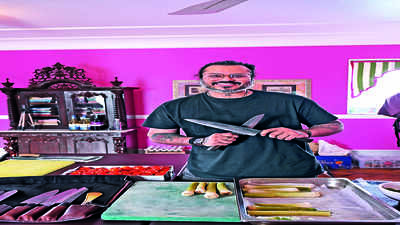
 The Kolkata boy who dreamt of joining the army, played the drums and discovered the culinary traditions of the hills during his boarding-school years, now commands the kitchen with a rockstar swag and the precision of an artist. Chef Priyam Chatterjee isn’t your typical Instagram chef pointing you towards the city’s best biryani. Among chefs, however, he is regarded as one of the most exciting voices in modern Indian cuisine. Knighted by the French government (Chevalier de l’Ordre du Mérite Agricole), recognised by the Michelin Guide and celebrated for marrying Bengal’s culinary memory with French technique, the 38-year-old was in Kolkata at Glenburn Penthouse for his first full-fledged residency. He spoke to CT about home, heritage and why the future of Bengali food lies in understanding its past.
Priyam Chatterjee with Pinky Kenworthy
You’ve cooked around the world. What makes this Kolkata residency special?Priyam: It’s amazing to come back home. I think we’ve kind of traveled all over the world and realised that Gangar jol is fantastic.I’ve never really cooked in Kolkata this way. So it always feels good to come back to your city and cook. More than business, it’s very important that I get to meet a lot of people and cook for a new audience. The food is also as non-conformist as I am. I’ve always believed that as a chef I could cook whatever the heck I want to cook. But if it did not mean anything to you or if you can’t relate to it, then I have failed. Normally my food style is blending French ethos and French techniques with Bengal and the subcontinent. Not fusion, but connecting dots. I’m super excited to be in my element.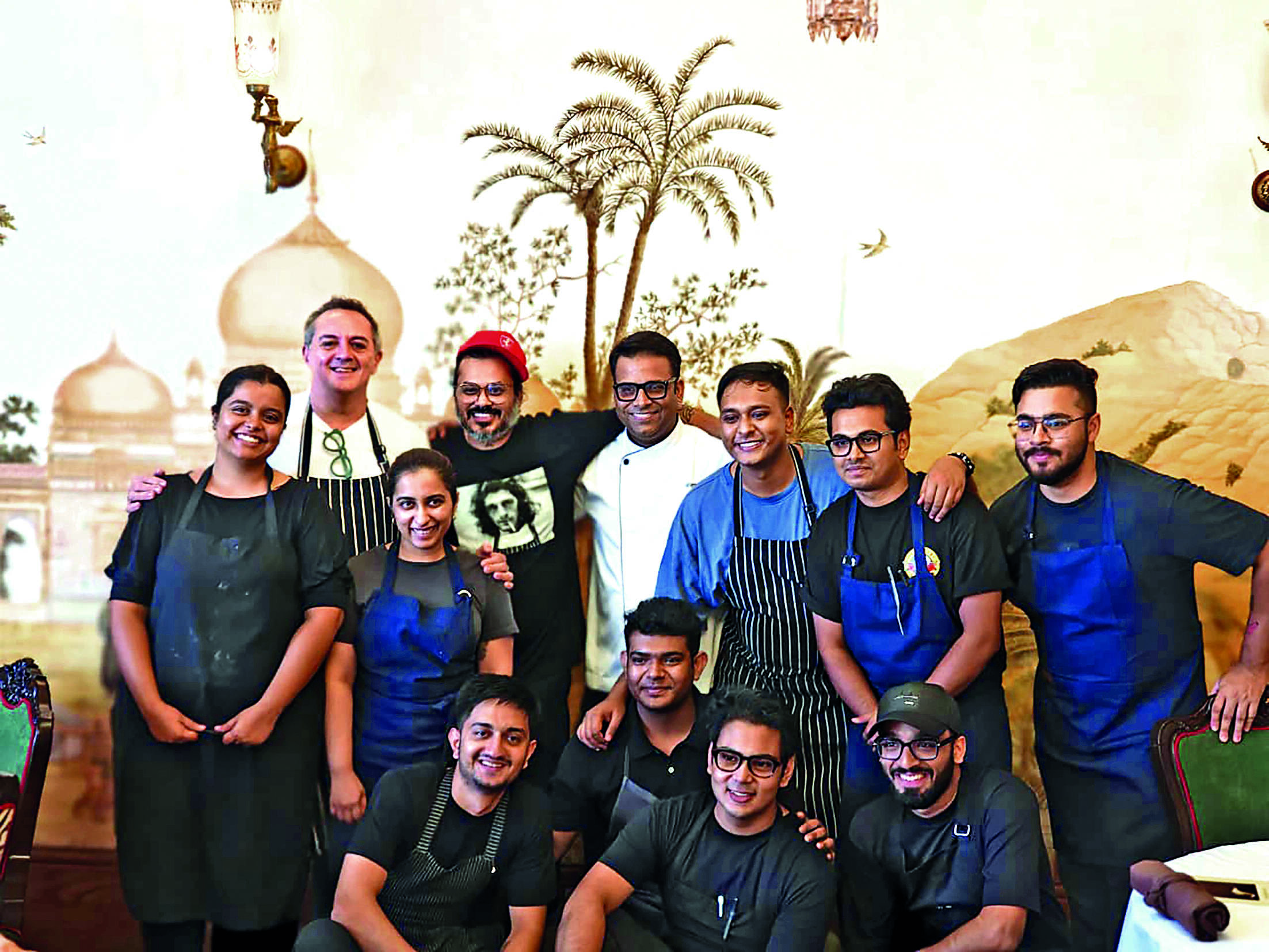
Priyam with his team and Shaun Kenworthy also created a Bistro-style brunch
How important is it for you, as somebody who doesn’t really conform to tradition, to respect tradition yet avoid being trapped by it?Priyam: That’s paramount. I have to know tradition to break it.I’ve told everybody that to even utter the word creativity, you have to first decipher tradition. You have to eat almost everything from your grandmom’s and mom’s repertoire before you can take it forward. I come from a family of exceptional cooks. Then I went to boarding school at Dr Graham’s Home, where I was exposed to farming, gardening, foraging, husbandry, slaughtering and manure. This has been my foundation.When someone asks me about being a chef, I say I’m an artist first who found food as my medium of expression.My mom comes from Noakhali. Dad from Kolkata. My friends from the hills introduced me to Naga food, Garo food and fermented food. I was lucky to be with the right chefs and I fell in love with French cuisine.The knighthood brought me recognition but a conversation with some of France’s greatest chefs fundamentally altered my philosophy. Some three-star chefs told me, ‘Priyam, bravo. If we were the Michelin Guide, you are already two stars. But we are French, you are not. At some point in your life, we would like to see curries, masalas, spices, your home, your roots, your grandmom, your mother. You need to bring them in.’ That conversation changed everything. Priyam’s prized knives are rare pieces crafted in Japan by Samurai families; When asked about travelling with a team of young chefs, he says he believes a mentor leads while a leader protects, adding that taking them along helps build a consistent core team and deliver a consistent experience. Having grown up learning from exceptional chefs, he now passes his learnings on to his team, with whom he hopes to eventually open a restaurant after growing together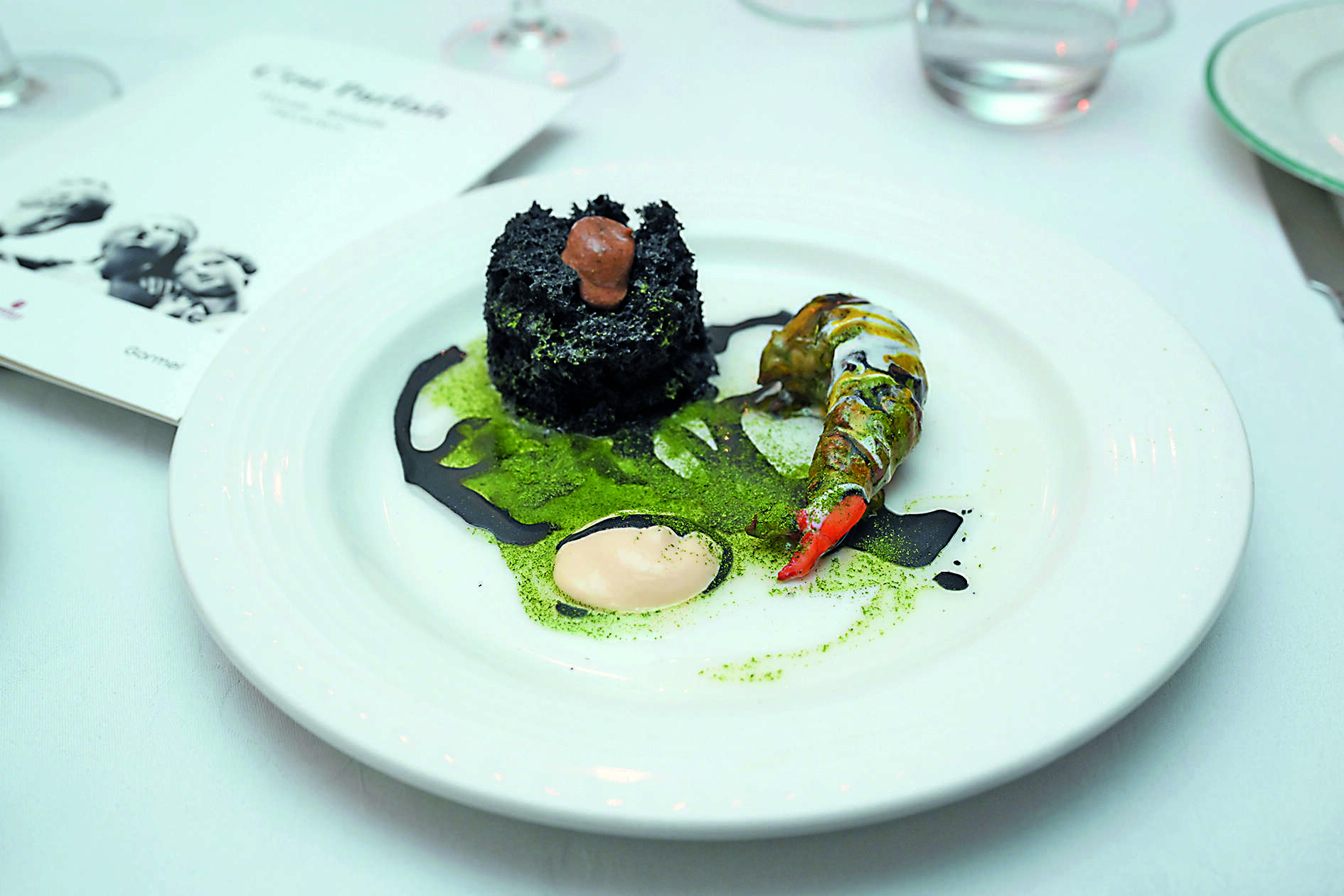
Sunderban prawn,sponge and artistry on the plate
Why is luxury dining in India so focused on imported ingredients and ideas?Priyam: Three hundred years of colonisation has left a huge mark and we are constantly trying to prove something. But we don’t have to prove anything. This country is magnificent. When you’re cooking another cuisine, you should use the best ingredients from where they belong. But I don’t need to put caviar on my menu to prove that I’m a great chef. I can do that with maacher dim also. I don’t need to imitate a Western chef doing nose to tail. My mom cooked every last strand of chingri. We’ve been eating nose to tail from the day we were born. Fine dining is not a statement. Fine dining is an idea. You have to feed that idea, not bask in the statement. 
Dinner began with a tomato, thyme and sable; Crystal, pea and olive mud; foie apricot
Do Bengal and France have a lot in common? Priyam: Once I moved to France and immersed myself in its food culture I realised Bengal and France are remarkably alike in their love for finesse, subtlety and precision.We also share nearly 280 years of culinary exchange. Mustard, fish, rice pudding… there are incredible parallels. When I served French classics with nolen gur, they were blown away. I think it’s time we celebrated and built on this shared culinary history.” 
Mon Suzette: The signature suzette with orange dulce
Chef Priyam’s Bengali tastingIf Priyam had to introduce Bengali cuisine to a first-time diner, this is what he’d serve: Kochu shak, reimagined with a sourdough cracker and pickles Bhuna loita, his pick to showcase Bengali fish. Aloo posto, “the most graceful and subtle way of eating” Dal, bora, aloo bhaja and potol dorma, dishes rooted in childhood memoriesA dessert celebrating gur and caramel, which he believes deserves far greater global recognition
Dining and Cooking