
![A Man in His 50s Put His Medical Career on Hold to Study Wine in France [Reporter Jang Joo-young's Book Travel Book]](https://www.diningandcooking.com/wp-content/uploads/2026/07/news-p.v1.20260724.e9e14e3e77884d00a7e5973d89c3b0ef_R.png "A Man in His 50s Put His Medical Career on Hold to Study Wine in France [Reporter Jang Joo-young’s Book Travel Book]")
What people gain from travel varies from person to person. If there is one common thread, it may be the discovery of a new meaning in life. In Shin Gyeong-han’s “Mid-50s, Studying Wine in Paris,” the author portrays the process of taking on new learning at a turning point in life and expanding the self.
 사진 확대 Photo = Bulkrosby
The author warmly follows a journey that goes beyond sightseeing and instead encourages readers to reflect on themselves in unfamiliar places and fill life with a new perspective.
Mid-50s, Studying Wine in Paris Shin Gyeong-han | Bookcrossby
 사진 확대 Photo = Bulkrosby
Going abroad to study in middle age feels a little, or even very, unfamiliar. For some, it is a time when life is at its peak, and those with children have even less room to breathe. If the person is a doctor, it is even harder to imagine.
Yet the world is full of surprises. Someone actually put this kind of “what if” into action. Internist Shin Gyeong-han left the clinic for a while and headed to Paris to study wine. Most people would ask, “Why bother?” The book “Mid-50s, Studying Wine in Paris” begins with that question. By the time you close the final page, the question changes. It is no longer “Why did he leave?” but rather “Maybe it is not too late for me either.”
 사진 확대 Photo = Bulkrosby
Shin Gyeong-han graduated at the top of his class from Seoul National University College of Medicine and is an internist. He ran a hospital in Jeju and once spent a sabbatical in San Diego, where he studied golf. Then, one day after turning 50, he decided to become a student again. His destination was Paris, and his classroom was the wine program at the world-renowned culinary school Le Cordon Bleu.
This is not a glossy beginner’s guide to wine. Nor is it a technical book that explains the history or grape varieties of French wine. Instead, it reads more like the record of a person who became a student again in an unfamiliar city. He sets aside the familiar title of doctor, prepares for exams, attends classes, faces setbacks, and slowly grows.
That is why the real subject of this book is not wine, but people. As he studies wine, the author often reflects on his own profession as a doctor. Blind tasting resembles listening to a patient’s medical history and making a diagnosis, while distinguishing aromas is similar to careful treatment that does not miss small symptoms. Though the two fields seem entirely different, he comes to realize that what matters most is understanding people.
 사진 확대 Photo = Bulkrosby
“What makes wine, which is nothing more than fermented grape juice, truly great is people.” That line stays with the reader. The book suggests that we remember the person we drank with more than the taste of the wine, and that the conversation from that moment lingers longer than a famous vintage. Travel is much the same, because in the end, people complete the memory more than places do.
He walks through the Louvre Museum, visits vineyards in Burgundy and Bordeaux, and raises a glass in Champagne. At times, he also travels to Amsterdam, Iceland, and Tromsø in Norway. But he does not simply list tourist attractions. Rather than boasting about which restaurant was excellent or which alley was beautiful, he tells readers what he learned there and what he thought.
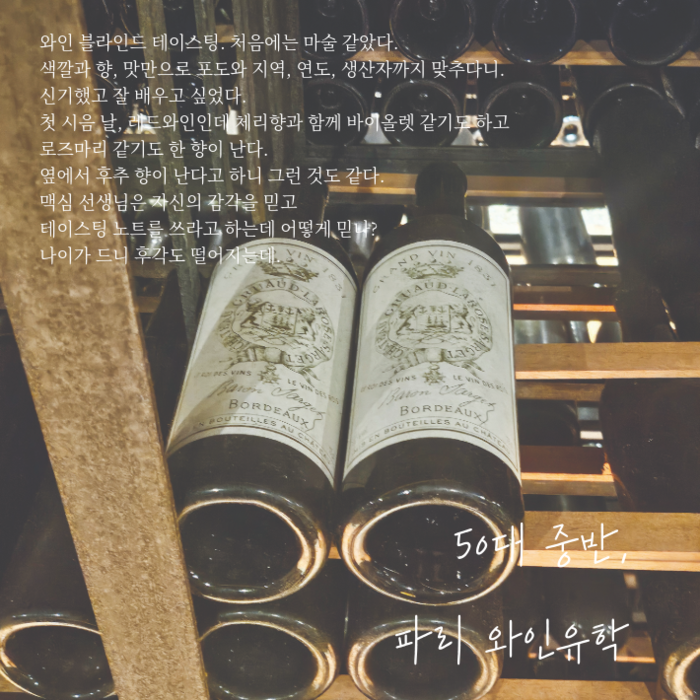 사진 확대 Photo = Bulkrosby
Thanks to that approach, readers do not just consume Paris; they live alongside it. Practical information is also woven throughout the book. It naturally includes Michelin Bib Gourmand restaurants that are easy to visit, tips for local life, and insights into French food culture gained while studying wine. For those preparing a trip, it works as a guidebook. For those who have already been, it becomes a record that brings back the afterglow of travel.
The author’s attitude toward life is also striking. Starting something new after middle age makes anyone uneasy. People worry about falling behind younger students and feel small in front of an unfamiliar language. The author does not hide those moments. He honestly writes about the tension before exams, the slumps, and the loss of confidence. As a result, his challenge becomes not a tale of extraordinary success, but a coming-of-age story that anyone can relate to.
 사진 확대 Photo = Bulkrosby
The book’s central subject, wine, is also handled in an engaging way. Wine is not simply a drink to be judged by taste. It is the result of patience, time, climate, soil, and human hands. People are much the same. In that sense, a well-aged wine and a human life are strangely alike, both shaped by accumulated time and experience.
So this book is both a story about wine and a story about life. As we grow older, we become used to postponing new beginnings. We convince ourselves that things are fine as they are, so there is no need to choose change. But the author became a student again after turning 50, and in an unfamiliar city he learned a new language and a new culture, expanding his life once more.
 사진 확대 Photo = Bulkrosby
What he learned in Paris was not only the aroma and varieties of wine. It was also the courage to let go of familiarity, the joy of learning again, and the belief that it is never too late to begin a new life. Just as a glass of wine develops deeper aromas as it ages, the book gently reminds us that people, too, can become stronger as time accumulates.
※ “Book Travel Book” carries the ambitious goal of bringing together and introducing all the world’s travel books scattered here and there. Established publishers are welcome, and books by individual travelers are welcome too. From travel guidebooks to travel essays and photo books, any theme is fine. If you want to introduce a travel-related book, please knock on the door of “Book Travel Book.”
This article has been translated by GripLabs Mingo AI.
Dining and Cooking