

When Jim Ulcickas writes about seafood it reads like a love song. He describes his dishes as rooted in simplicity and freshness, with many centered on what’s been freshly caught that day. Many are blessed with nostalgia. Ulcickas is the owner of the iconic Bluewater Grills, which he operates with business partner Rick Staunton. He told me that he feels like he has been preparing the text for his new cookbook during his entire 30 years in business.
The cookbook, “Flavors from the Shore: Nostalgic Seafood Recipes Celebrating Our Coasts and Waterways” by Jim Ulcickas, Richard Staunton with James O. Fraioli, showcases family-friendly dishes that use the freshest seafood. Geographically arranged, the recipes take readers from oceans and lakes across the United States, as well as sources beyond in faraway coastlines.
His Lithuanian-born grandparents, Simon and Mary Ulcickas, greatly influenced his early affection for seafood and fishing. He grew up in Massachusetts and from the age of 5 or 6, he loved hunting crawdads, frogs and turtles from creeks and ponds. His grandfather took him fishing close to the New Hamshire border and gave him by example an appreciation of growing and canning food. Later in life, his stepfather Curtis Blake, the cofounder of Friendly’s restaurants in the ’30s, helped to shape his goals for a future restaurant. Blake’s concept was to have “friendly” food, good service, and reasonable prices. His take? Premium quality food and great service at a reasonable price.
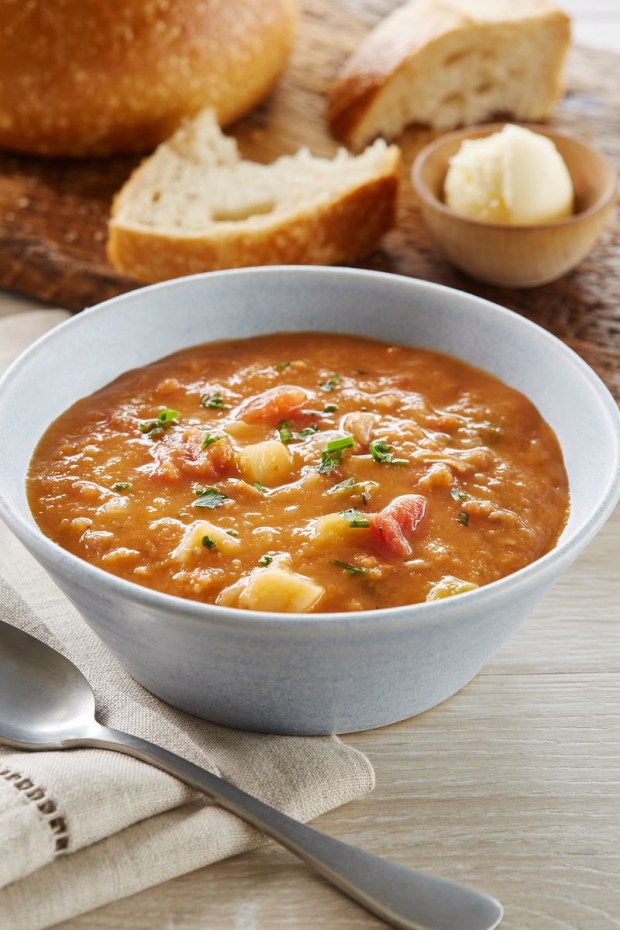 Tomato-based Manhattan Clam Chowder is among the dishes included in the cookbook “Flavors From the Shore: Nostalgic Seafood Recipes Celebrating OUr Coasts and Waterways” by Jim Ulcickas, Richard Staunton and James O. Fraioli. (Photo by Tucker + Hossler Photography)
Manhattan Clam Chowder
“In the 1800s the first tomato-based chowders were served at Delmonico’s in New York, influenced by the Portuguese fishermen who assembled stews with tomatoes, onions, and pork,” Ulcickas writes. At Bluewater Grills the cream-based New England chowder can be ordered served adjacent to the tomato-based Manhattan clam chowder — half and half chowders in the same bowl.
Yield: 4 to 6 servings
INGREDIENTS
2 slices of bacon, diced
1 tablespoon extra-virgin olive oil
2 medium carrots, peeled, cubed into 1/4-inch pieces
2 celery stalks, trimmed, diced into 1/4-inch pieces
1 cup yellow onion diced into 1/4-inch pieces
1 garlic clove, peeled, minced
1/2 teaspoon dried thyme
1/4 teaspoon celery seeds
1 (12-ounce) can crushed tomatoes
1 2/3 cups clam juice
4 cups peeled, diced (1/2-inch pieces) Russet potatoes
3 (10-ounce) cans clams, chopped, drained (reserve juice)
1 1/2 teaspoons sea salt
1/2 teaspoon fresh cracked black pepper
Tabasco sauce, to taste
Garnish: 2 tablespoons chopped fresh Italian flat-leaf parsley
For serving: Oyster crackers, Tabasco sauce, and hot sourdough bread and butter
DIRECTIONS
1. Add bacon to a Dutch oven over medium heat. Cook, stirring occasionally, until bacon is crisp and fat is rendered. Remove bacon with a slotted spoon and transfer to a paper towel to drain. Add olive oil, along with carrots, celery, and onion to the bacon fat. Cook for 4 minutes on medium heat, stirring occasionally. Add garlic and cook for 1 minute.
2. Add the reserved bacon, along with the thyme, celery seeds, tomatoes, and clam juice. Stir to combine and bring to a simmer. Add the potatoes and cover for 20 to 30 minutes, or until potatoes are cooked but not mushy. Add the clams and reserved clam juice (from the clams) and return to a simmer. Add the salt, pepper, and Tabasco sauce to taste. Cover and reduce heat to medium low, stirring occasionally, for 10 minutes. Remove from the heat.
3. When ready to serve, warm the chowder over low heat (about 160 degrees). Portion into cups or bowls, taking care to stir the chowder well before ladling to get even distribution of ingredients. Garnish with parsley. Serve with oyster crackers, Tabasco sauce, and hot sourdough bread.
Source: “Flavors from the Shore: Nostalgic Seafood Recipes Celebrating Our Coasts and Waterways,” by Jim Ulcickas, Richard Staunton with James O. Fraioli
 Baked Stuffed Lobster features stuffing made with crabmeat, shrimp, parsley, sherry and half a pound of smashed Ritz crackers. (Photo by Tucker + Hossler Photography)
Baked Stuffed Lobster
When Jim Ulcickas was asked to name his favorite recipe in the cookbook, he explained that the Baked Stuffed Lobster with Crab and Shrimp stands out. He said that growing up in New England played into his love of the dish. Eating, he said, isn’t just with your mouth — your mind and memories play a part.
This dish, an adaptation of lobster thermidor, is served at Bluewater Grill as a special during two months a year. He explains that the dish was made famous at Pier 4 on the Boston waterfront.
Yield: 1 lobster, 6 servings lobster stuffing
INGREDIENTS
Lobster:
Sea salt, as needed
1 1/4 pounds live Maine lobster
4 ounces Lobster Stuffing, recipe follows
1 1/2 ounces clarified butter, see cook’s notes
Melted butter and lemon wedges, as needed for garnish
Lobster stuffing:
1/2 pound crushed Ritz crackers (or use panko breadcrumbs)
1/2 cup clarified butter, see cook’s notes
3/4 cup lump crabmeat
3/4 cup bay shrimp
2 tablespoons chopped fresh Italian flat-leaf parsley
1/4 cup sherry wine
1/2 cup chicken stock
1 teaspoon kosher salt
1/4 teaspoon fresh cracked black pepper
Cook’s notes: To clarify butter, place butter in a Pyrex measuring cup. Cover with plastic wrap and microwave until melted and liquid. Remove from microwave and let the warm butter stand for several minutes until you see distinct layers. The bottom layer is a milky substance, the center layer is a clear yellow color, and the top layer is clear white salty foam. The center layer is the clarified butter and what you are after. To obtain this, the top layer must be poured off and discarded. Don’t worry if you discard some of the yellow oil; it is important that the that the top layer is completely removed. The next step is to slowly pour off the yellow oil into a container without any of the milky bottom layer contaminating it. Once done, discard bottom layer.
DIRECTIONS
1. Fill a large pot with water. (Note: Allow three quarts of water per 1 1/2 pounds of lobster.) The lobster should be completely submerged when added. Add 1/4 cup sea salt for each gallon of water (4 quarts = 1 gallon). This adds significant flavor to the lobster. Bring salted water to a boil. Add the live lobster using tongs. Do not cover. Boil for 3 minutes. Remove lobster from water and place on cutting board. Allow to cool to the touch. When cool, flip the lobster on its back and use a sharp kitchen knife to cut the belly from its head down to the tail. Be careful not to cut all the way through the shell. Next remove the brain sac and intestinal line. Crack the claws with the back of the knife or use a pair of crackers. Gently break open the body shell to flatten the lobster and open up the tail and body cavity.
2. For the lobster stuffing: In a bowl, add the crushed crackers, clarified butter, crabmeat, shrimp, parsley, sherry, chicken stock, salt, and pepper. Gently stir to combine. (Note: This stuffing makes enough for six lobsters, so adjust the recipe to avoid having leftovers.)
3. Preheat oven to 350 degrees. Place the lobster on a rimmed baking sheet. Lightly mound the lobster stuffing inside the cavity and tail; do not pack down. Place in preheated oven and bake for 10 to 12 minutes, or until the lobster is cooked through and the stuffing is golden brown. Transfer to a large plate and serve with melted butter and lemon wedges.
Source: “Flavors from the Shore: Nostalgic Seafood Recipes Celebrating Our Coasts and Waterways,” by Jim Ulcickas, Richard Staunton with James O. Fraioli
 Orange and Walnut-Crusted Halibut with Lemon Caper Beurre Blanc is a dish that is served at Bluewater Grill locations with scalloped potatoes and grilled asparagus. (Photo by Tucker + Hossler Photography)
Orange and Walnut-Crusted Halibut with Lemon Caper Beurre Blanc
This delicious entrée shows off one of the most prized fish in Alaska, the Pacific Halibut. At Bluewater Grill the halibut is coated with a delicious orange and walnut crust and topped with lemon caper beurre blanc sauce. At the restaurants it is served with scalloped potatoes and grilled asparagus.
Yield: 4 servings
INGREDIENTS
Orange and Walnut Crust:
3/4 cup walnuts
1/4 cup panko breadcrumbs
1 tablespoon minced orange zest
1/4 cup chopped fresh Italian flat-leaf parsley
2 tablespoons chopped fresh basil
2 tablespoons chopped fresh chives
1/4 teaspoon kosher salt
1/4 teaspoon fresh cracked black pepper
Halibut:
1 cup all-purpose flour, seasoned with kosher salt and fresh cracked black pepper
3 eggs, beaten with 1 tablespoon water (egg wash)
4 (8-ounce) fresh Alaskan halibut skinless fillets
2 tablespoons extra-virgin olive oil
Kosher salt and fresh cracked black pepper to taste
Lemon Caper Beurre Blanc:
2 tablespoons cold unsalted butter
1 tablespoon capers, drained
2 lemons, cut into 4 wedges and use the remaining to squeeze 1/2 cup juice (remove any seeds)
2 tablespoons chopped fresh Italian flat-leaf parsley, divided use
Sea salt and fresh cracked black pepper to taste
DIRECTIONS
1. For the orange and walnut crust, place the walnuts in a food processor and process until coarsely chopped. Add the walnuts to a mixing bowl along with breadcrumbs, orange zest, parsley, basil, chives, salt, and pepper. Mix well and set aside.
2. For the halibut, set up a dredging station by adding the seasoned flour to a shallow dish or plate. Add eggs and water to another bowl and beat until well mixed. Place the orange and walnut mixture on another plate.
3. Begin by breading the halibut. Dredge each piece first in the seasoned flour, gently shaking off the excess. Next dip into the egg wash, fully submerging each piece and letting the excess run back into the bowl. Then press each piece into the orange and walnut mixture to coat each side.
4. Add the oil to a large, deep saute pan over medium-high heat. When the oil is shimmering, add the halibut and season lightly with salt and pepper. Cook for about 5 minutes per side, or until the internal temperature of the fish is 135 degrees. Remove from heat.
5. For the Beurre Blanc Sauce: Heat a large nonstick skillet on medium-high heat; turn off heat and add the cold butter to the hot pan along with capers, lemon juice, and half of the parsley. Whisk until butter has melted. Season with salt and pepper to taste.
6. To plate: Serve halibut, preferably beside a serving of scalloped potatoes and grilled asparagus. Top each serving of halibut with 2 tablespoons beurre blanc and sprinkle with remaining parsley.
Source: “Flavors from the Shore: Nostalgic Seafood Recipes Celebrating Our Coasts and Waterways,” by Jim Ulcickas, Richard Staunton with James O. Fraioli
There are six Bluewater Grills in California and Arizona, plus two other restaurants, one called Mia’s (Solana Beach) and one called El Galleon (Avalon).
Dining and Cooking