

For The Union-Tribune
It only takes looking at a map to get a sense of how complex Turkish cuisine is. The south of Turkey sits on the Mediterranean Sea, so you would assume the food is also Mediterranean.
And yet, its northern border is on the Black Sea, opposite European countries Greece, Bulgaria, Romania, Moldova, Ukraine and, yes, Russia.
On the east and southeast, it borders Syria, Iraq, Iran, Armenia and Georgia. So, is Turkish food Mediterranean, Asian or Middle Eastern?
The answer is yes.
 Seckin Sage Anlasbay, a native of Turkey, is the chef and owner at Bosforo. (Kristian Carreon / The San Diego Union-Tribune)
The menu at Turkish restaurant and bar Bosforo, in San Diego’s Normal Heights neighborhood, reflects the range of Turkish cuisine and the heritage of owner and chef Seckin Sage Anlasbay, who was raised in Mersin, a port city in Southern Turkey. His staff is mostly Turkish. And he imports many of the ingredients that he believes are essential to replicate the kinds of dishes he grew up with.
So, their baklava includes Antep pistachios, renowned in that southeastern city, as is Antep pepper. The warm spice recurs in several dishes, as does sumac. There’s Turkish Ezine cheese; Turkish sucuk, a spicy, dry-cured sausage; Turkish thyme and Ayran, a Turkish yogurt drink. Eggplant is heavily featured in their meze, or appetizer, section, from eggplant atom with labne, garlic and chili; to karniyarik, an oven-roasted eggplant stuffed with spiced ground beef blended with onions, garlic, green pepper, tomatoes, Antep pepper, cumin and parsley. You’ll see dolmas and humus and köfte on the menu. Greek? No, here is the Turkish version.
Anlasbay shared three very homey, very traditional Turkish recipes that are on the menu by way of his parents: the karniyarik, köfte and the total comfort dessert sütlaç — his mom’s oh-so-creamy rice pudding.
Karniyarik, said Anlasbay, is a meal many Turkish people grow up eating from childhood.
“Almost every mother has her own version, and the smell of roasted eggplant and simmering tomato sauce is deeply nostalgic for many of us,” he said.
When I first enjoyed the karniyarik, I — a true eggplant lover — fell for it immediately. It was the stuffed eggplant I had longed to make but never seemed to excel at. Anlasbay’s mom’s recipe revealed a different approach than my efforts to roast, scrape out the flesh and mix it with other ingredients.
Karniyarik roughly translates to “split belly,” and it speaks to the technique behind the dish. Here, Anlasbay peels the Italian eggplants in alternating stripes and soaks them briefly in salted water. Then he roasts them at high heat for close to half an hour. Traditionally, he said, they would be lightly fried until soft.
 Three dishes that feature Turkish heritage, clockwise, from left: Karniyarik (eggplant), Grilled Köfte (meat) and Oven-Baked Sütlaç (rice pudding). (Kristian Carreon / The San Diego Union-Tribune)
While the eggplants are roasting, you make a simple filling that starts with sauteed onion, garlic, green peppers and ground beef. Tomato paste, fresh tomatoes, salt, black pepper, Turkish Antep pepper and cumin are mixed in and cooked until the tomatoes soften, and you have a reduced, fragrant mixture. At that point, add chopped fresh parsley.
Once the eggplants are ready, you don’t scrape out the tender meat. You simply cut a slit in the center of each one and gently pull away the sides to create a pocket for the filling. Stuff them generously and then top with a couple of tomato slices and one or two shishito peppers. Why shishitos? These are the closest Anlasbay could find locally to Turkey’s long, usually mellow sivri biber peppers.
The stuffed eggplants will now return to the oven, but before they do, quickly mix up a loose sauce of tomato paste, salt, pepper, a little ground cumin and hot water. Spoon it over and around the eggplants, then bake them for 20 to 25 minutes. Anlasbay said you can serve the dish with rice pilaf, yogurt or a yogurt-and-cucumber dish called cacik — along with fresh bread.
“Growing up in Turkey, one of the best parts was sneaking bites of the filling before the dish even made it to the table,” he admitted. “We would often take the freshly cooked meat mixture and stuff it into warm bread as a quick snack while our mothers finished preparing dinner.”
Next comes Turkish Grilled Köfte. It’s one of the foundations of Turkish cooking, Anlasbay explained, and everyone has their own version. At Bosforo, they use a blend of beef and lamb for richness and flavor.

Bosforo’s wood fire oven. (Kristian Carreon / The San Diego Union-Tribune)

The bar at Bosforo in Normal Heights, (Kristian Carreon / The San Diego Union-Tribune)

The interior of Bosforo. (Kristian Carreon / The San Diego Union-Tribune)

An interior view at Bosforo. (Kristian Carreon / The San Diego Union-Tribune)
Show Caption
1 of 4
Bosforo’s wood fire oven. (Kristian Carreon / The San Diego Union-Tribune)
Expand
Bosforo’s cooks grind their own meat and, as part of the grinding process toward the end, add in the onion, cloves, bell pepper and spices. One of Bosforo’s cooks brandished a zirh blade — an impressively long and sharp cross between a sword and mezzaluna — that he used to finely chop the mixture. You’d be fine using a chef’s knife.
In Anlasbay’s recipe, he skips all that and suggests buying ground beef and lamb, dicing the veggies, adding in the spices — salt, black pepper, Antep pepper and cumin — and combining them together. You’ll notice that the recipe calls for a couple of tablespoons of San Pellegrino. The carbonation creates tiny air pockets that lend a softer, fluffier texture.
“The key to good Turkish köfte is simplicity, proper seasoning, and high-quality meat. It’s less about heavy spices and more about balance and texture,” he said.
Ah — again, the texture. This is where you should focus your efforts. If you’re a bread baker, you’ll understand. To get the classic köfte texture, you need to get your clean hands in there and knead the meat mixture until it breaks down and becomes almost pillowy. Then, Anlasbay advised, place the mixture in the fridge for at least two hours and optimally overnight. This does two things: It melds the flavors and relaxes the meat proteins.
When you’re ready to grill, form the meat into oval patties or long, finger-shape köfte. Because lamb is part of the mixture, grill the patties until cooked through but don’t overcook. Serve with warm slices of lavash or pita, yogurt and sumac onions.
The seasoned onions are easy to make: Massage thinly sliced red onions with salt, then add plenty of sumac, chopped parsley and a drizzle of olive oil.
“We let them sit for about 10 to 15 minutes before serving so they soften slightly and absorb the flavors,” Anlasbay said.
You can also serve the köfte with rice pilaf or fries. I enjoyed it with a light arugula salad with thinly sliced radishes and onions. Anlasbay also includes pomegranate seeds and diced beets when they’re in season. It’s dressed with just smoked extra-virgin olive oil, fresh lemon juice and zest and salt and pepper. It was simple and amazing with that peppery arugula crunch.
Now for dessert. Who doesn’t love rice pudding?
“Sütlaç is one of the most nostalgic desserts in Turkish cuisine,” Anlasbay said. “Nearly every household has its own version, usually made by mothers and grandmothers using simple pantry ingredients like milk, rice, sugar, eggs and starch.”
There are two main steps. The first is to wash and cook the rice, adding milk along with sugar and a pinch of salt. Then whisk together egg yolks, cornstarch and cold milk. Now you’ll need to temper the egg mixture so the eggs won’t curdle going into that hot rice. So ladle just some of the hot milk/rice mixture into the cold egg mixture and whisk until it’s absorbed, then you can pour that tempered mixture into the pot. And keep stirring while it gently simmers and thickens. Now add vanilla.
At this point comes step two: baking. Pour the thickened, silky sütlaç into individual ramekins. Place those into a baking dish with sides. To make sure the mixture cooks all the way through, add hot water into the baking dish surrounding the ramekins — just halfway up. Now you can bake them at 400 degrees for about 20 minutes, until the tops form a brown skin. Optimally they’ll be lightly set, not as thick as pudding. Pull them out and let them cool, then refrigerate them before serving. To serve, you can dust each one with cinnamon and sprinkle with chopped, roasted hazelnuts.
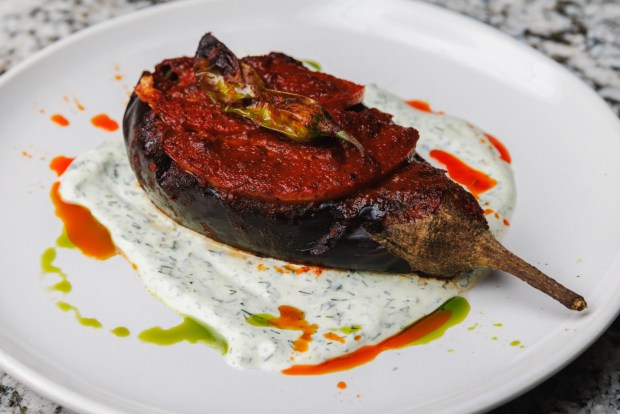 Karniyarik. (Kristian Carreon / The San Diego Union-Tribune)
Karnıyarık
Makes 4 servings
INGREDIENTS
For the eggplants:
4 Italian eggplants
Olive oil
Salt

Preparing the filling for the karniyarik. (Kristian Carreon / The San Diego Union-Tribune)

Sage cuts a slit into an Italian eggplant. Before this, the eggplants are peeled in alternating stripes and baked in the oven at 425 degrees Fahrenheit for about 25 minutes. (Kristian Carreon / The San Diego Union-Tribune)

The sides of the eggplant are separated and then filled with the meat mixture. (Kristian Carreon / The San Diego Union-Tribune)

Sliced tomatoes, a shishito pepper and tomato paste tops the eggplant and meat mixture. (Kristian Carreon / The San Diego Union-Tribune)
Show Caption
1 of 4
Preparing the filling for the karniyarik. (Kristian Carreon / The San Diego Union-Tribune)
Expand
For the filling:
2 tablespoons olive oil
1 medium onion, finely diced
3 garlic cloves, minced
1 green pepper, diced
1 pound ground beef
1 tablespoon tomato paste
2 tomatoes, diced
1 teaspoon salt
1/2 teaspoon black pepper
1/2 teaspoon Turkish Antep pepper, ground (available in Middle Eastern markets)
1/4 teaspoon cumin
Handful of chopped parsley
For baking:
Tomato slices
5 shishito peppers
1 tablespoon tomato paste
Salt and pepper to taste
1 cup hot water
DIRECTIONS
1: Prepare the eggplants: Peel the eggplants in alternating stripes and soak them in salted water for 20 to 30 minutes. Pat dry thoroughly.
2: Preheat oven to 425 degrees. Traditionally, the eggplants are lightly fried until soft. For a lighter Bosforo version, brush them with olive oil and roast at 425 degrees for about 25 to 30 minutes, until tender.
3: Make the filling: Heat olive oil in a pan over medium heat. Sauté the onions until softened, then add garlic and green peppers. Add the ground beef and cook until browned. Stir in tomato paste, tomatoes, salt, black pepper, Antep ground pepper and cumin. Cook until the tomatoes soften, and the mixture becomes rich and slightly reduced. Finish with chopped parsley.
4: Assemble: Preheat oven to 375 degrees. Place the eggplants in a baking dish and gently open a slit through the center of each one. Separate the sides to form a pocket. Fill generously with the meat mixture. Top each with two or three tomato slices and 1 shishito pepper. Mix the tomato paste with salt and pepper, a little ground cumin and enough hot water to create a loose sauce. Spoon it over and around the eggplants. Bake at 375 degrees for 20 to 25 minutes until bubbling and aromatic. Serve warm with rice pilaf, yogurt or cacik (a yogurt and cucumber dish), and fresh bread.
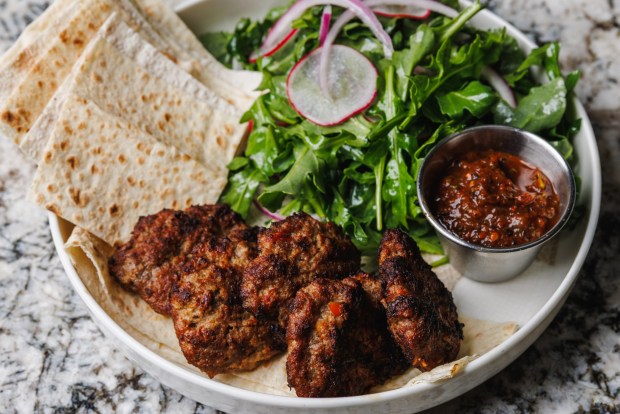 Grilled Köfte with arugula, red onion and radish salad, as served at Bosforo in Normal Heights. (Kristian Carreon / The San Diego Union-Tribune)
Turkish Grilled Köfte
Like many Turkish grilled dishes, köfte is often enjoyed family-style in the center of the table, meant for sharing and conversation.
Makes 4 servings
INGREDIENTS
2 pounds 80/20 ground beef
6 ounces lamb fat, finely minced or ground
1 small onion, grated
2 garlic cloves, grated
1 small red bell pepper, finely diced
1 tablespoon salt
2 teaspoons black pepper
1 teaspoon cumin
1 teaspoon Turkish Antep pepper
1 tablespoon olive oil
2 tablespoons San Pellegrino water
Handful chopped parsley

A mixture of ground beef and lamb fat are combined to make Turkish Grilled Köfte at Bosforo. (Kristian Carreon / The San Diego Union-Tribune)

Black pepper, cumin and Turkish Antep pepper are mixed into the meat. (Kristian Carreon / The San Diego Union-Tribune)

The Köfte meat mixture is shaped into oval patties. (Kristian Carreon / The San Diego Union-Tribune)

The Köfte can be cooked over charcoal, a cast-iron pan or grilled. (Kristian Carreon / The San Diego Union-Tribune)
Show Caption
1 of 4
A mixture of ground beef and lamb fat are combined to make Turkish Grilled Köfte at Bosforo. (Kristian Carreon / The San Diego Union-Tribune)
Expand
DIRECTIONS
1: Prepare the mixture: Combine all ingredients except parsley in a large bowl. Mix thoroughly for several minutes until the mixture becomes sticky and well incorporated — as tender as bread dough. This helps develop the classic Turkish köfte texture. Add parsley at the end, mix one last time.
2: Cover and refrigerate for at least 2 hours, preferably overnight to let the proteins relax and to develop flavor.
3: Shape into oval patties or long finger-shaped köfte.
4: Cook over charcoal, a cast-iron pan or grill over medium-high heat until nicely caramelized and fully cooked through. Avoid overcooking to keep the köfte juicy.
5: Serve with: Grilled tomatoes and peppers; an arugula, red onion and shaved radish salad; sumac onions; rice pilaf or fries, as well as warm lavash or pita, yogurt or spicy ezme (a chopped tomato and pepper condiment).
 Oven-Baked Sütlaç
(Rice Pudding). (Kristian Carreon / The San Diego Union-Tribune)
Oven-Baked Sütlaç (Rice Pudding)
Makes 6 servings
INGREDIENTS
1/2 cup short-grain rice
3 cups water
1 quart (4 cups) whole milk
Pinch of salt
3/4 cup sugar
2 egg yolks
2 tablespoons cornstarch
1/4 cup cold milk (for dissolving cornstarch)
1 teaspoon vanilla extract (optional)
Cinnamon for serving

Anlasbay’s mother would prepare sütlaç, a creamy rice pudding, that is poured into a clay bowl and baked at 400 degrees for 20 minutes. (Kristian Carreon / The San Diego Union-Tribune)

The tops of the Sütlac should become caramelized and completely cooled before serving. (Kristian Carreon / The San Diego Union-Tribune)
Show Caption
1 of 2
Anlasbay’s mother would prepare sütlaç, a creamy rice pudding, that is poured into a clay bowl and baked at 400 degrees for 20 minutes. (Kristian Carreon / The San Diego Union-Tribune)
Expand
DIRECTIONS
1: Rinse the rice well. Add rice and water to a pot and simmer over low heat until the rice becomes very soft and most of the water is absorbed. The rice should begin breaking down slightly and creating a naturally creamy texture.
2: Add the whole milk and pinch of salt. Cook gently over low heat for 20 to 25 minutes, stirring frequently to prevent scorching the bottom of the pot. Add the sugar and continue cooking for another few minutes.
3: Prepare the egg and cornstarch mixture: In a bowl, whisk together egg yolks, cornstarch and 1/4 cup cold milk. Mix until completely smooth. Slowly ladle some of the hot milk rice mixture into the bowl while whisking continuously to temper the eggs.
4: Slowly pour the tempered mixture into the pot while stirring constantly. Cook over low heat for another 5 to 8 minutes until lightly thickened and silky.Gently simmer after adding the eggs. Add vanilla if using.
5: Pre-heat oven to 400 degrees. Pour into oven-safe ramekins or traditional clay bowls. Place the bowls onto a baking tray with sides and fill the tray halfway with hot water around the ramekins. Bake about 20 minutes until the tops become deeply caramelized and slightly blistered. Remove from oven and cool completely, then chill before serving.
6: To serve, dust lightly with cinnamon and top with chopped roasted hazelnuts if desired. The ideal texture should be creamy, smooth, and lightly set, not overly thick like pudding.
Recipes from Seckin Sage Anlasbay of Bosforo.
Dining and Cooking