
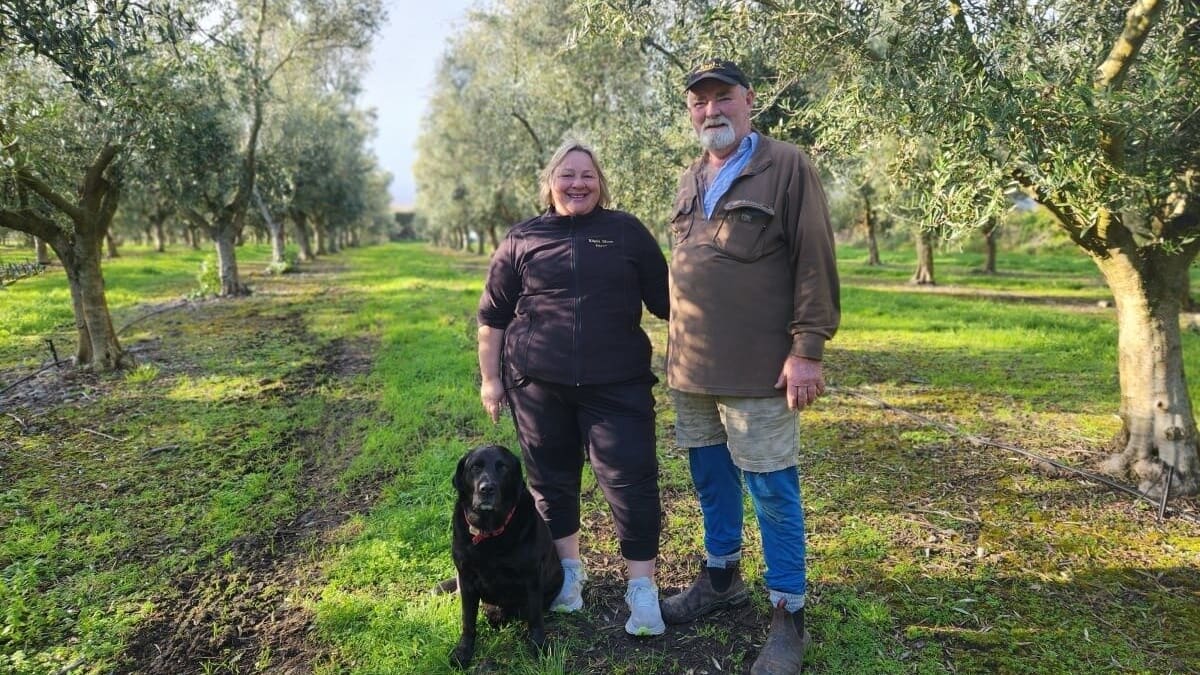
“We’re in our 60s now, and it’s great to be trying something different,” Diana added.
Previous owners David and Helen Walshaw established the olive grove in 2003 on dry stony soil, 2km from the coast.
The move from sheep and cattle to olives has transformed the Crosses’ pace of life.
“You can leave the gate open, and the trees don’t disappear, and they don’t stand on water lines,” Diana said with a laugh.
“The day-to-day is not as hard as sheep and beef farming,” Grant added.
“If it’s wet and it’s cold, I can make an executive decision and stay home.
“That took me a couple of years to get over not having to actually physically be there every day.
“When I came back after two days, hey, the trees were still there, they were fine.”
The Allflex tags were not the only thing that followed them from stockyards to olive trees.
They use soil testing, leaf sampling, and fertiliser knowledge from pastoral farming to maintain the trees’ health and have introduced innovative practices such as drone spraying.
“We used helicopters and planes on the farm,” Diana said.
“So, we’re like the first in the area and mainly in the olive industry to be doing [drone spraying] simply because we’re used to all those other technologies.”
They enjoy meeting their customers face-to-face on market days and even delivering the oil in person to retailers, a big difference from their sheep and beef farming days.
“The lambs and the bulls went on the truck, and off they went,” Grant said.
“Now we’re actually – and we’re going to do it this afternoon – delivering oil to the supermarket.”
Diana and Grant have taken on a whole new way of farming in their sixties, from livestock to olives. Photo / RNZ
Intimate knowledge of the production process is something they also enjoy sharing with their customers.
“There’s a story about that oil in that bottle that’s come from those trees,” Grant said.
“And the product we’ve got is a top product, whereas, you know, I’m not saying sheep and beef isn’t, but we were just another leg of lamb, another roast of beef.”
Grant maintains the grove, using problem-solving skills developed on the farm, and the task of bottling and labelling is something they share in the small factory a few kilometres away in Ōtaki.
The Crosses bottle and label their oil at their small factory in Ōtaki. Photo / RNZ
“These hands have done a lot of labelling and bottling,” Diana said, holding a bottle under a machine to be filled with the latest harvest, then meticulously sticking on the label with the Kāpiti Olive Oil brand.
“You don’t talk to the label lady when she’s labelling,” Grant joked.
Financially, is it more rewarding than sheep and beef?
“It’s allowed us to do what we want to do at the moment, which is, you know, just keep on going,” Grant said.
“We can get away when time allows.
“Fortunately, it’s a cash-positive business when there’s no overdraft or no debt in it, so that has really helped.”
Olives left for the birds post-harvest. Photo / RNZ
“As they always say, you won’t get rich, but you have a good life,” Diana added.
Some things are still the same; Grant keeps the habit of weather monitoring with three weather apps and a rain gauge from his farming days.
“Like farming, we’re still very dependent on the weather – what comes down from the sky or doesn’t come down.
The Crosses grow four varieties of olives for their Kāpiti brand. Photo / RNZ
“But it’s a very forgiving crop.”
The Crosses’ oils have won medals in New Zealand and overseas, but Grant is still chasing one thing.
“One more challenge before I retire is to have that trophy on the mantelpiece, and it’s a nice trophy, and it says Extra Virgin Olive Oil Best in New Zealand.
“Then I will – I’ve got to be careful – I’ll seriously consider retiring.”
“I’ll take you up on that,” Diana said.
Dining and Cooking