
My family dined on chicken of the woods last week. The “chicken” was delicious spread across the face of a medium rare sirloin steak!
This chicken had no feathers. It didn’t cackle or cluck or flap its wings. It was perched on an oak tree stump but no sound ever came from it.
Some of those who live in this north country already know of what I speak.
This “chicken” is really a mushroom. It’s Latin name is Laetiporus sulphureus. That’s a mouthful!
It is a shelf fungus and grows mainly on dead or rotting oak trees. And it is easy to spot wearing its neon yellow/orange colors. I spied my “chicken” deep in the woods behind our house just a week ago. The mushroom’s size filled three plastic grocery bags. This “chicken” laid no eggs.
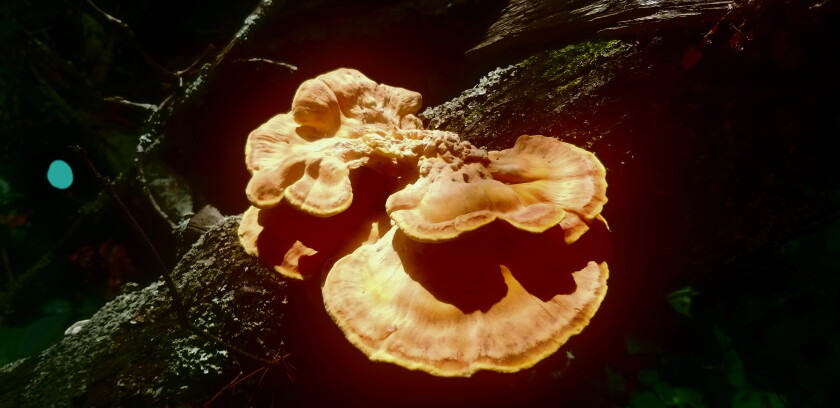
Chicken of the woods is one of the most identifiable edible mushrooms.
Contributed / John Wetrosky
I don’t normally eat any of the many mushrooms that grow around our home. There are mushrooms that can kill you and there are mushrooms that will make you wish you hadn’t ingested one.
But, there are also many that are tasty and provide a wonderful garnish to any meat dish or mixed in a soup.
The famous morel mushrooms are prized by many, and locations of where they can be found are usually kept secret and only passed on to next of kin. And then, maybe not even to those relatives!
In today’s “back to nature” movement, there is an emphasis put on garnering one’s own food supply. Some of that supply comes from nature itself. Humans are seen harvesting cattails, clover buds, dandelion roots and even stinging nettles!
My only recollection of nettles came from the times I followed my uncles on catfishing trips along the banks of the Big Sioux River on hot summer days. Brushing against a mature nettle plant instantly raised welts on whatever skin was bare.

John Wetrosky (2022)
Somehow actually eating a nettle never seemed attractive to me, but just recently I read several articles extolling the nutritional value of what I always called a weed. Thanks, I’ll pass.
My mother came through the hard scrabble times of the Great Depression where food was sometimes scarce. One of the natural foods she harvested as a kid were elderberry blossoms. She said how wonderful the blossoms tasted when dipped in a batter and then deep fried in lard.
Her description was so enticing that one day my sister and I ventured to our cow pasture and found elderberry bushes growing in full bloom along a fence line. Remembering how our mother extolled the tasty virtues of this plant, we picked an armload of blossoms and excitedly brought them into the kitchen where Mom mixed a batter, dipped the blossoms and deep fried the batch.
My sister and I each took a blossom, took a bite and decided that cows would have enjoyed it better than us. Mom said she remembered the blossoms tasting better than those. We decided she must have been very hungry during those lean times.
Just last week I came by my chicken of the woods dying oak stump and to my amazement that “chicken” had a batch of newborn chicks! The florescent yellow/orange glow stood out against the dark woods background like a neon sign at midnight.
It was new growth and I sliced it from its perch before it aged and attracted the insects that inhabit the mushroom as it ages. Just like a real chicken, as it gets older it gets tougher!
As many say about other exotic natural foods that they haven’t eaten before, “It tastes just like chicken!” And the chicken of the woods kind of does. If you spy one on one of your forays into the woods, take that chicken home.
If you don’t know what mushroom you’re looking at, leave it alone!
See you next time. Okay?
Dining and Cooking