
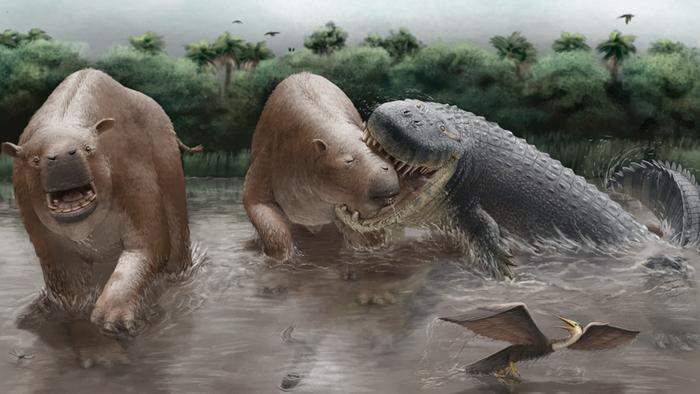
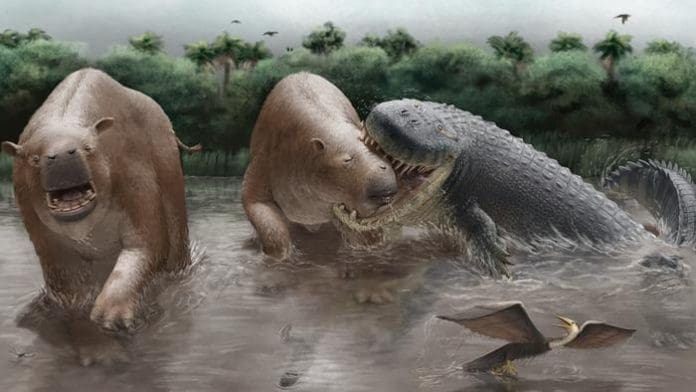
 Reconstruction of Purussarus neivensis attacking Pericotoxodon platignathus.
Credit Miguel Hernandez
A peer-reviewed study led by researchers at the University of Helsinki reveals that giant crocodylians, rather than mammalian carnivores, served as the primary apex predators across South America’s tropical wetland ecosystems over 10 million years ago
Apex predators of the Miocene wetlands
During the Miocene epoch, between 10.5 and 16 million years ago, much of South America was covered by vast wetland, river, and lake systems. These aquatic environments supported an extraordinarily diverse array of carnivores, including giant anacondas, sabre-toothed mammalian predators, flightless “terror birds” (Phorusrhacidae), and sebecids—terrestrial relatives of modern crocodylians.
Despite the variety of mammalian and avian hunters, the new research demonstrates that crocodylians occupied the undisputed top tier of the food web. The dominant predator of this habitat was Purussaurus neivensis, a giant caiman relative reaching seven meters in length and weighing approximately 1,800 kilograms.
Because the region supported an immense biomass of large herbivores, mammalian carnivores alone lacked the capacity to consume or control the prey population, leaving giant crocodylians to fulfil the role of primary megafaunal hunters.
Fossil evidence and fossilised bite traces
The study, published in the Journal of Vertebrate Palaeontology, relied on analysing fossil collections gathered from Miocene deposits. Because direct behavioural observations are impossible in deep time, researchers focused on identifying bite and tooth marks left on fossilised herbivore bones, which offer definitive proof of predator-prey interactions.
The high frequency of large, distinct bite marks matched to Purussaurus indicates that these aquatic giants actively hunted the continent’s largest land animals. The prey targeted along the lake margins included several extinct groups of South American megaherbivores:
Heavy native ungulates:
Massive extinct mammals such as toxodontids and elephantine astrapotheres (“lightning beasts”), which routinely weighed well over a tonne.
Armoured mammals and sloths:
Enormous ground sloths and heavily armoured glyptodonts, the ancient relatives of modern armadillos.
Ecological impact and top-down control
By systematically targeting the ecosystem’s largest herbivores, Purussaurus neivensis played a central role in shaping Miocene ecological dynamics.
Researchers conclude that the sheer size and hunting frequency of these giant crocodylians enabled them to exert top-down control over megaherbivore populations, influencing population sizes and ecosystem structure across prehistoric South America.
Dining and Cooking