
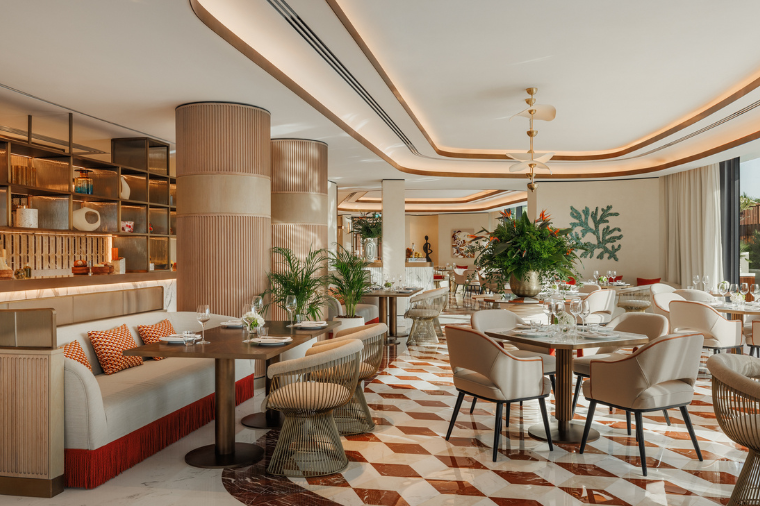
This week, we speak to Chef Nathan, Head Chef and Chef de Cuisine at Commodore Club, located inside Jumeirah Marsa Al Arab in Dubai.
Welcome to the Emirates Man series ‘How I Got My Job As…’, where we speak to incredible entrepreneurs and business leaders based in the UAE and globally, uncovering their career paths, daily routines, challenges, and advice for those looking to follow in their footsteps.

Asking Chef Nathan about his earliest memory of cooking, he doesn’t start with a dish; he starts with nostalgia for aroma. Long before he officially picked up a knife at 14, he was five years old and watching his grandfather work the pans in the family’s Paris restaurant. Two Michelin stars, a move through some French capital’s most disciplined kitchens, and a relocation to Dubai later, those same instincts – food as memory, food as joy – still shapes everything coming out of Commodore Club’s kitchen at Jumeirah Marsa Al Arab.
You’ve said your grandparents’ restaurant in Paris first drew you into cooking at 14. What is your clearest memory of being in that kitchen, and what did it teach you before you’d set foot in a professional one?
I officially started cooking when I was 14, but my memories of my grandparents’ restaurant go back much further than that. Actually, some of my first memories as a child are from there. From around five years old, I was already spending time in the kitchen, watching what was happening.
The first thing that comes to mind is the smell of the kitchen. Even today, when I think about that restaurant, I can almost smell it. And of course, watching my grandfather cook. He was always a role model for me. But more than techniques or recipes, what I remember most about my grandparents is the joy they found in making people happy through food. I believe this remains the simplest way to describe our work: we cook to bring joy to others through our food.
From there, you moved through kitchens like the Royal Monceau under Chef Roberto Rispoli and helped earn two Michelin stars at La Scène with Chef Stéphanie Le Quellec. What did each of those chefs push you to change about how you cook?
I had the chance to work in some incredible Parisian hotels and Michelin-starred restaurants, and this was really when something clicked for me. I realised that this world of excellence, the discipline and the constant search for improvement was where I wanted to be.
Roberto Rispoli and Stéphanie Le Quellec are very different chefs, both in their cooking and their management, but they share something very important: rigour and resilience. Stéphanie was really a mentor to me. Her cuisine is all about taste. It’s direct, confident and without unnecessary things on the plate. One of the biggest things I learned from her was “less is more”: concentrate on the flavours, remove what you don’t need, and make what remains as impactful as possible. This still influences the way I cook every day espeically here at Commodore Club.
Roberto provided me with a completely different perspective through his knowledge of Mediterranean cuisine. He also helped me grow enormously, both professionally and personally, and he is actually the person who allowed me the opportunity to come to Dubai. He has remained a real support system over the years, and today I consider him much more than just a chef I worked for.

You made the move to Dubai in 2020, joining Jumeirah Mina A’Salam and Jumeirah Al Qasr. What made that the right moment to leave Paris, and what surprised you most about cooking in the region once you arrived?
I had always wanted to travel. One of the greatest elements about our profession is that cooking gives you the opportunity to experience new places and regions, especially with a French culinary background, which is very appreciated internationally. When Roberto spoke to me about joining the renowned Jumeirah Group in Dubai, I didn’t think twice.
What surprised me most, in a very positive way, was the mix of nationalities and cultures here. You have people from completely different backgrounds working together, and everyone brings something different to the table. You can also find almost every cuisine in Dubai, often at a very high level. English was definitely a challenge for me at the beginning, but it also made me realise how universal food is. You don’t always need to speak the same language to understand each other in the kitchen or around a table. Food naturally brings people together.
Commodore Club describes itself as offering a generous, contemporary take on comfort food. How do you personally define comfort food, and how much of that definition comes from your own upbringing versus what you think Dubai diners want right now?
For me, food is first of all about memories. As I mentioned above, it’s how I got my start. A smell or a flavour can immediately bring you back to a specific place, a Sunday lunch, your grandparents’ house, or something you ate as a child.
It’s nostalgic. That’s where a lot of emotion in cooking comes from. As a chef, I’m always interested in how we can bring back that feeling for people, even if the dish itself is presented in a different or more contemporary way.
Comfort food is generous before anything else. A moment tied to a memory. It doesn’t necessarily mean “heavy food”. It means something you immediately understand, something satisfying, familiar and full of flavour. At Commodore Club, we try to take those references and memories and make them relevant to the way people want to eat in Dubai today.
The restaurant’s breakfast runs all day until 6pm, which is unusual even by Dubai’s relaxed dining standards. What was the thinking behind that decision, and has it changed how people actually use the space?
Dubai’s lifestyle really works with this kind of format. People don’t necessarily want breakfast at 9am and lunch at 1pm. They want the freedom to mix things and eat according to their day.
And honestly, that mix is part of what I love about Commodore Club. There’s something very satisfying about looking at a table and seeing a seabream ceviche next to a basket of viennoiseries, a Norwegian waffle with smoked salmon and caviar, and a cordon bleu. It shouldn’t necessarily work on paper, but here it does, and that’s part of the identity of the place.

Commodore Club sits directly on the Marsa Al Arab marina. How much does that setting shape the food itself, whether that’s the pacing of the menu, the produce you reach for, or simply the mood you’re cooking for?
Commodore Club is really a neighbourhood restaurant, and the marina, as well as the Residences plays a big part in that. Based on the location itself, we have a lot of walk-in guests coming directly from the marina, as well as diners who live on the property, so the restaurant needs to feel spontaneous and easy. The food has to reflect all kinds of clientele. You should be able to come in for a coffee or something light, have breakfast in the afternoon, or sit down for a proper meal. So both these combined definitely influence the way we think about the menu and the flexibility we want to give our guests.
You’re introducing a limited-edition Summer Menu that will run alongside the existing à la carte offering and change monthly. What was the reasoning behind adding a rotating menu rather than simply refreshing the main one?
There were a few reasons, but the main one is seasonality. Working with products when they are at their best, and sourcing as locally and directly as possible, is one of the foundations of our job and something we take very seriously at Jumeirah Marsa Al Arab for all of our dining outlets. With this new summer menu, we wanted to focus on the warmer season and also explore more of what this region and the GCC can offer us as chefs. There are some amazing products here that deserve more attention, which we can give them when we rotate the menu.
The second reason is simply to keep the Commodore Club interesting and busy. We have many regular guests, so having a faster rotation allows us to constantly give them something new to discover without completely changing the identity of the main menu.
The new dishes range from a Tomato Gazpacho and Watermelon Ceviche through to a Fish & Chips Burger and a sharing Chicken Paella. Was there a single dish on this menu that took the longest to get right, and what kept sending you back to the drawing board?
Most of the dishes actually came quite naturally because the starting point was simple: something fresh, generous and easy to eat during summer.
Maybe the most personal one for me was our version of Petits Farcis Niçois. It comes directly from my childhood memories. It’s the kind of dish you eat on Sunday with your family: vegetables stuffed with rice and slowly cooked for hours with tomato and peppers. The smell fills the kitchen and takes me back in time.
The challenge was not necessarily technical. It was more about keeping the soul of that memory while making it feel like Commodore Club. Sometimes the simplest and most familiar dishes are actually the ones you have to be the most careful with.

Pan con Tomate & Wagyu Coppa is an interesting pairing of Spanish tradition and a very different protein. Talk us through how a dish like that comes together, and how far you’re willing to push a classic before it stops being recognisable.
This dish actually came after a trip to Spain earlier this year. One of the first things I always want when I arrive there is pan con tomate. It’s such a simple and iconic way to start a meal, and I usually have it with some local charcuterie, especially Jamón Ibérico.
When we developed the dish at Commodore Club, the idea was to recreate some of the qualities I love in Ibérico, the richness, the nuttiness, the fat, but through something different. So we developed our own Wagyu coppa, curing and drying the beef to create that depth of flavour. With the tomato, olive oil and toasted bread, the result is still very Mediterranean and fresh, and you immediately understand the reference.
For me, that’s probably the limit when playing with a classic: you can change the ingredients or technique, but the guest should still understand the original idea. Our guests have really loved this one, so I’m actually considering keeping it on the main menu.
Desserts like the Tiramisu and the sharing Apple Crumble with vanilla ice cream feel deliberately nostalgic. How do you decide when a dessert should stay faithful to the original and when it earns a reinterpretation?
It always comes back to the reason people love the original in the first place. With something like a tiramisu or an apple crumble, there’s already a strong emotional connection, so you have to be careful not to lose that by trying to be too clever. We can improve the ingredients, play with textures or make small changes, but the first bite still needs to feel like a tiramisu or an apple crumble. Sometimes respecting a classic is more interesting than reinventing it.

Since a new dish will appear each month through summer, how do you personally decide something is ready to go on the menu versus needing more time in development?
It’s a lot of testing and small adjustments. Sometimes we get there in three days, and sometimes we spend several weeks working on one dish. But I think when a dish is finished, you know quite quickly. If we are still questioning an element or trying to convince ourselves that something works, usually it means it’s not ready yet. When everything makes sense from the first bite, and there is nothing you want to add or remove, that’s normally when you know the dish deserves to be on the menu.
Between your Parisian training, Michelin-starred kitchens and now several years cooking in Dubai, how would you describe your food today if you had to place it somewhere between those two worlds?
My cooking has evolved a lot over the years. Paris gave me the foundations: technique, discipline, respect for ingredients and that very classic French understanding of sauces, balance and flavour.
Dubai opened everything up for me. Living here, you’re exposed every day to different cultures, spices, ingredients and ways of eating. It made my cooking much more open-minded and, I think, more instinctive.
Today, I don’t really try to put my food into one category. The French foundations are always there because they’re part of who I am as a chef, but there are also Mediterranean influences, Asian influences and things I’ve discovered through travelling and living in this region. Ultimately, I want my food to be generous, approachable and full of flavour. I’m less interested now in showing technique for the sake of technique. If people enjoy the food, understand it and leave with a memory of it, then for me, we’ve done our job here at Commodore Club.
– For more on how to look smart and live smarter, follow Emirates Man on Facebook and Instagram
Images: Supplied
Dining and Cooking