
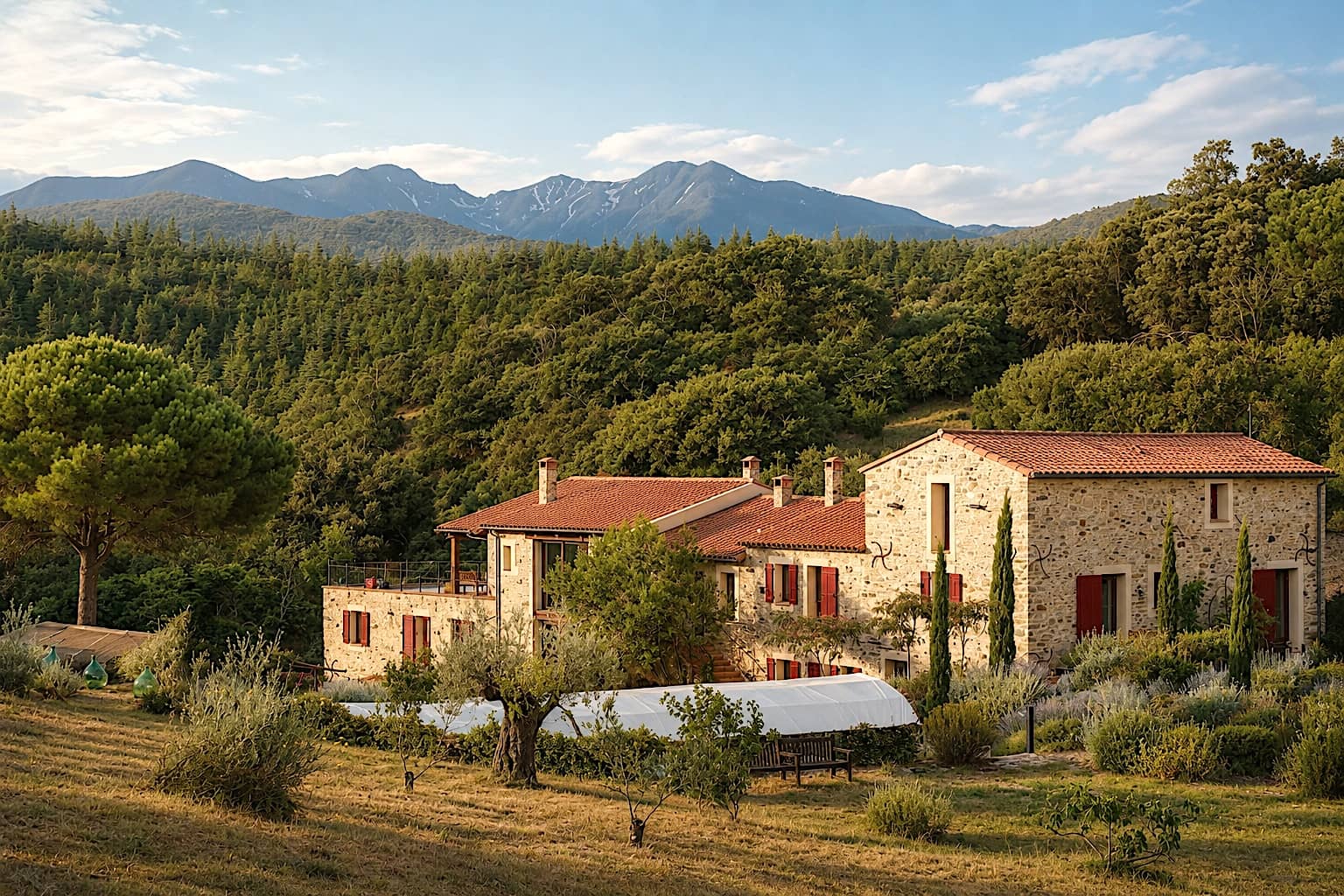
Querubi’s first annual Harvest Retreat Weekend will take place from 9 to 11 October 2026 in French Catalonia, offering three days of olive picking, oil tasting, regenerative farming and gratifyingly long lunches at a working estate in the foothills of the Eastern Pyrenees.
It is a retreat, certainly, although anyone imagining three days spent horizontal beside a pool may discover that agriculture has rather more opinions on the matter.
Guests will stay at Domaine Madrona, Querubi’s restored 13th-century Catalan farmhouse near the olive groves, and spend the weekend moving between the pleasures of rural hospitality and the considerably older business of getting fruit off trees.
That distinction makes the proposition interesting. France has no shortage of handsome houses prepared to feed visitors beautifully. Fewer invite them into the machinery of the landscape itself.
An olive harvest retreat with some dirt under its fingernails
The weekend is built around the beginning of Querubi’s 2026 harvest.
Owner Willem Voorvaart and estate manager Holly will join the farm team and guests in the groves, picking olives before lunch among the trees. Holly will also lead an olive-oil tasting session, while Voorvaart will discuss the farming methods developed across more than two decades on the estate.
Therein lies the difference between this and the familiar country-house weekend involving a cookery demonstration, a linen apron and very little possibility of perspiration.
Querubi is giving visitors access to a working period in the agricultural calendar rather than constructing an activity around one. Harvest time has consequences. Fruit is ready when fruit is ready. Lunch may be leisurely, but the olives have not read the itinerary.
For anyone increasingly interested in where food comes from — rather than merely the font used on its packaging — that should be part of the appeal.
Twenty years of rebuilding a patch of the Pyrenees
Voorvaart bought the neglected land more than 20 years ago with the aim of rebuilding its soil through regenerative farming.
His approach was influenced by Japanese farmer and philosopher Masanobu Fukuoka’s The One-Straw Revolution, and the estate’s first olive trees were planted in 2008.
Querubi now has 12,000 organically cultivated olive trees, producing relatively small quantities of extra-virgin olive oil characterised by the company as low in acidity and high in polyphenols.
The more interesting story, though, sits underneath the trees.
Querubi’s philosophy places soil health and biodiversity ahead of the temptation to bully the landscape into submission with chemical inputs. The idea is straightforward enough: healthier soil supports healthier trees, which have a rather useful habit of producing better fruit.
During the Harvest Retreat Weekend, Voorvaart will discuss the practical rewards and frustrations of that approach. Farming in harmony with nature sounds wonderfully lyrical until nature develops a contrary opinion, which it regularly does.
That reality gives the weekend some intellectual heft beyond the food and scenery. Regenerative agriculture has acquired considerable cultural currency, but spending time with people applying those principles on an operating farm offers a rather better education than encountering the phrase on a restaurant menu.
Domaine Madrona makes a convincing base camp
After the groves comes Domaine Madrona, a restored 13th-century Catalan farmhouse close to the estate.
Original stone and timber have been retained throughout the property, with colourful interiors and local antiques stopping the place from slipping into the familiar beige anonymity of over-restored luxury accommodation.
Its communal spaces are central to the weekend: the long farmhouse table, the swimming pool and an outdoor platform set among Mediterranean woodland.
Meals will draw on produce sourced from neighbouring suppliers and markets, with Querubi’s olive oil appearing liberally throughout.
There is an obvious luxury to all this, although not the velvet-rope variety. Its appeal lies in access, landscape, good ingredients and time: commodities that have become curiously expensive without anyone needing to put gold leaf on them.
French Catalonia provides more than a pretty backdrop
The setting also gives the retreat a character difficult to reproduce elsewhere.
The farm sits in French Catalonia, in the foothills of the Eastern Pyrenees, where Mediterranean vegetation meets mountain country and Catalan culture ignores the administrative neatness of an international border.
Querubi says part of its wider ambition is to provide local employment and encourage tourism into one of France’s less economically prosperous regions.
That makes the project more interesting than a retreat parachuted into the countryside purely because somebody discovered an attractive stone house.
Food tourism works best when visitors encounter an existing place rather than a sanitised imitation built for them. Here, the olive trees, neighbouring producers, markets and farming calendar are already doing the heavy lifting.
Guests are simply being allowed through the gate.
From the October harvest to a bottle in London
The experience has an unusually satisfying final chapter.
After October’s harvest, retreat guests are due to reconvene in London in November for the launch of Querubi’s 2026 harvest oil. They will taste the finished product and receive a bottle made from the harvest in which they participated weeks earlier.
That closes a loop usually invisible to consumers.
Olive oil tends to materialise on a shelf in a handsome dark bottle with plenty of romance attached and remarkably little indication of the work between tree and table. Picking fruit in October and tasting the resulting oil in November turns provenance from an abstract selling point into something tangible.
The London gathering is also intended to bring together people working across food, farming, wine and hospitality, continuing discussions around provenance, chemical-free agriculture and olive-oil production.
For reference, a bottle of Querubi’s 2025 extra-virgin olive oil is priced at £26.50.
Why Querubi’s Harvest Retreat feels timely
Olive oil has become noticeably fashionable, moving beyond the kitchen cupboard into restaurant tastings, specialist shops and the broader conversation around ingredients with identifiable origins.
Querubi insists its farming predates that enthusiasm by some distance, and the timeline supports the point: Voorvaart began restoring the land more than 20 years ago and planted the first olive trees in 2008.
The retreat therefore arrives at a useful intersection.
Travellers increasingly want access rather than spectacle, while food lovers have become more interested in farming, soil and provenance. Querubi happens to have the landscape, accommodation and agricultural history to put those things in the same place for a weekend.
There is a swimming pool, naturally. Civilisation need not be abandoned altogether.
But the memorable part is likely to happen farther down the hill, among 12,000 olive trees, where visitors discover that the best bottle to take home is sometimes the one that made you work for lunch first.
Dining and Cooking