
Since its domestication around 5000 BCE1, the olive tree (Olea europaea L. var. europaea) is the most prominent and economically significant fruit tree in Europe, especially within the Mediterranean Basin2. It produces not only edible fruits but also high-quality, edible, and storable oil, which is vital to food production in countries bordering the Mediterranean. Over the past decade, global olive oil production has averaged about 3 million metric tons annually, with the EU contributing approximately 60%3. This translates to a trade value of more than 2 billion euros each year for EU nations. To sustain this output, more than 11 million hectares are cultivated worldwide in temperate regions—primarily in EU Mediterranean countries—with olive trees, employing traditional, intensive, and, more recently, high-density planting practices under both conventional and organic management4. Besides its economic importance, olive groves are crucial to the Mediterranean region’s cultural identity and environmental conservation5,6, supporting over 500 million inhabitants7.
Over the last twenty years, significant progress in olive oil production has been made through the expansion and improvement of irrigation and fertilization methods, and the development of new cultivars more adapted to intensive plantations. However, olive farming now faces urgent environmental and socioeconomic challenges (Table 1). Major environmental issues include climate change, land degradation, emerging pests and diseases, and biodiversity loss, which are already impacting olive yields and oil quality8,9. Factors like decreased rainfall and higher temperatures during flowering and ripening are particularly critical10. For instance, in recent years, Andalusia – the largest olive oil producer region in the world – has experienced significant interannual declines in olive oil production due to higher temperatures and spring drought during flowering11,12. Furthermore, projections suggest that rising temperatures in the Levant will adversely affect olive tree growth and oil yields8. Combined with societal changes—such as declining rural populations, reduced demand for farm labor, and the declining profitability of traditional olive groves—these environmental issues threaten to lead to the acceleration of abandonment of olive groves in parts of the Mediterranean13.
Table 1 Multi-factorial challenges of Mediterranean olive systems and their impacts, mapped to the five pillars of the integrated frameworkScope, conceptual basis, and approach
This Perspective synthesizes the consensus that emerged from the International Conference on Sustainability in Olive Cultivation (ICSOC) 2025, which brought together researchers, growers, industry representatives, and policy makers across the Mediterranean Basin. Rather than a systematic review, the article articulates a forward-looking expert position on how to reconfigure Mediterranean olive systems for climate resilience. We acknowledge as a limitation that, by relying on expert consensus and selective evidence, the depth of treatment for any single domain is necessarily condensed. The added value lies in integrating domains traditionally examined in isolation—soil, biodiversity, plant health, the water–energy–carbon nexus, and the market–governance environment—and in making explicit how they reinforce or constrain one another. To avoid ambiguous use of recurrent terminology, we adopt operational definitions of four transversal concepts—sustainability, resilience, circularity, and innovation—provided in Box 1, which guide the analysis throughout the paper and explicitly include the integration of traditional ecological knowledge held by olive-growing communities. Throughout the framework, agricultural productivity is treated not as one output among others but as the operational anchor that ultimately legitimizes the time and investment required by regenerative management—it is the outcome through which resilience and sustainability translate into rural livelihoods, and the criterion by which rural adopters weigh the effort of the practices we propose.
Box 1 Operational definitions of the four transversal concepts
Sustainability. A dynamic equilibrium among the environmental, economic, and social dimensions of olive systems, evaluated through quantifiable indicators such as soil organic carbon, functional biodiversity, efficient use of natural resources (e.g., water and carbon footprints), farm-level economic viability, and intergenerational and gender equity. Sustainability is treated here as a trajectory rather than a fixed state.
Resilience. The capacity of the olive agroecosystem to absorb climatic, biological, and economic perturbations and to maintain critical functions—productivity, oil quality, ecosystem services, and social viability—without transitioning to a degraded state. It is operationalized through recovery time after disturbance, amplitude of tolerance to stress, and functional redundancy of biotic and management components.
Circularity. The closure of material and energy flows within the productive system through reincorporation of by-products—olive pomace or alperujo (the semi-solid mixture of pulp, water, and pits from two-phase extraction), leaves, pruning biomass, and mill wastewater—as inputs (compost, biochar, bioplastics, energy) or as high-value-added products (e.g., phenolic extracts). A simple operational metric is the ratio of valorized to generated by-products.
Innovation. The deployment of new technologies (sensing, artificial intelligence, agrivoltaics, blockchain), new governance models (cooperatives, rural innovation hubs), and new knowledge configurations—explicitly including the recovery and integration of traditional ecological knowledge held by olive-growing communities—to reconfigure the olive system. Innovation is treated as transversal because it operates simultaneously across all five pillars and three levels of analysis.
Together, these four concepts function as lenses, not as separate pillars (innovation, resilience, and circularity may be seen as key ways to achieve sustainability): every section in the paper can be read through each of them, and Fig. 1 shows how they wrap around the five pillars and three nested levels.
A unified framework for climate-resilient olive systems
We organize these challenges and solutions in a framework structured along three orthogonal axes (Fig. 1). First, we identify five thematic pillars that together constitute the operational dimensions of olive systems: (P1) Soil, (P2) Biodiversity, (P3) Pest and Disease Control, (P4) the Water–Energy–Carbon Nexus, and (P5) Market and Governance. Each pillar is treated in a dedicated section that distinguishes evidence-based diagnosis, proposed solutions, and explicit cross-domain links and trade-offs. Second, the four transversal concepts defined in Box 1 cut across the five pillars and the entire paper, anchoring the discussion in clear, quantifiable, and evaluable terms. Third, we recognize three nested levels of analysis—the plot (orchard agronomy and soils), the landscape (ecological infrastructure, watersheds, and disease epidemiology), and the socio-ecological system (regional markets, governance, communities)—because solutions that work at one level can generate trade-offs at another. The framework, therefore, moves the discussion beyond five parallel mini-reviews to a system in which interventions can be evaluated for their cross-pillar synergies (e.g., groundcover simultaneously increasing soil organic carbon, biodiversity, and natural pest regulation) and tensions (e.g., agricultural intensification raising productivity at the expense of biodiversity and soil function). The remainder of the paper develops each pillar in turn, returning in the conclusions to how the five domains, the four concepts, and the three levels jointly define a transition pathway from input-driven olive farming toward a regenerative, inclusive, climate-resilient olive system. Every pillar contributes to productivity through a distinct pathway—soil health via reduced yield losses under drought and erosion (P1); biodiversity via pollination and biocontrol that stabilize fruit set (P2); plant health via avoided tree mortality and orchard destruction (P3); the water–energy–carbon nexus via yield stability under climate stress (P4); and market and governance via income streams that legitimize the effort of regenerative management (P5). This productivity anchor is made explicit in the background of Fig. 1 as the ultimate outcome that the framework serves.
Fig. 1: Integrated framework for climate-resilient Mediterranean olive systems.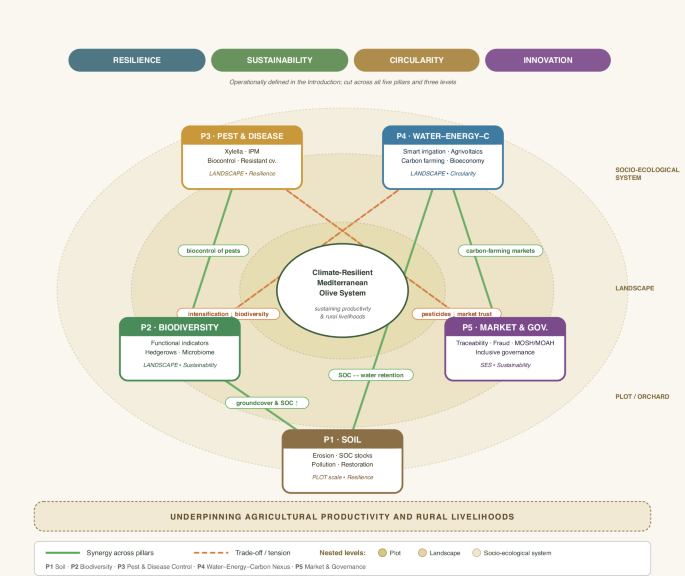
The framework is structured along three orthogonal axes. The first axis comprises five thematic pillars—P1 Soil, P2 Biodiversity, P3 Pest and Disease Control, P4 Water–Energy–Carbon Nexus, and P5 Market and Governance—represented by the color-coded boxes arranged around the central olive-system core. The second axis comprises four transversal concepts—resilience, sustainability, circularity, and innovation—defined operationally in Box 1 and shown as the colored band along the top of the figure; these concepts cut across all five pillars and operate as analytical lenses rather than as separate domains. The third axis comprises three nested levels of analysis—plot/orchard, landscape, and socio-ecological system—visualized as concentric ellipses; each pillar is positioned within the level at which it primarily operates, although interactions across levels are common. Solid green lines indicate selected cross-pillar synergies that emerge across the framework: groundcover practices simultaneously building soil and biodiversity (P1 ↔ P2), soil organic carbon and water retention reinforcing each other (P1 ↔ P4), biodiversity enabling ecological pest regulation (P2 ↔ P3), and traceability mechanisms rewarding regenerative practice through carbon-farming markets (P4 ↔ P5). Dashed orange lines indicate explicit trade-offs that must be governed: agricultural intensification reducing biodiversity (P4 ↔ P2), and reliance on chemical pesticides eroding consumer market trust (P3 ↔ P5). Additional synergies and trade-offs identified within each pillar are discussed in the corresponding Cross-domain links and trade-offs paragraph of each section.
Soil as the foundation of climate resilience
Soil degradation is the foundation crisis of Mediterranean olive agriculture: it conditions every other pillar in this Perspective and is the dimension at which the resilience of the system is built or lost.
Evidence-based diagnosis
Centuries of cultivation on steep slopes, coupled with tillage and reduced vegetation, have stripped soils of structure and carbon9. Erosion rates frequently exceed 20 t ha−1 yr−1 in many groves14,15 and can surpass 100 t ha−1 yr−1 in extreme cases16,17; projections indicate further increases by 2050 driven by more frequent high-erosivity rainfall events18. Soil organic carbon (SOC) stocks remain consistently low in rainfed olive soils, frequently below regional baselines for Mediterranean cropland19, although exceptions exist where regenerative practices have been adopted20,21. Beyond erosion and carbon depletion, soil pollution from copper-based fungicides, residual pesticides22, antibiotics, and microplastics emerged at ICSOC 2025 as an immediate threat to soil functionality and food safety.
Solutions and recommendations
Effective and feasible management options are well documented23. Easy-to-apply nature-based solutions include straw mulching, retention of pruning residues, and herbaceous groundcover24,25,26,27. When combined with reduced or no tillage, these practices recover SOC, stabilize aggregates, restore infiltration, and reduce sediment loss. They align with the EU Soil Mission and the EU Carbon Removals and Carbon Farming (CRCF) Regulation, providing producers with potential access to a regulated voluntary carbon market.
Cross-domain links and trade-offs
Soil restoration conditions four of the other pillars: increased SOC enhances water retention (P4) and reduces irrigation needs; permanent groundcover simultaneously protects soil and supports above- and below-ground biodiversity (P2); and well-structured, less polluted soils contribute to plant health by reducing host vulnerability to Xylella and Verticillium (P3). Trade-offs are nonetheless real. Groundcover can compete with olive trees for water in dry years, requiring species selection adapted to local rainfall patterns; mulching is labor-intensive and only economically viable where by-product flows from the olive system itself are available (P4 circularity), and mechanization is allowed, i.e., in low to moderate sloped orchards28; and conversion to high-density orchards, while improving short-term productivity, typically undermines the very soil stability on which long-term yields depend29,30. Crucially, soil restoration underwrites productivity itself: SOC and structural gains translate directly into avoided yield losses under drought and into more stable rain-fed harvests, which is what ultimately makes the effort worthwhile for growers who bear its labor cost.
Take-home—P1
Restoring Mediterranean olive soils is a precondition for resilience: SOC, water retention, biodiversity, and plant health all build on it, but only when management choices integrate plot, landscape, and farm-economic constraints simultaneously.
Biodiversity and functional restoration
Biodiversity is the ecological infrastructure of resilient olive systems and the layer that translates soil health into productivity, plant health, and farm-level stability.
Evidence-based diagnosis
Mediterranean olive groves harbor a disproportionately rich biota: research in southern Spain has documented at least 165 bird species, 58 ant species, more than 500 annual plant species, and nearly 140 woody plant species31, accounting for 20–33% of regional flora and fauna and confirming olive landscapes as key refuges for Mediterranean biodiversity. This biota delivers concrete agronomic services: pollinators sustain fruit set in the few self-incompatible cultivars and increase oil quality where mixed-cultivar groves are managed for cross-pollination32,33; ground-active arthropods and birds suppress key pests including Bactrocera oleae34; cover-crop microbiomes mineralize nutrients and reduce inorganic-fertilizer dependence21; and herbaceous covers cut runoff and erosion by an order of magnitude under typical Mediterranean rainfall35,36. However, agricultural intensification erodes both taxonomic and functional diversity, particularly by filtering out rare species37, and simplifies orchards both above- and below-ground30,38, increasing dependence on external inputs.
Solutions and recommendations
Biodiversity restoration must operate at multiple levels: groundcover vegetation to prevent soil erosion and attract pollinators37; hedgerows and buffer strips to link fragmented habitats and reintroduce ecological connectivity at the landscape scale39; and active management of soil microbiomes through organic amendments and reduced tillage to enhance nutrient cycling. Functional biodiversity indicators—combining soil microbiota, plants, pollinators, vertebrate predators, and frugivores—should be deployed alongside productivity, management, and landscape gradients to allow farmers and certification bodies to evaluate ecosystem health objectively34,40,41. Embedding such indicators in the EU Biodiversity Strategy 2030 and in private certification schemes would convert biodiversity from an externality into a measurable, tradable outcome.
Cross-domain links and trade-offs
Biodiversity sits at the heart of the framework. It depends on soil restoration (P1), enables ecological pest regulation (P3), is sensitive to agrivoltaic deployment and irrigation intensification (P4), and can be rewarded through traceability and biodiversity-linked premiums (P5). The principal trade-off is intensification: high-density and irrigated orchards consistently support fewer functional groups than traditional ones30, so biodiversity-positive interventions frequently require accepting some yield-per-tree concession42 or compensation through landscape-scale governance. Functional biodiversity is, however, itself a productivity asset: biocontrol reduces yield losses, and belowground microbiomes underpin nutrient cycling—services that appear on the productivity ledger even where they do not appear on the certification label. Connecting biodiversity loss to pest dynamics motivates the next pillar.
Take-home—P2
Biodiversity is not an aesthetic addition but the operating system of pollination, pest regulation, and soil function in olive landscapes; it must be measured, managed, and rewarded through indicators that span plot to landscape scales.
Pest and disease control
Plant health in Mediterranean olive systems faces a renewed challenge: established pests persist while emerging vector-borne pathogens, particularly Xylella fastidiosa, threaten the agronomic and economic core of the sector. The integrated framework defended here positions pest control as a system function rather than a chemical intervention, leaning on the biodiversity dimension introduced in the previous section.
Evidence-based diagnosis
The xylem-inhabiting, gram-negative bacterium Xylella fastidiosa, transmitted exclusively by sap-feeding insects such as sharpshooters and spittlebugs43, has emerged as the most disruptive biotic threat to Mediterranean olive cultivation since its 2013 outbreak in Apulia, Italy44. Strains infecting olive have since been reported in France, Portugal, and Spain, with no curative treatments currently available45,46. Alongside Xylella, traditional pests and diseases continue to cause periodic outbreaks: the soil-borne fungus Verticillium dahliae, the leaf-spot pathogen Spilocaea oleagina, the olive moth Prays oleae, and the olive fly Bactrocera oleae. With the partial exception of V. dahliae, these are typically managed seasonally with chemical pesticides, which adds to the environmental and food-safety burden of olive cultivation.
Solutions and recommendations
Strengthening Integrated Pest Management (IPM) under climate change requires three coordinated lines of action. First, surveillance and diagnostic technologies—remote sensing, hyperspectral satellite imagery, and molecular diagnostics—are now mature enough to enable early detection at the landscape scale47,48. Second, ecological pest regulation must be deployed jointly with technological surveillance: conservation of natural enemies through groundcover and hedgerows, augmentation of generalist predators, microbiome-mediated suppression of V. dahliae, and the deployment of resistant or tolerant cultivars are complementary, evidence-based pathways33 that align with the biodiversity pillar (P2). Third, vector management for Xylella, primarily targeting the meadow spittlebug Philaenus spumarius, depends on timely groundcover management at the landscape scale and on coordinated regional surveillance.
Cross-domain links and trade-offs
Plant health both depends on and reinforces other pillars: it benefits from biodiversity (P2), requires healthy soils to reduce host stress (P1), and produces outputs (low pesticide residues, traceable IPM compliance) that condition consumer trust (P5). Trade-offs are explicit. Calendar-based chemical control is cheap and predictable in the short term but undermines biodiversity and consumer confidence; conversely, ecological pest regulation requires farmer training, landscape coordination, and tolerance for higher inter-annual variability. Resistant/tolerant cultivars protect against current threats but reduce the genetic diversity that underpins long-term resilience to future ones, so deployment must be combined with the genetic-resource strategies discussed in P4. The productivity stakes here are especially direct: an outbreak of Xylella fastidiosa or unchecked Bactrocera oleae can eliminate multi-year harvests and even entire orchards, so early detection and ecologically regulated plant health are a first-order return on the effort they require.
Take-home—P3
Olive plant health cannot be sustained on chemistry alone: it requires combining real-time surveillance, ecological pest regulation, and cultivar diversification within the same landscape.
The water–energy–carbon nexus of adaptation
Water scarcity, energy intensity, and carbon balance are tightly coupled in olive systems. Adaptation requires treating them as a single nexus rather than as separate concerns and integrating into it the circular valorization of by-products.
Evidence-based diagnosis
Although the olive tree is naturally drought-adapted, irrigation has become integral to maintaining stable yields49. Over the past three decades, the planted area has moved in the way of intensification (increasing plants per hectare) from traditional plantations (100–200 trees ha−1) towards intensive (200–600 trees ha−1) and super-high-density orchards (2000–2500 trees ha−1)50, with up to 25% of productive area in regions such as Andalusia now under intensive irrigation30. This shift raises water demand to 2500–3600 m³ ha−1 yr−1 in a basin where surface and groundwater bodies are already over-extracted30 and significantly increases the energy footprint of cultivation. A soil–water–crop–energy (SWCE) nexus framing is therefore increasingly necessary to evaluate trade-offs among irrigation water use, energy consumption, and yield stability51.
Solutions and recommendations
Five complementary strategies should be pursued in parallel. First, drought-tolerant cultivars developed through advanced genetic and genomic tools52, including allele-rescue from the wild relative Olea europaea var. sylvestris (oleaster), can shorten the breeding timeline that has traditionally constrained adaptation. Second, smart-agro irrigation technologies—sensor networks, water-stress prediction models, and decision-support platforms—substantially improve management of irrigation under deficit conditions53,54. Third, nature-based water-harvesting devices such as biochar-based hydroinfiltrators improve soil moisture retention and olive productivity in rainfed Mediterranean systems and increase water-use efficiency in drip-irrigated orchards under deficit irrigation55. Fourth, agrivoltaic systems integrated into olive groves deliver renewable electricity, lower emissions, and reduce evapotranspiration, with documented advantages in renewable-energy generation and land-use efficiency56; when combined with biochar-based amendments, they can further improve water retention and soil carbon stocks51. Fifth, carbon farming—as enabled by the EU Carbon Removals and Carbon Farming Regulation57—allows growers to monetize the soil-carbon and biomass gains achievable through regenerative practices: nature-based climate solutions in olive groves have been shown to sequester approximately 5.4 t CO₂ ha−1 yr−1, well above conventional management58, while regenerative practices may reach up to 4.5 t CO₂ ha−1 yr−1 according to the International Olive Council59. In parallel, circular valorization of by-products—alperujo, olive leaves, pruning biomass, and mill wastewater—into compost, biochar, phenolic extracts, bioplastics, lightweight bricks, and biogas is technically mature60,61,62,63,64,65.
Cross-domain links and trade-offs
The nexus connects directly to every other pillar: SOC built through P1 increases water retention and reduces irrigation needs; precision irrigation must be designed to remain compatible with biodiversity (P2) and avoid drying out herbaceous covers; agrivoltaic deployment, while beneficial for energy and shading, can pose risks for pollinating insects, bats and birds (P2) unless panels and rotational grazing are designed for biodiversity coexistence; and the economic viability of carbon farming and by-product valorization depends on functioning markets and policy support (P5). Trade-offs are explicit: precision irrigation increases water-use efficiency but raises kWh ha−1; carbon farming generates revenue but adds monitoring, reporting, and verification (MRV) costs that may exclude small producers; circular valorization alternatives are technically viable but frequently lack economic viability without coordinated business models, regional processing facilities, and integrated supply chains66,67,68,69. Managed as a nexus, water, energy, and carbon also stabilize productivity itself: deficit-optimized irrigation and drought-tolerant cultivars protect harvests through the increasingly frequent hot-dry years, while carbon-farming income and by-product valorization add revenue streams that make the whole management package viable for rural producers.
Take-home—P4
The Mediterranean olive system can be turned from a water-stressed emitter into a renewable-energy producer and net carbon sink—but only if water, energy, carbon, and by-product flows are managed as a single nexus and the resulting trade-offs are explicitly governed. In this respect, the implementation of circular principles should help ameliorate trade-offs while embracing an innovation-based management.
Market and governance
Technological innovation alone cannot ensure sustainability; socio-economic renewal and governance reform are equally necessary. This pillar operates primarily at the socio-ecological-system level and connects on-farm practices to market incentives, consumer trust, and inclusive rural development.
Evidence-based diagnosis
Olive-growing regions face rural depopulation, loss of generational continuity, and low public trust in agri-food markets13,70,71. Market evidence indicates that 75% of consumers distrust product claims and more than half actively seek verifiable sustainability credentials72,73. At the same time, olive oil quality is increasingly threatened by mineral oil hydrocarbon (MOH) contamination, including its two fractions: mineral oil saturated hydrocarbons (MOSH) and mineral oil aromatic hydrocarbons (MOAH)74. The sources of MOH in the olive oil supply chain, including in-field operations, and potential mitigation strategies have been recently reviewed75. The forthcoming EU regulation on MOAH limits, expected by 2027, will impose new analytical and supply-chain controls. In addition, consumers generally lack knowledge about olive oils and their categories76. This generates a fertile ground for different kinds of fraud—mislabeling, dilution, and country-of-origin manipulation—which erodes consumer confidence and is amplified by misinformation that disproportionately associates olive oil with adulteration risks.
Solutions and recommendations
Three lines of action stand out. First, traceability technologies—particularly blockchain-based systems linking field-level practices to bottle-level claims77—provide reliable authentication of sustainable origin. Coupled with measurable sustainability metrics (soil health, water efficiency, biodiversity, carbon balance), they can rebuild trust and reward responsible producers78; a recent willingness-to-pay study found consumers ready to pay up to 26% more for verified sustainable olive oil, including premiums for plastic-waste reduction, water stewardship, rural development, and biodiversity79. Second, advanced analytical methods, including untargeted screening combined with multivariate statistics, are increasingly able to detect adulteration and contamination at scale80 and should become routine within Panel-test and quality-assurance frameworks. Third, inclusive governance models—cooperatives, rural innovation hubs, women- and youth-led training initiatives—convert sustainability transitions into territorial competitiveness and generational renewal81,82,83.
Cross-domain links and trade-offs
Market and governance translate the agronomic and ecological gains of the previous pillars into producer income and consumer trust: certifications signal soil health (P1), biodiversity (P2), low pesticide residues (P3), and circular-economy compliance (P4). Trade-offs are equally real. Strong sustainability standards may exclude small or traditional producers who cannot bear MRV costs; blockchain tradability raises entry barriers; and carbon-farming or circular-valorization business models often require public-policy support to be economically sustainable69. Inclusive governance is therefore not optional but the condition under which the technological dimensions of the framework remain compatible with rural equity. Ultimately, market and governance close the productivity loop: they convert the agronomic and ecological gains of the other four pillars into the price premiums and cooperative structures that keep the effort of regenerative management economically legitimate for rural communities.
Take-home—P5
Sustainable olive systems will only exist if markets, governance, and rural communities are developed in tandem with the agronomic and ecological pillars: traceability rewards good practice, but inclusive governance is what keeps small producers inside the transition.
Dining and Cooking