

In order to be successful in today’s consumer market one should have a few different strings to one’s bow, something that Italian winery Famiglia Cecchi knows well, having established world-class estates across two of the country’s premier regions.
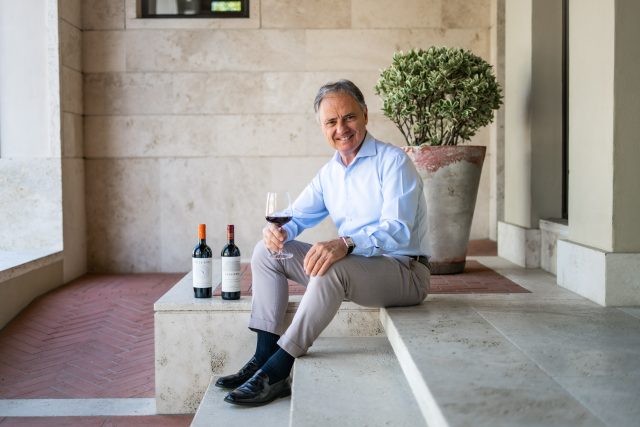 Andrea Cecchi
“Sommeliers are always looking for something that doesn’t exist yet, something new, so for a very historical brand like ours it is extremely important to stay ahead of the times and keep them engaged through fresh and distinctive offerings,” says Andrea Cecchi astutely.
As the owner, president and CEO of Cecchi, a family of five wine estates located across Tuscany and Umbria, he knows a thing or two about staying relevant in a changing wine market.
Indeed, Cecchi has strategically positioned itself in arguably the most important wine regions of Italy including Chianti Classico, Montalcino, and more recently, coastal Maremma as the term “freshness” continues to bloom in popularity among the wine trade.
Sangiovese expertise
The common seam running through this mosaic of territories is Sangiovese, with the red variety remaining “the lifeblood” of Cecchi, alongside a growing arterial network of Bordeaux varieties and whites like Vermentino and Viognier.
“Sangiovese is a chameleon because it changes from the coast to the mountains but at the same time it is a bull that is challenging to manage, no matter where it is grown,” Cecchi tells db. In other words, it needs an expert hand.
Across all five wine estates – Val delle Rose in coastal Maremma, Villa Cerna and Villa Rosa in Castellina in Chianti, Tenuta Aminta in Montalcino and Tenuta Alzatura in Umbria – Sangiovese expresses itself uniquely, but the signature Cecchi style is always “clean and pure wines,” the group’s owner says.
According to Cecchi, it took “many years” to master the art of making wines from Sangiovese “because you have to change the technology, the process, sometimes the people. Now we are very proud of what we have”, he states.
Below, the drinks business delves into the character of some of the different Cecchi estates.

The heritage estate: Cecchi and Castellina in Chianti
Cecchi has been producing a Chianti Classico vintage wine since the Chianti Classico appellation was established as an independent denomination in 1996. Castellina in Chianti, where the family settled in the early 1960s with the vision of establishing roots in an area that would soon be distinguished by its denomination, and where these wines are still made today, represents the backbone of the Cecchi group and its long-reaching roots in one of the most significant quality demarcations in Italy. But according to Andrea Cecchi, the care in the selection of grapes has improved vastly over the years.
“In the ’90s, Chianti Classico wines were powerful expressions with big structure in the mouth, now they are more enjoyable, with more fruity aromas, no oak, no extraction,” he says, adding: “These are wines that can be in love with food all the way through a meal.”
Grapes for Cecchi’s Chianti Classico ‘Storia di Famiglia’, Chianti Classico ‘Riserva di Famiglia’ and Chianti Classico Gran Selezione ‘Valore di Famiglia’ wines are picked from two estate-owned vineyards, with “the geography in the mouth really changing between the two sites,” says winemaker Miria Bracali.
One of the factors that makes the Cecchi Chianti Classico wines from this area so special is the vineyards’ proximity to a large cypress forest, as well as oak and olive trees, which imparts an earthy characteristic to the final expressions, reflecting their terroir.
The current Riserva in the market (2024) has a splash of 10% Cabernet Sauvignon to help with the longevity of the wine, but, says Bracali, even this Cabernet “talks the Sangiovese language”. Meanwhile, the Gran Selezione is produced from 100% Sangiovese, harvested from old vines planted in 1965.
“Together, the three wines are the evolution of our growing knowledge of Sangiovese,” says Cecchi. “Like three brothers, they each have their own personalities but still share the same family traits.”
And in a region where everyone is making wines from the same grape (Sangiovese), how do you make your brand stand out? Cecchi’s calling card, says Andrea Cecchi, is “historical, family-made, authentic wines that are respectful of the vintage, the grape and the terroir. In Chianti Classico, heritage and very ancient families is one of the main tools we have to make sure the world knows us.”

The coastal estate: Val delle Rose in Maremma
While Cecchi’s historical ties to Chianti Classico are a key part of its DNA, the group has also made pioneering moves in the coastal Tuscan region of Maremma. In fact, Cecchi was one of the first producers to move into Maremma, establishing its Val Delle Rose winery there in 1996.
Located just 5km from the sea, Val Delle Rose makes the most of Maremma’s sandy soils, previously considered unsuitable for winegrowing, to showcase not only fresh, noticeably smooth expressions of Sangiovese, but also white wines made from Vermentino and Viognier.
“Cecchi is becoming an ambassador for Maremma-made Vermentino,” Andrew Cecchi tells db. He adds that in Tuscany: “Vermentino and Viognier are going up, thanks to their fresh, aromatic, authentic traits that duet perfectly with the region’s Mediterranean terroir.”
It is only in relatively recent history that grape growing has become viable in the region. Until the 1930s, much of Maremma was uninhabitable swamp, mainly used as a hunting ground for local noble families. Its sandy soils clung onto water in the same way the hunter’s dogs retained the scent of their prey. Then in the 1930s, Mussolini, divining Maremma’s future potential, decided to drain the swamp, and in doing so made agriculture there possible.
“Good soil means soil that is able to have water,” says Cecchi. “Soil without water is just soil. Soil with water means potential. And white grapes, especially, need water.”
The Val delle Rose estate, certified organic since 2021, produces 100,000 to 200,000 bottles per year, with a 70%/30% split between reds and whites. In order to display Maremma Toscana DOC on the labels, the region’s producers must use a minimum of 85% Sangiovese in any red wine/red blend/rosé, with the milder climate giving markedly “softer tannins and rounder wines,” says Cecchi.
Indeed, the benefits of having a property in Maremma are twofold: it enables Cecchi to incorporate more velvety, smoother reds into its portfolio, and also to branch out into white wines to sate the growing consumer appetite for this category. He describes Maremma whites as being “saline, with intense, powerful flavours.”
“Maremma reds are smoother than in other regions, these are easy drinking wines for the young generation,” says Asia Guercini, European export manager for Cecchi. “As a region, Maremma is playful and vibrant. It offers the chance to be more creative and to try more things. Of course we have tradition, but we express it in a more modern way.”
The wines themselves are “very mineral, with aromatic herbs, long in the mouth, with a saltiness, thanks to the sea,” Guercini adds. Various fermentation vessels including stainless steel tanks and amphoras made from a hybrid mix of sand, clay and concrete, allow Val Delle Rose to offer whites ranging from fresh and accessible through to the more complex Cobalto Vermentino Superiore.
“We are rediscovering what it means to be a pioneer again in Maremma after 30 years and creating energy for other people to come invest in the region. To be a pioneer means this,” says Cecchi.

The prestige estate: Aminta, Montalcino
Cecchi has been a negociant in Montalcino for more or less 50 years, but Andrea Cecchi knew that having his own winery and vineyards in this prime Brunello-making territory would give him the control over quality that he was searching for in the region.
Consequently, Cecchi acquired its Montalcino estate in 2018, with just over 6ha under vine, and the winery and grounds have been treated to a complete refurbishment in order to become the ‘jewel in the crown’ of Cecchi’s portfolio. Case in point: some of the machinery in the revamped cellar has been shipped over directly from the esteemed Chateau d’Yquem.
The first wine to be made from this estate, a Brunello di Montelcino by name of Tenuta Aminta, was unveiled at Vinitaly last year, with a tiny initial run of 3,000 bottles for the first vintage (2020) with the aim to double this in 2021.
Aminta also plans to be a frontrunner in the evolving Rosso di Montalcino category, which is undergoing major changes in the region.
“The Montalcino model is like an upside down pyramid,” explains Francesco Vitulli, export director for Cecchi. “There used to be only about 500ha of grapes planted for the production of Rosso. Now the appellation is bringing the Rosso surface area up to around 40% of Montalcino’s total, so it is now closer to 700ha.”
Once affectionately termed “Baby Brunello”, the recently rebranded Rosso di Montalcino is a contemporary interpretation, which according to Vitulli “is really taking off. Even international markets are responding.”
“Imagine Montalcino as a panettone shaped hill,” urges Vitulli. “The northern side has more clay, it’s fresher, but the wines were a bit lean and lacking in colour.” But, he adds, with the increased focus on younger, fresher Rosso, “this could become an advantage.”
“It used to be that ‘Baby Brunello’ was seen as a younger, cheaper version of Brunello; a more accessible way for local restaurants and for people to enjoy a taste if Montalcino’s magic without spending a fortune,” explains Vitulli. “It was also a good way to give a little more cash flow to producers as they could sell the Rosso wines after just one year. But now this is not the case. Our Rosso di Montalcino wine has its own identity. It is more like the enfant terrible, not the baby!” says Vitulli.
This youthful, fresh, fruit-forward expression of Sangiovese, is ideal for the increasingly popular by-the-glass market.
“We were looking for a different style of wine, more approachable, lighter in colour, not too extracted. Good a bit chilled,” says Andrea Cecchi, who adds that thanks to tech like Coravin, more international restaurants are opening their doors to the formerly known ‘Baby Brunello’ wines.
“It has another soul and heart, this place. These are not just more Cecchi wines,” he remarks.
Related news
Wanderlust bets on Sardinia as demand shifts to Italy’s lesser-known regions
Don’t miss db’s Italy Report 2026, out now
Italy launches new ‘crisis fund’ for winemakers in Trentino
Dining and Cooking