
By Lisa Radinovsky from Greek Liquid Gold.
In Greece, rural women often find joy and fulfillment in their work. However, challenges for women olive farmers in Greece also persist. Part 2 in a series for the United Nations International Year of the Woman Farmer* considers common farmers’ problems, women’s extra burdens, barriers to women’s advancement in agribusiness, and encouraging signs of change.
General problems for Greek olive farmers
Severe weather, drought, destructive fires, and rising temperatures—worsening problems as global warming continues—can cause costly losses for any farmer. To make matters worse in the Greek olive oil sector, most of the exported oil is sold in bulk at low prices, to be blended with other nations’ olive oils and bottled in Italy. Vera Alexandropoulou (Elysian Earth) is concerned about “the imbalance that still exists between the effort small producers invest and the recognition or value they receive in return. Many of them work with extraordinary care, knowledge, and consistency,” but earn little for that work, even as production costs rise.
Christina Chrisoula (Taxidi) speaks for many in bemoaning a “lack of vision and/or knowledge about olive oil in Greece” throughout the value chain, from farmers to decision-makers, so that the longstanding problem with bulk exports (as well as pest control and numerous other issues) continues. Chrisoula is also concerned about the dependence on “monocultures, extensive use of pesticides, and depletion of water and natural resources.”
Additional challenges for women olive farmers in Greece
On top of the challenges worrying most farmers, women face extra obstacles. Several women tell Greek Liquid Gold that traditional expectations that women will do all the unpaid child and elder care, housework, and cooking have persisted in rural Greece, creating an extra burden when women also work in the agrifood sector. Women’s longstanding contributions to agricultural labor have often occurred in the background, without recognition or pay, and without accessible childcare facilities. On top of that, men continue to hold most leadership and decision-making positions and (partly due to traditional inheritance patterns) own more property.
Sometimes the impediment appears to be women’s own feelings, but these feelings have been shaped by traditional cultural forces. As Chloe Dimitriadis (Biolea) points out, “women in Crete are most often the invisible force behind everything. They play very important roles in harvesting, cultivating, and preparing products, but often due to patriarchal structures or cultural stereotypes they do not want to take on leading roles. Many times, women are also discouraged from following education and careers in agriculture, perhaps because it is considered more of a male role.”
Obstacles to Greek women olive farmers’ agrifood business creation
When women do decide to start agrifood businesses or take on leadership roles, various gender-related disadvantages often make this even harder for them than it is for men in Greece. Maria Moraiti (Zariphico) believes the solution to high costs and low pay for bulk olive oil sales is for individuals or groups to establish their own businesses for bottling and branding their own extra virgin olive oil (EVOO). However, “for women, this entrepreneurial transition is uniquely hindered by limited access to business education, lack of land ownership for credit collateral, male-dominated trade networks, and the restrictive social burden of managing both a household and an enterprise.”
Moreover, Moraiti acknowledges the need for substantial financial resources to purchase machinery and pay for certifications—resources out of reach for most of the rural women who do not own property, and even many who do. Alexandropoulou believes financing is a “key challenge, especially for small-scale or women-led initiatives. While funding tools and programs exist, access often requires networks, administrative support, and time that are not equally distributed.”
Even if a woman can manage the initial financial investment, Moraiti suggests, “once a product is ready, navigating market penetration and networking presents another steep hurdle. Bringing a branded product to the retail shelf demands aggressive commercial negotiations in an arena where wholesalers, middlemen, and procurement managers are predominantly male,” and “deep-seated implicit biases” are common. As Maria Martinaki (Amazona) points out, for women in the agrifood sector, “one of the greatest challenges is having to constantly prove yourself in a traditionally male-dominated sector.”
A proposal for overcoming challenges for women olive farmers in Greece
On the other hand, Moraiti can envision a brighter alternative that overcomes those barriers. She sees potential in “the power of targeted collaborations and alliances among women farmers. Driven by a shared ethos, these female-led synergies can successfully preserve the intrinsic value of the product and secure a fair, sustainable price that guarantees profitability.”
She suggests that “with radical honesty and transparent practices, these networks can forge a direct, trust-based relationship with the modern consumer—ensuring a genuinely viable, premium market for olive oil that honors both the producer’s labor and the consumer’s health.” And Moraiti would not exclude the “progressive men doing ethical work with olive oil”–for example, young, educated Greek men “sharing the same values.”
Improvements in women farmers’ education, knowledge, and influence
While there is debate about how much decision-making power Greek rural women have today, Moraiti believes it is increasing. She also believes women farmers have the potential “to shift farming into more sustainable agriculture in Greece.” Vera Alexandropoulou sees reason for optimism as well. In her view, “education and training have improved significantly” among Greek women. “More women are now entering agrifood-related studies and bringing strong technical and academic knowledge into the sector.”
Christina Chrisoula concurs: “nowadays, young women farmers are starting to have a voice. They are well-educated, they have innovative ideas and bring their own footprint into the whole agrifood system! Of course, we are still doing baby steps; there’s a lot of space for women to conquer.” That seems clear, but many Greek women are already doing impressive work with olive oil. With additional education, collaboration, innovation, and increasing decision-making power, the future of Greek women in the agri-food sector looks promising.
With that promise in mind, Part 3 in Greek Liquid Gold’s series of articles celebrating the International Year of the Woman Farmer considers the benefits women olive farmers in Greece offer their communities, regions, country, and planet.
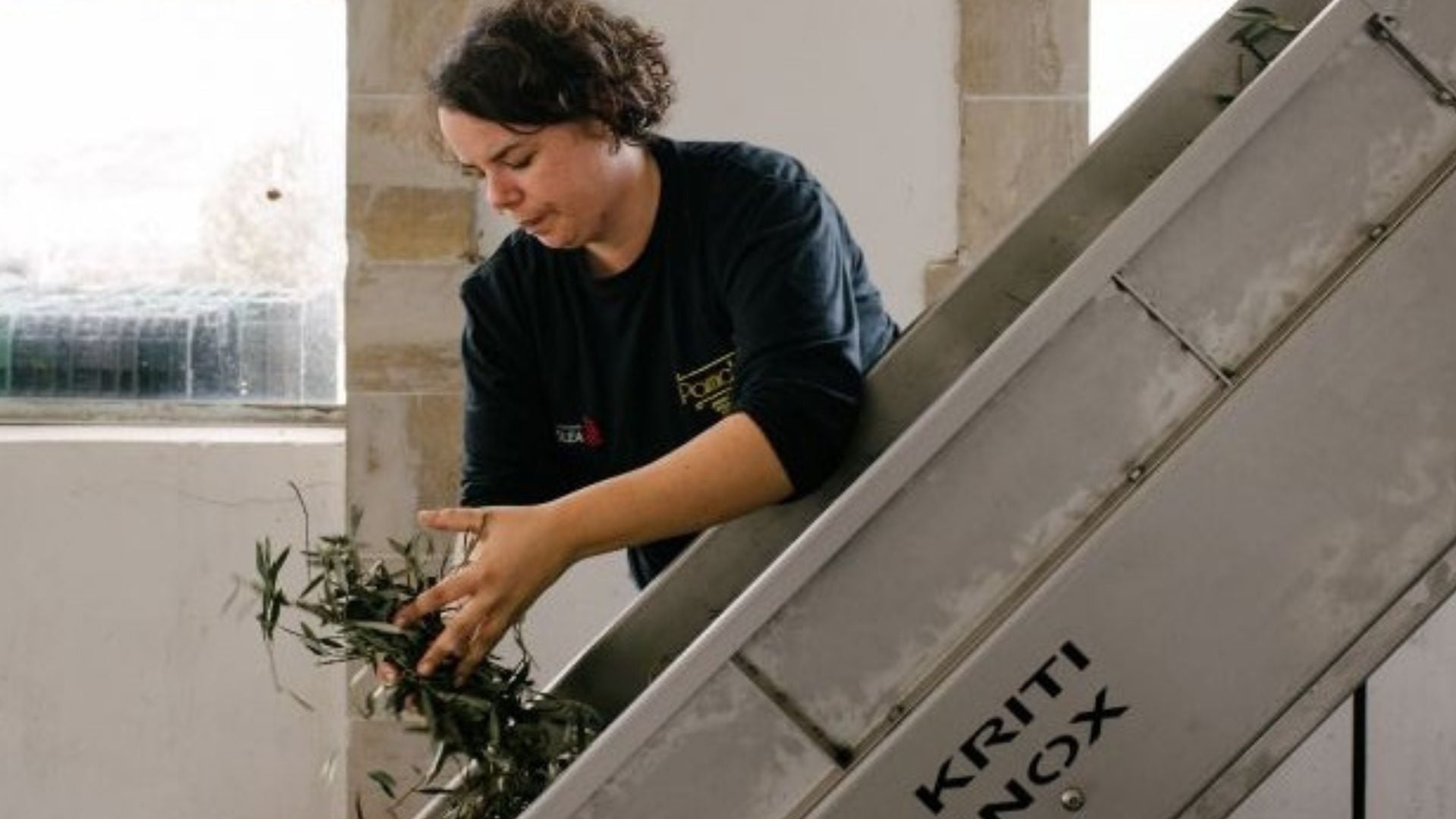
Thanks to Chloe Dimitriadis (with the conveyor belt) and Christina Chrisoula (in the olive grove) for the photos of them that were used with this article.
*International Year of the Woman Farmer
The United Nations declared 2026 the International Year of the Woman Farmer (IYWF 2026) “to raise awareness of the role of women in agrifood systems and the challenges they face” and “to encourage policies and investments that empower women in agrifood systems.” This is part of the United Nations Decade of Family Farming 2019–2028, which promotes inclusive policies and investments for family farming, and reinforces the vital contributions of women farmers and pastoralist communities to sustainable, climate-resilient agrifood systems.”
For more about Greek women farmers, see Women Olive Farmers in Greece: What Motivates Their Work as well as Women Olive Farmers in Greece: Impact Beyond the Groves.
*Originally published on Greek Liquid Gold: Authentic Extra Virgin Olive Oil (greekliquidgold.com). See that site for recipes with olive oil, photos from Greece, agrotourism and food tourism suggestions, and olive oil news and information.
Dining and Cooking