

For Madison chef and author Sultan Ahmed, the recipes in his debut cookbook aren’t meant to be quick, 30-minute meals.
“We live in a world that increasingly demands a quicker pace, right?” Ahmed told WPR’s “Wisconsin Today.” “Cooking that produces depth of flavor takes time, it takes effort, and it takes intention … (these recipes) are intended to teach you technique as well.
Ahmed’s first cookbook is titled “Zameen: Pakistani Roots, Wisconsin Soil.” The first word of this title means “land” in Urdu, the common language spoken in Ahmed’s home country of Pakistan. He emigrated to the United States from Karachi in 1998. He told WPR the book combines the cuisine of Pakistan with his home in Wisconsin.
Understanding Wisconsin, Together.
WPR’s “Wisconsin Today” newsletter keeps you connected to the state you love without feeling overwhelmed. No paywall. No agenda. No corporate filter.
 Sultan Ahmed, owner and chef at “Sultan” in Madison, is photographed for the cover of his cookbook “Zameen: Pakistani Roots, Wisconsin Soil.” Courtesy Kayla Gendron via Orange Hat Publishing
“I chose (Zameen) for the title of the book because a central component of our philosophy is that the cuisine is defined by the land that it’s cooked on,” Ahmed said. “We want to highlight Wisconsin agriculture.”
This cookbook introduces Pakistani cuisine, by way of ingredients native to Wisconsin or North America — like walleye or yukon gold potatoes — and includes twists to classics like a Wisconsin fish fry or chicken and waffles.
Ahmed told “Wisconsin Today” about the book and why he said it’s worth it to put in the extra effort to grind spices and focus on how to plate food at home.
The following was edited for clarity and brevity.
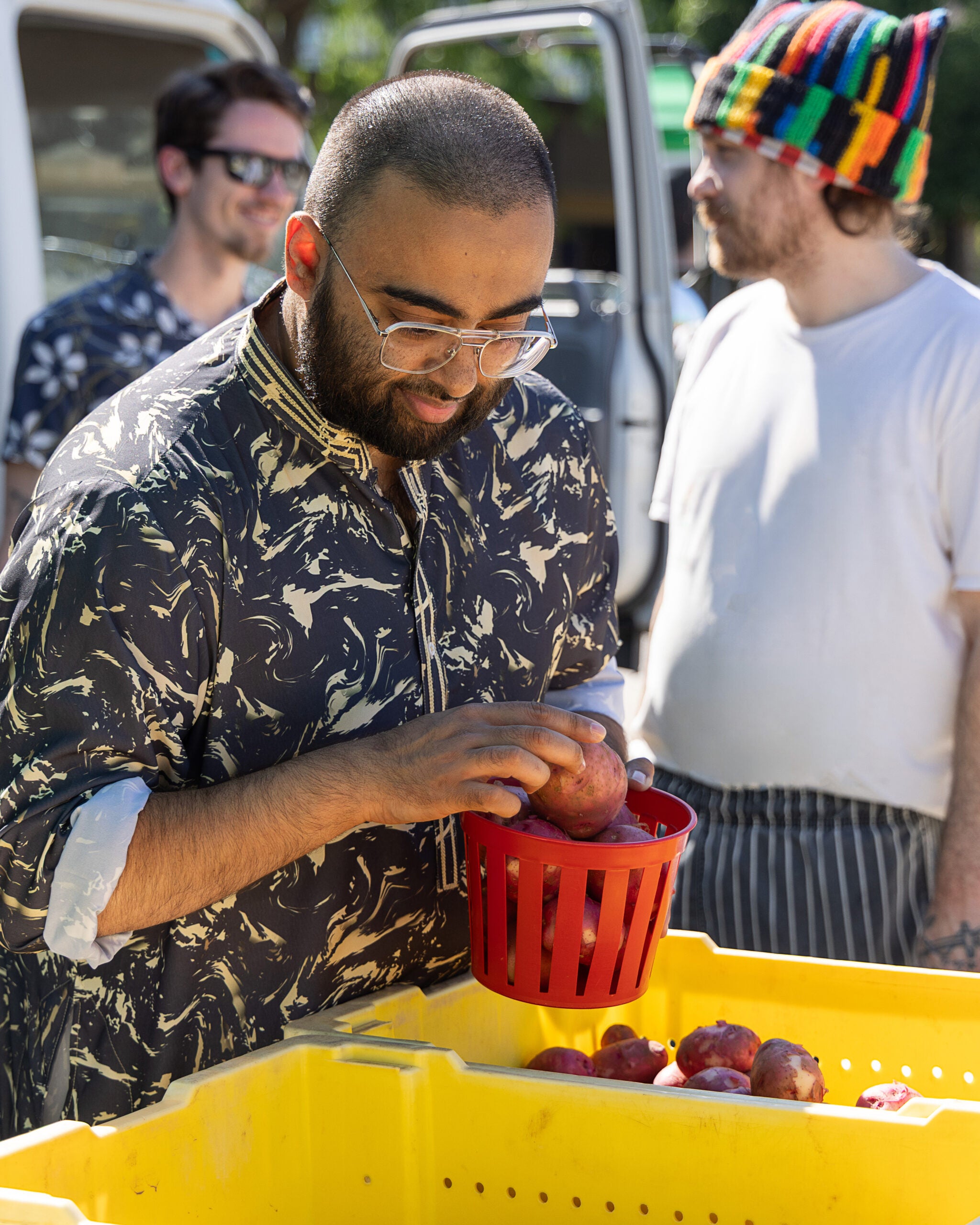 Sultan Ahmed, owner and chef at “Sultan” in Madison and author of the cookbook “Zameen: Pakistani Roots, Wisconsin Soil” is photographed at a farmers market. Courtesy Kayla Gendron via Orange Hat Publishing
Kate Archer Kent: For people new to cooking Pakistani food, you say it’s not about drowning in spice, but understanding a spice’s personality. What ingredients and spices should we become acquainted with to delve into this food?
Sultan Ahmed: Some of the common ones that are used in the cuisine — Tellicherry pepper is I think one of the central ones. You buy ground black pepper at the store, but we really advocate that you buy whole Tellicherry peppercorns, which is an Indian species of peppercorn, and grind it fresh.
Turmeric is a central one. Chili powders like Kashmiri chili powder, even like South American chipotle chili powders. Understanding the differences and when they can be used, those are really important. And then the herbal spices too: ginger, coriander. These ones are used a lot in the cuisine and in the book. And it’s important to understand how they function.
 Miscellaneous spices are photographed for the cookbook “Zameen: Pakistani Roots, Wisconsin Soil.” Courtesy Kayla Gendron via Orange Hat Publishing
KAK: You urge readers to grind and toast spices themselves, rather than purchase them pre-ground. Why should someone making these recipes go through these extra steps themselves?
SA: For a lot of spices, especially the ones that come from seed or solid material — like coriander or cinnamon or like cardamom pods — the flavor from those and the aroma comes from the oils that are trapped within the substance. So if you grind it or you create the powder ahead of time, then all those oils start evaporating. So as they’re sitting in the bottle or sitting on your shelf, you’re losing more and more of the potency and flavor.
The difference between the fresh ground spice — or the whole spice that goes into your braise and a pre-ground spice from the store — is night and day. I think a lot of people haven’t ever experienced fresh ground spices, so they don’t quite know the difference and how dramatic it can be.
KAK: Your cookbook asks us to move away from precise measurements for spices. These recipes call for ingredients in proportion. I can imagine this can be a challenge for some home cooks who haven’t used proportion and really lean into precise ingredients in their recipes. What advice do you have for us to become more comfortable with cooking in this way?
SA: Proportional ingredients apply specifically to spices, and the reason for that is because the spices are changing all the time. Even within the same day, if you leave cardamom pods out on your porch, they will taste completely different in the morning than they will in the afternoon, than they will in the evening.
It also depends. Turmeric root is grown all over the South Asian continent. Turmeric roots that are grown 200 miles apart yield a completely different sort of flavor depending on the soil, the climate, all of these factors. To have a precise measurement doesn’t really do the recipe justice, and will actually give you a different result almost every time. It’s not going to taste the same, and oftentimes it won’t taste correct.
So really, the only way to do it is to learn how to taste the spices. And you do that by grinding them and then blooming them in some sort of neutral fat. You can use oil. We use ghee because that’s the most common oil fat that’s used in South Asian cuisine. But you can use canola oil or grapeseed oil. You have to just apply the heat and then taste, and you have to learn the character of the spices that you have. And so, really, it’s just a process of trial and error, and experience.
 A serving of aloo palak is phototographed on a black plate. Courtesy Kayla Gendron via Orange Hat Publishing
KAK: You write that aloo palak — one dish in your book made with Yukon gold potatoes coated in a masala, placed atop a thick spinach puree — is the most emblematic dish in the book. Why is that?
SA: The reason it’s emblematic is because it’s a complete deconstruction and a slight elevation of what is a staple in South Asian cooking. The aloo palak, you can get it in any region of Pakistan, any region of India. It’s always kind of the same. It’s like very soft potatoes that are braised and almost falling apart in this spinach puree. Sometimes the spinach isn’t even pureed. It’s just like a spinach sauce, and the leaf is still in there. Like with a lot of South Asian dishes, it’s very homogenous. It’s a sauce and components that are floating in it and slow-simmered in it, and so everything comes together.
What we’ve done here is we separate everything. So we create the spinach puree separately. We do the potatoes with their own bespoke spice mix separately. We blanch and shock them, and then we sauté them to get a nice texture. We don’t put a crust on them or a sear, so we still maintain the soft texture that you would get as if it was one homogenous dish. And then we plate the potatoes on top, and we add a little bit of an elevated element with our crispy spinach chips, which are also dusted with a Punjabi spice mix to add a little extra texture into the dish as well.
 A serving of kaddu saag is phototographed in a white bowl with a side of rice. Courtesy Kayla Gendron via Orange Hat Publishing
KAK: You mentioned plating … because this and other recipes are pretty too. There is a presentation aspect to this. Why should we care about how we plate our dishes?
SA: Plating has two functions. First, beautiful food tastes better. Studies have shown this. People eat with their eyes first and if it’s pretty, they’ll just automatically think it tastes better. It’s a psychological thing, so that’s very important.
But at the same time, I really want South Asian food to be considered at the upper echelons of cuisine. The techniques are complex, the skill is very high level, and it takes a lot of knowledge and talent to cook this. But oftentimes, when the dishes are cooked, they’re just thrown into a bowl and then you get a bowl of rice or some bread with it on the side, and then you eat it. A lot of that process gets lost in it.
But I think when you do a beautiful plating, it really highlights all the different components that comprise the dish. I think people should pay more attention to their plating, even when they’re cooking at home. Plus, it’s just kind of fun. It’s artistic to play around with it and see how different things look.
Dining and Cooking