
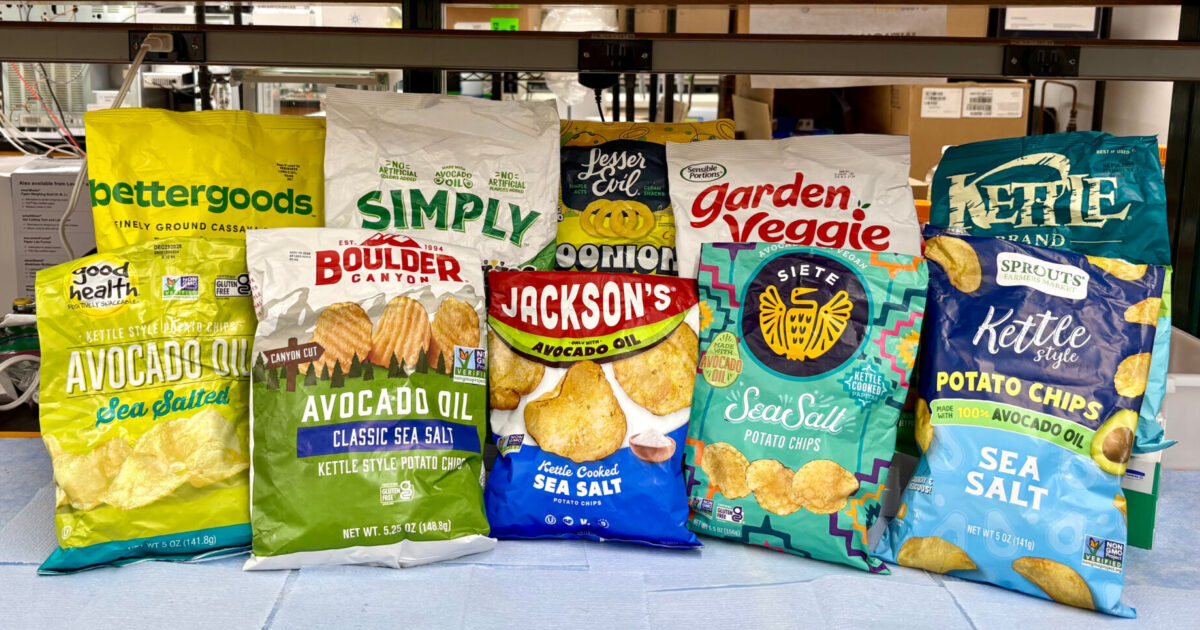

The products pictured were among the 54 avocado-labelled products tested for avocado oil authenticity in the Wang lab at UC Davis. Image source: Natalie Lopez-Alvarez/UC Davis
A new study by researchers at the University of California, Davis (UC Davis) found that 89% of avocado oil-labelled processed foods tested contained other oils.
As part of the study, the team tested processed foods marketed as containing avocado oil. Out of the 54 products tested, 48 were adulterated with other oils, a 15 July press release on the UC Davis website said.
Purchased in 2025 and 2026 from online retailers and California stores, the products represented only a portion of the avocado oil processed food market, the study pointed out.
“Consumers are increasingly paying a premium for products made with avocado oil or olive oil,” said lead author Selina Wang, Professor of Cooperative Extension in the UC Davis Department of Food Science and Technology.
“They deserve to get what they pay for and food manufacturers deserve confidence that the ingredients they purchase from suppliers are authentic.”
Researchers found that of the products tested, 93% of potato chips, 71% of mayonnaises and 100% of salad dressings labelled as authentic avocado oil contained other oils.
However, when the same purity tests were applied to 20 olive oil-labelled processed foods, only one failed.
The gap between avocado and olive oil results reflected the fact that olive oil authenticity had been studied, tested and scrutinised for decades, the report said.
As a relatively new and expensive product category, avocado oil had not been monitored at the same level.
In response to the latest UC Davis study avocado oil in processed foods, the Avocado Oil Manufacturers Association (AOMA) issued a statement on its website on 14 September.
“The substitution, dilution or misrepresentation of avocado oil is unacceptable,” AOMA said.
“We call for rigorous science, responsible communication and international cooperation to strengthen authenticity standards, protect consumers and support responsible producers worldwide.”
AOMA called on the entire sector – producers, food manufacturers, laboratories, universities, regulators and retailers – to organise a coordinated international research programme to develop a standard of identity covering all commercially relevant avocado varieties, origins and production methods.
The study was the latest in a series of UC Davis research projects on the authenticity of avocado oil. A 2020 study found 82% of commercial bottled avocado oil were either rancid or mixed with other oils, while a later study found 70% of private label oils were rancid or adulterated.
The findings of the latest study were published in Applied Food Research.
Dining and Cooking