

When, in early 2009, Boekenhoutskloof’s managing partner and technical director, Marc Kent, was driving north through the Swartland with Rudiger Gretschel to look at some sites for his Chocolate Block label, Gretschel pointed out an elevated block where Eben Sadie got his Syrah from for his celebrated Columella blend. The pair decided to call in on the owner-grower to see if they might, too, buy some of his fruit.

Porseleinberg is one of the world’s top Syrah vineyards
“We met this guy Jakob, but he said he’d only got eight tons to sell,” Marc Kent recalled. “He’d already allocated most of it to Eben and Adi Badenhorst, who were both across the road, but he decided to give me a ton. ‘That’s all I can spare you,’ he declared, ‘but don’t you want to buy the farm?’ I replied no thanks. So I took my ton, made two barrels of wine, and realised I had something special here.”
The barrels provided the wine for the Cape Winemakers Guild Boekenhoutskloof Syrah 2009, which earned rave reviews. “It was an interesting time for Boekenhoutskloof as Chocolate Block was really taking off, but we were quite exposed because of my limitations,” Marc continued.
“As a business, we didn’t want to own vineyards as viticulture is not my skill-set, but I started thinking maybe this is the time for us to own our own vineyards and secure our future, as most of our Syrah was coming from Schalk Burger in Wellington. So I went back to my partners and we agreed to buy Jakob’s farm.”
And so the legend of Porseleinberg was born. Marc still needed, however, to find someone to act as both viticulturist and winemaker for the farm. Ironically, he met what proved the right man at a Swig clients’ tasting in Soho: Callie Louw, then winemaker for Tulbagh Mountain Vineyards.

“I would taste all the wonderful Rhône wines and use them as a reference to inspire myself before harvest.” Marc Kent.
“I realised Callie was quite a cool guy who knew what he was doing,” Marc mused. “I went home, looked up his number, and asked him round for a beer. He said straightaway he was in on the Porseleinberg project. He incubated it, and we grew it together. His appetite and work ethic has been unparalleled. He was planting 20 hectares of vines for us 16 years ago, and now aged 47, he’s planted 17 hectares this year again. He’s incredible.”
Marc Kent was speaking at a special vertical tasting of Porseleinberg in early September that was laid on by Boekenhoutskloof’s UK importer, New Generation Wines. It is the first retrospective of the wine in London since Callie Louw conducted a tasting in London in 2023, and the first since Eben Meiring took the winemaker reins as Louw’s successor, having previously worked alongside Gottfried Mocke at Boekenhoutskloof.
The September tasting also coincided with the release of the latest Porseleinberg vintage, 2024, which was part of the tasting along with the 2010, 2011, 2012, 2013 and 2014 vintages. The Cape Winemakers Guild Boekenhoutskloof Syrah 2009 was also featured. More on them later.
Continuing the story, Marc recalled how, after recruiting Louw, he still needed a press and decided to buy one in France at the annual Marché aux Vins d’Ampuis festival in January 2010.
“I would taste all the wonderful Rhône wines and use them as a reference to inspire myself before harvest,” he said. “I took Callie along in 2010, but we didn’t have a press, so I took Xavier Gérard from Condrieu aside and told him I was looking. He knew someone from Côte Rotie who wanted €800 for his. I bought it, and It cost about €3000 to get it over to South Africa. To this day, that press is the only one that presses Porseleinberg fruit.”

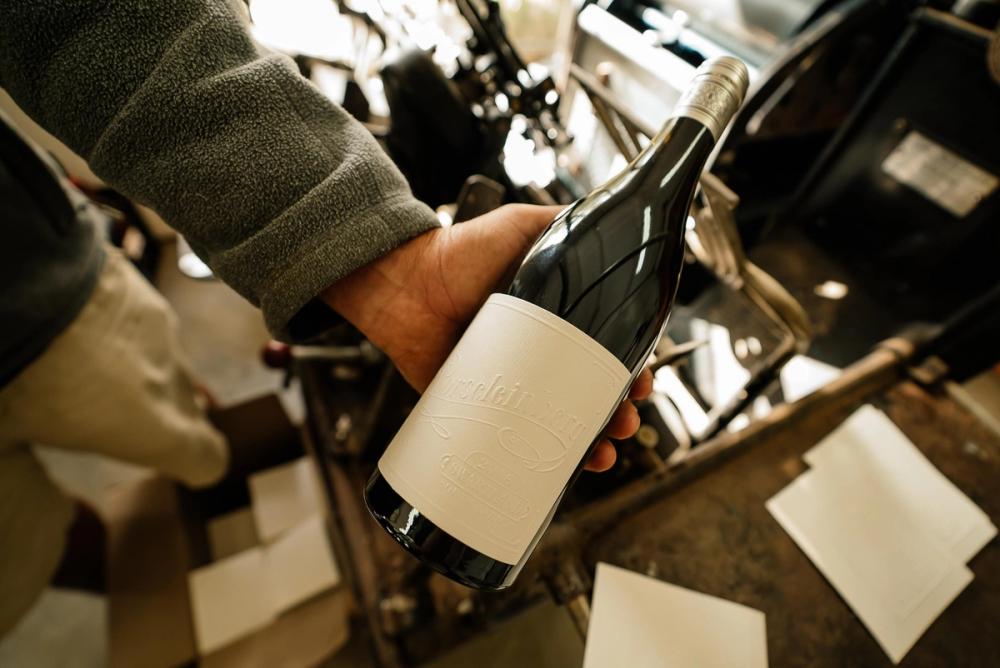
Every one of Porseleinberg’s labels has been printed by Callie Louw on the printing press at the vineyard
“That’s been the fun part of the journey – a bit the same as the label. I went to the designer and said I want a label without ink. He said that would be a problem with the authorities, and it was. So I went to our printer and asked him if he could do it. He said there were only two letter presses in Cape Town that were suitable, but I bought one of them. Callie has done all the printing for every single label himself. With each bottle, the label has to go through that press four times. You emboss the front label, then you put it through again to cut it; then you print the back label, which has the statutory info on it, and you put that through again to cut it.”
“Our rule then was that you couldn’t buy Porseleinberg unless you’d been to the vineyard. It was quite difficult to enforce but we were quite rigid at the time. We kind of insisted on that and it worked. To this day, we have about 700-800 private clients who each get their own Porseleinberg back label.”
If that was unusual, so too was the experimentation with Porseleinberg’s élevage.
“We had the opportunity to really take our time over the project,” Marc said. “With the 2010, the élevage was 18-24 months. With the ’11, very deliberately, we had 24 months; then with the ’12, it was 12 months; with the ’13, 24 months; with the ’14, 12 months. So we kind of bottled two vintages at a time and were following the trajectory. It was a real luxury but it was by design. We wanted to see what we could do differently at Porseleinberg but we had the luxury of not having the pressure to sell. We landed up with much shorter élevage – in foudres and concrete eggs, and then more time in bottle pre-release.”

Tasting back vintages at the launch of Porseleinberg 2024, London, September 2026
The celebrated 2011, of which only 100 cases were released, was sold at auction for a then record-breaking R2000 per bottle. A fearsome heatwave in January and early February hampered growing conditions, leading to tiny volumes that filled just two concrete eggs after fermentation. Blue fruit from Porseleinberg’s blue mica schist was a hallmark of this complex wine.
The 2012 vintage yielded a slightly higher crop – still only a measly 9hl/ha – with 230 cases produced. Acidity was even lower (TA 4.8g/l; pH 3.9) but sufficient to balance a wine of lower alcohol (13.6%) and softer tannins. The fruit’s brightness was captivating .
Maturation was in 60% foudres and 40% concrete eggs for the 2013 vintage, which saw some rain at the right times and a slightly cooler ripening period. Harvesting was, accordingly, a little later, in the second week of February. Suave tannins were a feature, while still providing plenty of structure. Long and intense, this had appealing liquorice notes.
The 2014 vintage was a farming nightmare, with lots of downy mildew to contend with. Yields were consequently low, but thanks to a wet winter, berries were bigger than normal. Maturation was in 100% foudres. Beautifully bright fruit was apparent, as were fine-grained tannins that, like the older vintages tasted, still retained their grip.

At first only visitors to the vineyard could buy bottles of Porseleinberg
Porseleinberg 2024
And, finally to the Porseleinberg 2024, the first vintage after full organic certification was conferred in 2023. At 14.26% abv, it was the highest in alcohol of the flight but, bolstered by TA of 5.7g/l, neatly balanced with refined tannins. Elevage before bottling in June 2025 was 90% in foudres and 10% in concrete eggs. Fermentation was made using wild yeasts, with predominantly whole clusters (10% de-stemmed fruit). Harvest was one of the earliest of the past decade, but the yield was generous and fruit concentration formidable.
Strongly perfumed with aromas of violet, black pepper and wild herbs, the multi-layered ’24 has gloriously intense and complex concentration with notes of black cherry and blackberry. While powerful with sufficient structure to age for 15-20 years, it oozes freshness and saline minerality. All its components are in balance with no acidification necessary (as per every Porseleinberg vintage according to Kent). Long and noble, it could be a top northern Rhône – a Super Rhône even – but let’s give it its own moniker: a Super Swartlander.
Another magisterial Porseleinberg indeed, from one of South Africa’s true icons and one of the world’s great Syrah vineyards.
Porseleinberg 2024 along with the rest of the Boekenhoutskloof portfolio is available in the UK through New Generation Wines which is a commercial partner of The Buyer.
Dining and Cooking