

Abstract
In Italy, agricultural districts have evolved from their original configuration, inspired by industrial district models, towards structures that are more functional and aligned with agri-food policies and territorial development strategies. This process culminated in the institutional recognition of food districts through Law No. 205/2017. Despite not providing a fully unified legal framework, this law brought various forms of districts under a common definition. Today, these entities are regarded as territorial tools intended to promote endogenous development, territorial cohesion and sustainability. This study examines the institutional and regulatory architecture of food districts in Italy from a multilevel governance perspective, focusing particularly on regional differentiation and territorial distribution. The research combines a systematic review of national and regional legislation with an updated map showing the locations of officially recognised districts, classified by typology. The objective is to evaluate the consistency of the regulatory framework and to identify emerging models of territorial implementation. The results reveal a highly heterogeneous institutional landscape characterised by uneven levels of regulatory completeness and differentiated implementation models at regional level. This fragmentation impacts coordination between different governance levels and influences their operational capacity. Overall, food districts emerge as flexible place-based governance instruments, the effectiveness of which depends on the degree of alignment between national legislation and regional regulatory adaptations, as well as the quality of participatory processes at the local level. These findings provide valuable insights for designing integrated territorial development policies and strengthening sustainability transitions within agri-food systems.
1 Introduction
The concept of district has progressively gained recognition and significance in the analysis of local agri-food systems (Berti, 2020; Iovino et al., 2023) and in rural development policies (Tarangioli, 2023, 2024). Although the district concept originated within industrial policy theory, after many years of debate and study of local experiences, it can now be effectively applied to agricultural and rural contexts.
Starting from the 1970s, development has been progressively conceived as a multidimensional process rooted strictly into local contexts, where institutional, social and cultural factors play a decisive role (Sen, 2001; Thorbecke, 2007; Todaro and Smith, 2015). This has fostered the importance of endogenous development models and place-based approaches founded on multi-level governance and bottom-up processes (Segrè and Frascarelli, 2008; Rossi et al., 2019; Sforzi, 2005). These changes have directly affected policies supporting rural and agri-food development, laying the groundwork for the institutionalization of functional systems of endogenous development as food districts are (Capello, 2016). In Italy, this process culminated in 2017 with the formal recognition in legislation of food districts. This provision provides official regulatory and operational recognition of agricultural and rural districts across in Italy. It has supported the formalisation of these entities, enabling the analysis of local agri-food systems while responding to the need to implement bottom-up strategies for local development (Iovino et al., 2023; Strambi, 2024).
Within the Italian regulatory framework, the notion of the agricultural district derives from the concept of productive district introduced by Law no. 317/1991. The extension of the district model to the agri-food sector was first legally established by Legislative Decree 228/2001, which introduced rural districts and quality agri-food districts. This transition reinforced the importance of the agricultural sector, agri-food supply chains, and regional strengths, with a clear focus on promoting place-based policies, in accordance with Title V of the Italian Constitution (Brasili et al., 2004). Subsequently, Law 27 December 2017, no. 205 (art. 1, paragraphs 499–504) institutionalised food districts as national agricultural policy instruments expanding and systematising the previous regulatory framework. The legislation introduced the national register of food districts, assigning to the Regions the task of recognising districts and to the Italian Ministry of Agricultural, Food and Forestry Policies (MASAF) the functions of monitoring and managing the register. The food district is thus configured as an “umbrella” category, capable of encompassing rural districts, quality agri-food districts, organic districts, local productive systems in urban areas, and other forms of territorial organisation founded on principles of sustainability, participation and supply chain integration. From an institutional perspective, therefore, districts in the agricultural and agri-food sectors are configured as policy instruments that originate from a national legislative input and are subsequently shaped at regional and local levels, based on defined rules and criteria. This configuration reflects a multi-level governance structure, in which national regulatory direction is progressively adapted to territorial specificities through coordination processes between public institutions and local actors.
Considering the regulatory framework outlined above, this contribution presents an updated mapping of food districts in Italy, distinguishing them by type and territorial distribution.
Nearly 10 years after the introduction of this framework, it seems relevant to assess how legislation has been implemented at the territorial level, highlighting differences and common features across regions. Furthermore, the authors aimed at assessing the extent of the diffusion of the district phenomenon in Italy, by examining the differences that emerge at the local level, particularly in terms of typologies and sectoral specialization. To this end, the regulatory architecture governing their operation is analysed, with reference to the relationship between national legislation and its regional interpretations. In this framework, the following research questions are addressed:
(i) How have Italian regions implemented the national legislation on food districts at local level? What differences emerge among Italian Regions in terms of recognition criteria, institutional requirements, and place-based governance instruments for the identification and management of food districts?
(ii) Which types of districts are most widespread and what is the current map of food districts in Italy in terms of territorial distribution and typology
(iii) To what extent does regional heterogeneity affect the ability of food districts to contribute to sustainability and territorial development objectives?
To address this research ambition, the paper is structured into six sections. The first section is dedicated to the introduction of the topic. The second section is devoted to the theoretical framework of the district concept, with a focus on its evolution from industrial economics to rural development. The third section describes the study’s methodological framework, which is based on an integrated approach combining public policy analysis, comparative institutional analysis, and the construction of territorial datasets. It also explains the criteria for data collection, harmonisation, and classification of normative and territorial data related to food districts, with particular attention to regional differences and the development of a national mapping. The fourth section presents the results of the regulatory and territorial analysis. This section also provides an in-depth examination of the funding programs promoted by the MASAF for food districts, illustrating the features, criteria, and territorial distribution of projects funded under the 2020 and 2024 calls. The fifth section is dedicated to the discussion and analysis of the results obtained, while the final section presents the conclusions of the study.
2 The theory around the concept of district: a brief review of the concept of districts and its evolution from industry to agriculture
The concept of district originated with Marshall (1920), who interpreted it as a territorial concentration of firms sharing an “industrial atmosphere,” based on the exchange of tacit knowledge, informal learning and a strong territorial rootedness. In Italy, the Florentine school developed this vision by placing the territory at the centre as a complex socio-economic system, in which communities, businesses and institutions are closely interconnected (Becattini, 1987, 1990). Becattini’s (1990) analyses, combined with the successful experiences of Tuscan districts, highlight the centrality of space, relational dynamics, and functional interdependencies among local actors as drivers of endogenous development, anticipating many of the premises later adopted in food districts. In his view, the district is understood as “an independent socio-territorial entity, characterised by the active co-presence, within a defined territorial area, naturally and historically determined, of a community of people and a population of industrial enterprises”. What distinguishes Becattini’s approach is the focus on the community and institutional dimension of the production process, an element particularly relevant in the analysis of territorialised agri-food systems. The district is therefore not merely an aggregation of firms, but a territorialized productive system in which the community and institutional dimension assume a key role (Iovino et al., 2023; Sforzi, 2008).
The application of the district model to agricultural and rural systems has generated extensive theoretical debate over time. However, more than 30 years after the first contributions on the subject, the transfer of the district paradigm from industry to agriculture at a theoretical level can be considered essentially complete. The extension of the district paradigm to agriculture is owed above all to the contributions of Iacoponi (2001) and Cecchi (1992), who highlighted its relevance for agricultural and rural systems (Iovino et al., 2023). The district concept was indeed reinterpreted in the agri-food sphere, assigning districts a central role in fostering collaborative learning and shared innovation (Del Puente et al., 2026; Guareschi et al., 2020).
This evolution is embedded in a broader rethinking of rural territories, relating both to normative analysis and to policies. The concept of rural has gradually acquired new significance, becoming an enabling condition for potentially virtuous development pathways (Storti, 2000). From a mere container of productive activities, the rural territory has started to being considered as a relational space where productive practices, institutions, knowledge and local communities interact to support the construction of sustainable models, integrating coordination instruments, technological innovations and participatory approaches (Dansero et al., 2015; Edelmann et al., 2020). Within this framework, the value of “local” approaches and relational networks has encouraged more flexible, multi-level place-based governance instruments, where public actors, businesses and local communities interact to support processes of technological innovation and integrated practices for sustainable development (Briamonte et al., 2026; Colella and Caputi Jambrenghi, 2020; Del Puente et al., 2026; Lamine et al., 2023).
Territorialized agri-food systems therefore emerge as operational instruments of territorial development, capable of connecting endogenous resources, institutional capacities and processes of socio-technical innovation (Berti, 2020; Dansero et al., 2015; Lamine et al., 2019). Among these, districts can be interpreted as territorial policy instruments aimed at reorganising local food systems according to logics of multidimensional sustainability, value chain integration and multi-level institutional coordination (Caron et al., 2018; FAO, 2018; Lamine et al., 2023). The theoretical debate has therefore now shifted from the question of the model’s adaptability to its capacity to respond to the new challenges of rural development and food systems, such as economic, social and environmental sustainability, territorial resilience, and the strengthening of local competitiveness.
Value chains rooted in the territory play a strategic role in redistributing economic value, qualifying production, and fostering competitive advantages based on quality, traceability, and territorial identity (Ciasca et al., 2025; Colella and Caputi Jambrenghi, 2020; Guareschi et al., 2020). These territorial institutional structures contribute to integrating public policies, local actors and environmental resources, thereby functioning as operational devices for systemic resilience in contemporary food systems (FAO, 2021), while simultaneously enhancing agriculture as both a producer of goods and a provider of environmental services. Here, resilience means the ability of socio-ecological systems to adapt and change when faced with economic, environmental, or social shocks (Briamonte et al., 2026; Folke, 2006; Walker et al., 2004). The district approach enables us to interpret the enhancement of rural economies through a territorial lens, where endogenous resources are transformed into competitive assets. However, this competitiveness can only be realised when supported by appropriate place-based governance instruments (Bencardino et al., 2005).
In this model, governance is no longer simply a functional tool for coordinating stakeholders, becoming an enabling factor. It can guide local development paths, encourage collective action, and integrate economic, environmental, and social objectives. This perspective positions food districts within a broader array of soft governance instruments (Tarangioli et al., 2024). They represent soft place-based governance instruments, the effectiveness of which depends on the activation of shared responsibilities, collective learning and territorial project capabilities (Fondacci, 2023; Russo, 2024; Strambi, 2024). In particular, the transition from a hierarchical regulatory model to a participatory one, based on local partnership, has been described as a genuine regulatory regime shift (Briamonte and Scarpato, 2025; Mantino, 2006; Sivini, 2006). Here, the effectiveness of policies and norms does not rely solely on prescriptive or punitive mechanisms, but rather on the ability to foster shared responsibilities and collective learning among the actors involved.
Viewed from this angle, the territorial and institutional model in Italy offers a valuable case study. Empirical studies highlight that such frameworks are especially pertinent in rural and agri-food settings. In these areas, the complexity of territorial relationships makes coordination tools and intermediary institutions particularly important (Fondacci, 2023; Gattullo, 2022; Russo, 2024). Districts can therefore be seen as a means of territorializing food policies. Through this, sustainability strategies are translated into practical actions embedded within local contexts and regional institutional frameworks (Monticone et al., 2023; OECD, 2023). Beyond the Italian case, the study also contributes to the broader European debate on place-based governance instruments for sustainable rural and agri-food development, offering reflections on the transferability and limitations of territorial coordination models within different institutional settings.
3 Materials and methods
This analysis is situated within the regulatory and programme evolution of food districts in Italy. This process is characterised by the progressive stratification of support tools and measures that are not always aligned with a unified strategic plan. Specifically, the absence of a comprehensive review of the overarching policy framework, combined with the high degree of heterogeneity in governance, particularly regarding the relationship between the state and the regions, necessitates a systematic and comparative reconstruction of the phenomenon.
This study takes an integrated approach, combining public policy analysis, comparative institutional analysis and the development of territorial datasets, to reconstruct the multi-level regulatory architecture and territorial distribution of these districts. The analysis was conducted through policy mapping based on information retrieved from institutional websites and public databases (Monticone et al., 2023). More specifically, the study combines spatial, institutional and regulatory mapping approaches, integrated with a typological classification of food districts. The spatial mapping concerns the territorial distribution of districts across Italian Regions, while the institutional and regulatory mapping focuses on recognition criteria, institutional requirements and governance instruments adopted at regional level. The research is grounded in three primary methodological components:
Systematic analysis of national and regional legislation;
Construction of a structured dataset of regional legislative acts;
Identification, classification and mapping of districts recognized in the National Register of food districts.
This multi-source strategy uses a data triangulation approach to strengthen the robustness and comprehensiveness of the empirical evidence, especially given the different administrative practices in Italian regions. The dataset was developed based on relevant national legislation, specifically Law No. 205/2017 (titled “State Budget for the 2018 financial year and the multi-annual budget for the three-year period 2018–2020”), and was supplemented by an analysis of regional implementation measures and administrative acts governing the recognition of individual districts. Data collection involved systematically examining primary and secondary regulatory sources, official regional registers and institutional documentation retrieved from the relevant administrative websites. The data were then standardised and harmonised to ensure consistency in classification, despite the terminological and procedural variations at regional level. Based on national and regional regulatory frameworks, a classification methodology for food districts was developed and organised according to legal typology, territorial scope and functional characteristics. The resulting mapping provides updated, comparable information, which is instrumental in reducing information asymmetries between regional contexts and enhancing the monitoring and evaluation of sectoral policies. Figure 1 provides a conceptual and methodological framework of the overall research design, illustrating the integration between the three analytical components (legislative analysis, dataset construction, and territorial mapping) and the sequential workflow from data collection to harmonization and mapping outputs.

Analysis framework of Italian Food Districts. Source: authors’ elaboration.
3.1 Systematic analysis of national and regional legislation
The study is based on the construction of a comprehensive and systematic dataset of Italian Regional legislation regulating territorial districts in the agri-food system. The unit of analysis is the individual regulatory act adopted at the regional level. The dataset, developed as a structured Excel spreadsheet, collects and organizes regional legislation concerning productive, agri-food, rural, organic and, more broadly, food districts, as framed by the national legislator following the introduction of a unified definition food districts under by Law No. 205/2017.
The repertoire includes regional laws, cabinet resolutions, managerial decrees and implementing regulations, enabling a comparative assessment of regional approaches to food districts governance. This comparative perspective is grounded in an institutional analysis approach, which interprets regulatory provisions as formal rules structuring governance arrangements, actor roles and implementation processes (Ostrom, 2009).
The temporal scope spans from 1999 to 2025, allowing for a longitudinal analysis of regulatory development before and after the introduction of the national definition of food districts under Law No. 205/2017. The starting year (1999) was selected as it corresponds to the earliest identifiable and systematically comparable regional legislative interventions concerning territorial and agri-food development instruments, preceding the subsequent phase of consolidation and harmonisation introduced by law. This temporal comparison enables the examination of regulatory adaptation and vertical coordination dynamics within Italy’s multilevel governance system (Bache and Flinders, 2004) (see Table 1).
Region1999–20172018–2025TotalAbruzzo707Basilicata224Calabria617Campania426Emilia-Romagna066Friuli Venezia Giulia336Lazio4610Liguria909Lombardy11516Marche6410Molise314Autonomous Province of Bolzano134Autonomous Province of Trento415Piedmont13619Apulia448Sardinia347Sicily516Tuscany16824Umbria167Aosta Valley101Veneto6410
Legislative and administrative acts issued by each region (1999–2017 and 2018–2025).
Source: authors’ elaboration.
The table highlights a higher level of regulatory production during the 1999–2017 period, which can be interpreted as a phase of construction and consolidation of the regional legislative framework. In this timeframe, most Regions concentrated the adoption of foundational and structural measures. In contrast, the 2018–2025 period shows an overall reduction in the number of enacted measures, with some notable exceptions (such as Emilia-Romagna, Lazio, and Umbria), where legislative and administrative activity intensified. This trend suggests a shift from a predominantly foundational and regulatory phase toward a more implementation-oriented stage, focused on updating, refining, and operationalizing existing legal instruments.
For each regulatory act, a structured content analysis was conducted to identify the presence or absence of key institutional components relevant to district governance and operational functioning. The coding procedure follows established approaches in qualitative content analysis applied to policy and legal texts, ensuring systematic and replicable classification of regulatory provisions (Krippendorff, 2018). The authors performed a qualitative analysis of the regional policies, which entailed the creation of interpretative frameworks for the evaluation of their context and content (Monticone et al., 2023). The content analysis was complemented by an institutional policy analysis aimed at interpreting the regulatory logic and governance orientation underlying regional legislative frameworks.
The analytical structure is organized along two axes:
The variables were grouped into five governance dimensions, outlined in Table 2 below:
N.Governance dimensionDescription1SubjectsThe entities/subjects promoting the food district2ObjectivesThe goals of the food districts3GovernanceThe governance and planning arrangements for the districts (e.g., district committees, assemblies, district plans, etc.)4RecognitionThe procedures for the individuation and approval of the districts (their territory, the representativeness, the production area, etc.)5MonitoringMonitoring and control mechanisms for the districts
The governance dimensions.
Source: authors’ elaboration.
The selection of these governance dimensions reflects a policy design perspective, focusing on how institutional instruments define actor roles, implementation mechanisms and monitoring arrangements within public policy frameworks (Howlett, 2019). The justification for choosing these dimensions draws upon the official ministerial decrees regulating the criteria, methods and procedures for the establishment of the food districts in the Italian regions.1
Each variable is coded using a binary classification (yes/no), indicating whether the regulatory act explicitly addresses the relevant element, enabling a cross-sectional and comparative assessment of regulatory heterogeneity across regions. This methodological coding allows the analysis to focus on institutional completeness and regulatory consistency, rather than on differences in legal language or formal drafting differences, thus enabling cross-regional comparability. The resulting dataset provides a systematic and replicable basis for comparative institutional analysis across regions and over time. A central analytical dimension is the distinction between legislation adopted before and after 2017, the year in which Law No. 205/2017 introduced a unified national definition of food districts. This temporal demarcation is central to the analysis, enabling the assessment of regulatory convergence, institutional adaptation and vertical coordination within Italy’s multilevel governance system.
Pre-2017 norms reflect heterogeneous and often sector-specific regional approaches, while post-2017 legislation increasingly engages with a shared national conceptual and regulatory framework. The analysis focuses on formal regulatory provisions and does not directly assess the practical implementation or effectiveness of food district policies at the territorial level. Differences between formal institutional design and operational performance may therefore persist.
The classification framework adopts an institutional perspective, interpreting district typologies as formal organizational arrangements defined by regulatory provisions rather than as purely functional or economic categories (Ostrom, 2009).
3.2 Mapping and classification of food districts in Italy
The primary objective of this investigation was to systematically identify, classify and map food districts across the national territory, to construct a homogeneous, updated and replicable informational baseline for comparative analysis and evaluation of public policies within the district framework. The analysis primarily relied on official institutional sources, specifically the registry of food districts recognised by the Italian Ministry of Agriculture. This ministry manages the national register based on communications from regions and autonomous provinces. These data were supplemented by secondary documentary sources for verification and integration, including regional government resolutions, administrative acts of recognition, chamber of commerce records and official district websites. This multi-source approach enhanced the overall reliability of the dataset. Informal and non-systematised sources, such as project documents, promotional materials and institutional communications, were used to classify participating municipalities and enterprises as standardised public data on these components is generally unavailable. The study defined an explicit classification methodology consistent with current legislation, notably Legislative Decree No. 228/2001, Law No. 205/2017 and regional implementation measures. This facilitated the harmonisation of diverse district configurations into homogeneous criteria, despite significant regulatory heterogeneity. For each district, variables such as regional affiliation, year of establishment, district typology (e.g., rural, quality agri-food, organic, local production systems or supply chain), prevailing production sector and territorial scope were systematised. Territorial dimensions were reconstructed using lists of participating municipalities and, where available, the location of involved agricultural and agri-food firms. Finally, data quality control was conducted to ensure consistency across sources. In cases of ambiguous classification, districts were assigned to the most appropriate regulatory typology based on a joint analysis of the available documentation. This validation process follows standard data cleaning and verification procedures for territorial and institutional datasets (Krippendorff, 2018) and provides an empirical basis for analysing the spatial distribution, institutional diversity and governance models. While the mapping supports the evaluation of national and regional regulatory frameworks based on evidence, it focuses exclusively on formally recognised districts and does not account for informal networks or emerging initiatives. It should be noted that variations in regional administrative practices may influence the level of detail and completeness of the available information.
4 Results and discussion4.1 Systematic analysis of national and regional legislation
The temporal distribution of regulatory acts reveals higher regulatory activity during the 1999–2017 period, which can be interpreted as a phase of institutional construction and consolidation of regional district policies. During this phase, most regions adopted foundational and structural measures. By contrast, as we have already verified, the 2018–2025 period is characterized by a general decline in the number of new acts, accompanied by targeted regulatory activity in specific regions (e.g., Emilia-Romagna, Lazio and Umbria). Overall, the dataset highlights a temporal asymmetry in regulatory production, with the pre-2017 period characterised by a greater number of legislative initiatives and the post-2017 phase marked by fewer but more targeted regulatory interventions. The observed evolution appears associated with increasing attention to implementation, institutional consolidation and operational refinement of existing frameworks. This temporal shift suggests a move from exploratory regulatory experimentation toward structured governance and operational standardization. The graphs below show this comparison for each of the variables identified above. For what regards the variable 1 (Subjects), the maps show a clear increase in the number of regions explicitly regulating this aspect after the Law No. 205/2017. This trend is particularly evident in several regions of North and Central Italy, such as Lombardia, Emilia-Romagna, Umbria and Lazio, which strengthened or introduced provisions identifying the subjects involved in the promotion and organisation of food districts only after 2017. By contrast, Southern regions appear to have been relatively more advanced in the regulation of this variable already before Law No. 205/2017. In these regions, the identification of promoting and participating subjects was more frequently addressed in pre-2017 legislation, and this attention largely persisted in the post-2017 period. This change does not merely reflect an increase in formal regulation, but a qualitative shift toward greater procedural specification and institutional clarity. In comparative terms, the expansion of regulatory coverage is accompanied by a progressive standardisation of policy design across regions (Figure 2).

Comparison between the regional regulation of variable 1 (Subjects) before (a) and after (b) the national Law No. 205/2017. Source: authors’ elaboration.
About variable 2 (Objectives), the maps show an overall strengthening of regional regulation following Law No. 205/2017, along with a broader and more homogeneous definition of policy objectives, often aligned with national priorities such as territorial development, sustainability, and supply-chain integration (Figure 3). In the post-2017 period, an increased number of regions, particularly in North and Central Italy, introduced or revised regulatory acts explicitly defining the objectives of food districts, aligning them with the national framework. At the same time, Southern regions, which were relatively more advanced in regulating this variable before the Law No. 205/2017, largely maintained this attention after 2017. The post-2017 evolution therefore indicates not only regulatory diffusion but also increasing depth of institutionalisation. Regional policy objectives appear progressively aligned with a shared national framework, signalling processes of coordinated institutional adaptation existing structures.

Comparison between the regional regulation of variable 2 (Objectives) before (a) and after (b) the national Law No. 205/2017. Source: authors’ elaboration.
Governance arrangements (variable 3—Governance) represent one of the dimensions most affected by post-2017 regulatory change. The maps highlight a marked strengthening of regional regulation after the Law No. 205/2017. Pre-2017 regulation was fragmented and often incomplete (Figure 4). After 2017, many regions, particularly in North and Central Italy, introduced structured governance frameworks, including coordinating bodies, planning instruments and participatory mechanisms. Southern regions, which in some cases had already addressed governance aspects before the Law No. 205/2017, generally maintained this regulatory attention in the post-2017 period, often by consolidating or formalising existing structures. The strengthening of governance arrangements represents a critical step in the transformation of districts from loosely defined territorial initiatives into structured policy instruments. The growing presence of formal coordination mechanisms indicates increasing institutional capacity at the regional level.

Comparison between the regional regulation of variable 3 (Governance) before (a) and after (b) the national Law No. 205/2017. Source: authors’ elaboration.
About the variable 5 (Recognition), the maps show a clear strengthening of regional regulation after the Law No. 205/2017. In the pre-2017 period, recognition procedures for food districts appear uneven and often weakly formalised, with several regions either not regulating this aspect at all or addressing it only implicitly, through generic references to territorial or productive characteristics. After 2017, an increasing number of regions, particularly in North and Central Italy, introduced or reinforced explicit recognition procedures, defining more clearly the criteria for the identification and approval of food districts, including territorial delimitation, representativeness and production requirements. Southern regions, which in some cases had already regulated recognition mechanisms before the Law No. 205/2017, generally maintained this regulatory attention in the post-2017 period, often by refining or standardising existing provisions. The increasing formalisation of recognition procedures reflects a broader shift toward rule-based institutional frameworks, reducing discretionary interpretation and enhancing regulatory transparency (see Figure 5).

Comparison between the regional regulation of variable 4 (Recognition) before (a) and after (b) the national Law No. 205/2017. Source: authors’ elaboration.
For what regards the variable 5 (Monitoring), the maps show a clear strengthening of regional regulation after the Law No. 205/2017 (Figure 6). In the pre-2017 period, monitoring and control mechanisms for food districts are only sporadically regulated, with most regions either not addressing this dimension or doing so in a very limited and unsystematic way. As a result, early district frameworks often lacked formal tools for evaluating performance, compliance or policy effectiveness. After 2017, an increasing number of regions, particularly in North and Central Italy, introduced explicit provisions concerning monitoring, reporting and control mechanisms, often linked to district plans, recognition procedures or public support schemes. The situation for southern regions remains practically unvaried. The emergence of monitoring provisions signals the gradual incorporation of evaluative capacity within regional policy frameworks. This development marks a transition from declarative regulation toward performance-oriented governance.

Comparison between the regional regulation of variable 5 (Monitoring) before (a) and after (b) the National Law No. 205/2017. Source: authors’ elaboration.
The analysis reveals a historically heterogeneous regulatory landscape. Before 2017, regions developed diverse territorial district models with different names, objectives and institutional designs (e.g., industrial districts, local production systems, rural districts, quality agri-food districts, organic districts, fisheries districts, commercial districts, among others). This heterogeneity reflects the absence of a unified national framework, which allowed regions to experiment with autonomous governance models rooted in local production systems and sectoral policy priorities. This regulatory pluralism reflects a phase of institutional experimentation in which regions developed policy instruments tailored to territorially embedded development strategies. However, such diversity also limited interregional comparability and constrained the emergence of a coherent national policy framework. However, the distribution of “yes” entries across the analytical columns shows that these districts, although sometimes sharing organizational or territorial characteristics, did not adhere to a homogeneous regulatory model. Many pre-2017 acts lack key institutional elements such as governance structures, recognition procedures or monitoring systems, limiting the operational capacity of districts as policy instruments. The adoption of Law No. 205/2017 represents a major regulatory turning point. The table clearly shows that, in the following years, several regions (Emilia-Romagna, Lombardy, Veneto, Piedmont, Marche, Umbria, Basilicata, Sardinia and Sicily) initiated adaptation processes, adopting new acts with higher levels of institutional specification. In this respect, the adoption of Law No. 205/2017 coincided with a broader process of regional regulatory adaptation, during which several regions introduced new acts characterised by higher levels of institutional specification and procedural formalisation. The national framework functioned as a regulatory focal point, reducing institutional uncertainty and providing a shared reference for regional policy design. Rather than imposing uniformity, national legislation appears to have activated processes of coordinated institutional convergence within a multi-level governance system. This reflects increasing alignment with the national requirements for food districts, which include, among others: objectives of territorial development and social cohesion, environmental sustainability, supply-chain integration, food quality and safety, reduction of waste, and valorisation of local production. These objectives clearly extend the role of food districts beyond a narrowly defined productive function, positioning them as integrated tools for a more inclusive territorial governance.
This process of convergence becomes evident in the increased frequency of elements such as:
Formalized governance instruments (e.g., committees, assemblies, managing entities of the districts);
Structured recognition procedures based on territorial, productive, and representativeness criteria;
Integrated planning instruments such as district plans;
Monitoring and control mechanisms.
Taken together, these developments indicate a progressive transition from symbolic recognition of districts to their operational institutionalisation as policy instruments. Institutional maturity is reflected not only in regulatory density but also in the integration of organisational, procedural and evaluative dimensions.
4.2 District analysis
Starting from this regulatory perspective and the variety of regional approaches, the next stage of the investigation focuses on the empirical dimension of food districts. The adopted methodology has enabled the reconstruction of the territorial extent and primary production sector of each district, in line with the theoretical framework of the district-based approach applied to agricultural and rural systems, highlighting the need to clearly define the food district, its organizational model, and types of interventions, while integrating needs analysis, territorial consultation, and coordination with other rural cooperation tools (Iacoponi, 2001; Tarangioli, 2023).
This empirical reconstruction enables the district phenomenon to be examined not merely as a legal category, but also as a geographically embedded organisational configuration. By linking regulatory recognition to territorial and productive structures, the analysis shifts from a formal institutional perspective to an operational territorial one. Based on the information gathered and the regulatory criteria identified, it was possible to classify food districts into five principal typologies derived from current legislation.
Rural districts (RD) (Legislative Decree 228/2000, Art. 13, para. 1): local production systems referred to in Article 36, paragraph 1, of Law No. 317 of 5 October 1991, as amended, characterised by a homogeneous historical and territorial identity deriving from the integration of agricultural activities and other local activities, as well as from the production of goods or services of specificity, consistent with traditions and natural and territorial vocations.
Quality agri-food districts (QAD) [Legislative Decree 228/200, Article 13(2)]: local production systems, including interregional ones, characterised by a significant economic presence and interrelation and interdependence of agricultural and agri-food businesses, as well as by one or more certified and protected products in accordance with current EU or national legislation, or by traditional or typical products.
Local production systems (LPS) (Law 140/99, Art. 6, par. 8): homogeneous production contexts, characterised by a high concentration of industrial enterprises and the production specialisation of enterprise systems.
Organic districts and bio-districts (OD) (Law No. 23 of 9 March 2022): these include areas where organic farmers, processors, consumer associations and local authorities sign agreements aimed at spreading organic methods, promoting sustainable practices and enhancing the value of the territory beyond agriculture.
Supply chain districts (SCD) bring together economic and institutional actors operating along a specific agri-food value chain, integrating the various stages of production in a coordinated manner (MASAF—Ministero dell’Agricoltura, della Sovranità Alimentare e delle Foreste, 2025).
This classification reveals the coexistence of various institutional logics within the Italian district model, from geographically embedded development frameworks to supply chain integration mechanisms. The diversity of district typologies reflects differentiated policy objectives, organisational structures and territorial functions, confirming the hybrid nature of the Italian district system. Figure 7 illustrates the territorial distribution of food districts recognised in Italy as of November 2025. Furthermore, the constructed database enables the joint analysis of the territorial and sectoral dimensions of these districts, offering an integrated interpretation of the productive and spatial configurations of the district phenomenon on a national scale (Vanni and Viganò, 2020). This integrated spatial-sectoral perspective allows not only an evaluation of district localisation, but also of how distinct productive specialisations shape models of territorial governance. Consequently, the geography of these districts reflects the underlying economic structure and prevailing institutional strategy.

Geographic distribution of recognized food districts in Italy (November 2025). Source: authors’ elaboration.
The results reveal marked heterogeneity in the territorial distribution of food districts, reflecting diverse productive, institutional and strategic frameworks at regional level. Certain regions, such as Tuscany, have a particularly high number of districts, which confirms a well-established agri-food structure and a long-standing tradition of territorial enhancement policies. Calabria, Sardinia and Campania also record significant Figures (29, 24 and 23 districts respectively), highlighting the importance of the district model in organising and promoting local supply chains with strong territorial identities. In these contexts, geographical fragmentation, the prevalence of inland areas and high diversity of traditional production favour the proliferation of districts reflecting historically rooted production communities (Favia, 2000).
Conversely, other regions show a much more limited presence, as seen in Liguria (one district) and Trentino-Alto Adige (three districts). This reflects different organisational setups and a lower propensity to utilise the district instrument as a territorial governance tool, also in relation to specific orographic conditions. Regions such as Lombardy, Lazio, Piedmont and Puglia display intermediate values, indicating the selective dissemination of food districts that is consistent with specific regional rural development strategies.
Overall, variability in regional data highlights the existence of multiple development models: some regions prioritise greater territorial capillarity, while others, such as Emilia-Romagna, prioritise fewer but more extensive and structured districts. These discrepancies suggest that district dissemination is not merely a function of agricultural structure but also reflects strategic political choices and region-specific governance models. The territorial distribution of these districts can therefore be interpreted as an indicator of differentiated regional approaches to rural development and institutional coordination.
Figure 8 illustrates the clear prevalence of Quality agri-food districts in Italy, which account for 44% of the national total, when it comes to the distribution of food district typologies. With over 897 IG products and agri-food exports exceeding 60 billion euros, this figure confirms the centrality of certified productions (PDO and PGI) as a lever for competitiveness, and Italy utilises these districts to consolidate the link between territorial identity and the global market.
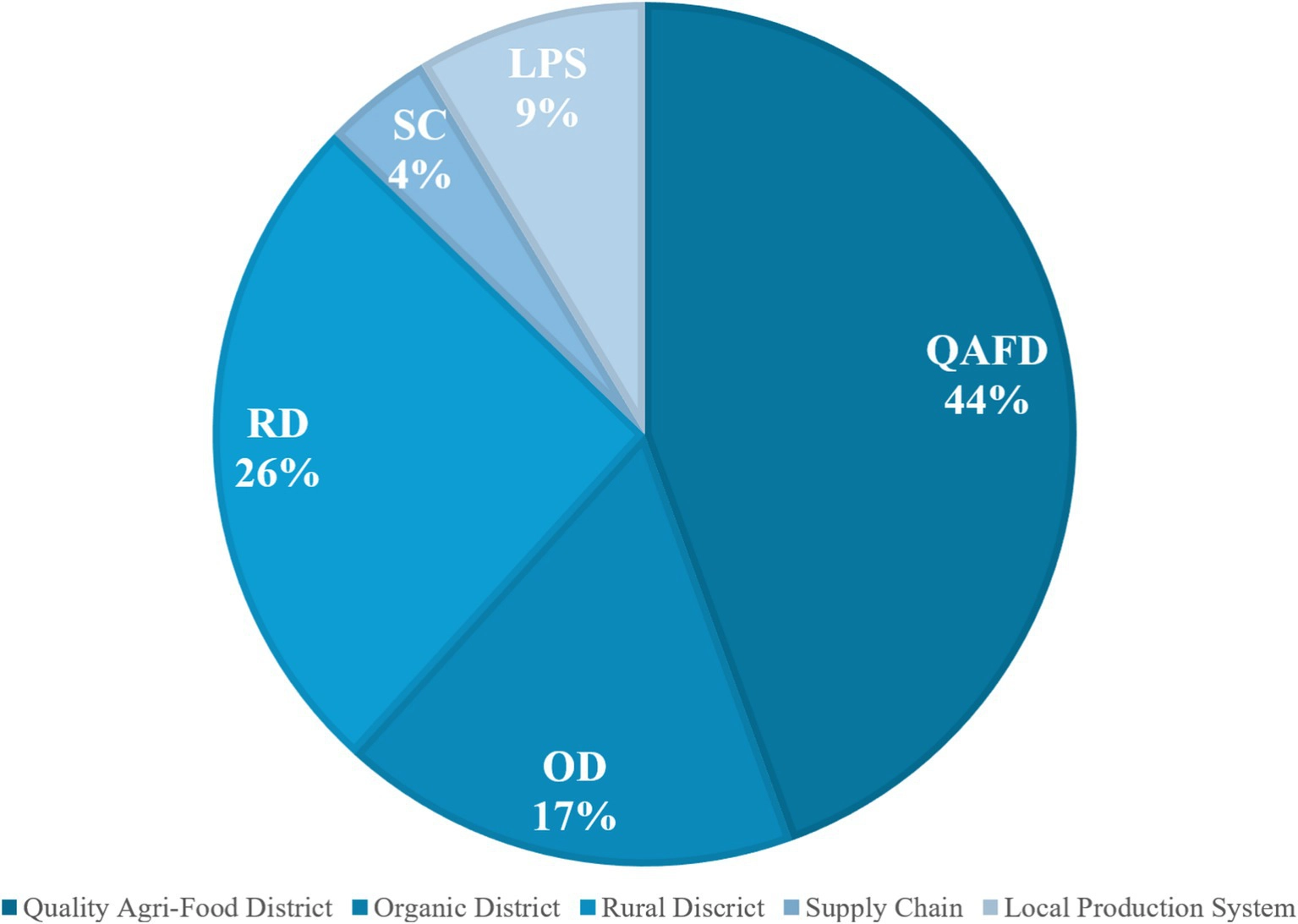
Food districts: sectoral dimension. Source: authors’ elaboration.
Rural districts follow with 26%, highlighting the significant spread of integrated rural development models in which the agricultural dimension is interwoven with social, environmental and territorial factors. Meanwhile, the growth of organic districts (17%) directly responds to the challenges of the European Green Deal and the Farm to Fork strategy by promoting agroecological models that integrate biodiversity protection with the socio-economic resilience of inland areas.
In contrast, Supply chain districts (5%) and Local production systems (9%) are numerically more limited. Although they play a more marginal role in quantitative terms, they contribute to the diversification of organisational forms within the national district landscape. The distribution of these district typologies reveals a clear hierarchy of policy priorities, with quality certification, territorial integration and ecological transition emerging as dominant structural principles. Less common organisational models appear to perform complementary or specialised roles within the broader institutional architecture.
Taken together, these results present a picture of an Italian district system that is firmly focused on quality, sustainability and territorial integration.
The prevalence of Quality agri-food districts (QADs), followed by Rural districts (RDs) and Organic districts (ODs), outlines a territorial development model that aligns with the priorities of the 2023–2027 Common Agricultural Policy (CAP). This policy prioritises production quality, the ecological transition and strengthening local economies through place-based approaches (CREA, 2025; European Commission, 2021). This suggests that district policies operate as territorial implementation mechanisms for broader European agricultural and rural development strategies.
Districts serve as local governance mechanisms and as institutional interfaces between European policy objectives and regional development practices. As OECD analyses of European agricultural systems have highlighted, regional rural development policies tend to favor models capable of combining competitiveness, sustainability, and territorial cohesion, particularly in contexts characterised by production fragmentation and a high concentration of small and medium-sized agricultural farms (OECD, 2023).
From this perspective, districts can be seen as coordination platforms that reduce fragmentation in geographically dispersed production systems. This strengthens collective action and improves market positioning. Their institutional structure supports horizontal cooperation among producers and vertical integration along value chains.
Concurrently, the Italian district model appears to be strongly oriented towards enhancing agricultural multifunctionality. As emphasised by Eurostat and the FAO, integrating agro-food production with rural and enogastronomic tourism, traditional craftsmanship and cultural services is a key factor in the resilience of European rural areas, especially in inland and mountainous regions (EUROSTAT, 2023; FAO, 2022). In this sense, districts reinforce the link between territorial identity and economic development by expanding agricultural and non-agricultural income opportunities.
This multifunctional orientation reinforces the role of districts as territorially integrated development systems rather than purely sectoral production clusters. Their economic function is therefore inseparable from broader processes of territorial regeneration and socio-institutional cohesion. The higher concentration of food districts in regions characterised by significant production fragmentation, the wealth of traditional products and a substantial presence of inland areas suggests that this instrument is primarily utilised as an integration mechanism for place-based policies. Within this framework, food districts emerge as territorial governance platforms capable of integrating agricultural development, social cohesion and landscape protection, thereby contributing to the local implementation of regional and national rural development strategies (CREA, 2025; OECD, 2023).
In this sense, districts operate as meso-level governance arenas where sectoral policies, spatial planning and local development strategies converge. Their institutional configuration reflects the growing importance of coordinating diverse policy areas in contemporary rural governance. Conversely, the limited prevalence of supply chain districts and local production systems in Italy suggests that the district model is primarily used for territorial integration rather than the vertical integration of production chains, which is often managed through alternative contractual and organisational instruments (ISMEA, 2025). This pattern indicates that the Italian district model is predominantly territorially oriented rather than value-chain driven, emphasising spatial cohesion over vertical integration of production.
Reconstructing and mapping food districts across the national territory provides a framework for interpreting access to public support instruments. Indeed, the territorial and typological distribution of districts is not merely descriptive; it is a structural prerequisite for the activation of funding policies and the capacity of territories to access national resources. From this perspective, analysing funding programmes dedicated to food districts enables the integration of spatial and sectoral interpretations with an operational and policy dimension. This demonstrates how the formal presence of districts can translate to varying degrees, into project capacity and access to public resources. Consequently, the financial dimension is a crucial lens through which to evaluate the operational capacity of districts and their ability to translate institutional recognition into concrete development outcomes.
4.3 Funding programs for food districts and territorial distribution
The financing programs dedicated to food districts promoted by the MASAF provide support for integrated investments aimed at strengthening local agri-food chains, promoting environmental sustainability and encouraging territorial development. The regulatory framework is defined by MASAF Decree No. 7775 of 22 July 2019, which sets out the eligibility criteria, types of admissible interventions and selection procedures. MASAF has launched specific funding for food district Contracts, initially through a call for proposals in 2020, and again in 2024. These calls financed investments ranging from €3 to €25 million, carried out by business networks, local authorities, and other territorial entities. Eligible projects focused on supply chain competitiveness, environmental sustainability, territorial governance, and the innovation and digitalisation of production processes. For both calls, the number of applications exceeded the available budget. The funded projects, 20 in the first call and 11 in the second, are distributed across various Italian regions (see Figure 9), revealing significant regional disparities. Some regions demonstrate a higher number of funded projects in the first round compared to the second, while others show an increased capacity to access resources in the more recent call.

Number of funded projects related to food districts in Italy. Source: authors’ elaboration.
These results highlight that access to financial support has been significantly influenced by institutional capacity, governance quality and the organizational density of districts. Consequently, the distribution of funding reflects structural agricultural indicators as well as the effectiveness of local territorial coordination mechanisms.
5 Policy implication and conclusions5.1 Policy implications
Food districts are territorial governance instruments that integrate public policies with civil society initiatives. This promotes local development, enhances agri-food chains and encourages the democratic participation of stakeholders (Lazzeroni et al., 2023; Monticone et al., 2023). Although public policies have utilised tools provided by European and national legislation to foster collective innovation processes within specific territories, this impetus towards ‘soft’ innovation—grounded in cooperation among local actors, knowledge sharing and governance networks—frequently appear more normative in principle than operational in practice.
In this context, the ‘soft governance’ model of food districts encourages the adoption of technological innovations, such as precision agriculture and blockchain-based traceability systems, particularly among small and medium-sized enterprises (SMEs) which would otherwise lack the capacity or resources to invest individually. By establishing collaborative platforms and shared infrastructures, these districts enable collective learning and risk-sharing, effectively lowering the barriers to innovation for SMEs.
The findings demonstrate the complex interaction between standardised national policies and regional autonomy within a multi-level governance system. In the absence of institutional coordination and collaboration, trans-local approaches, knowledge-sharing networks and interactions between civic and institutional actors aimed at transforming urban food systems emerge instead (Doernberg et al., 2019). The introduction of a unified legal definition for food districts has not resulted in identical regulatory models across regions. Instead, it has triggered processes of selective adaptation and progressive alignment, whereby each territory has integrated the new national framework into its existing institutional structures.
From a public policy perspective, this configuration reflects coordinated decentralisation: the state defines the general direction and common principles, while regions retain considerable discretion in implementation. This type of relationship between levels of government is consistent with theoretical approaches to multi-level governance, which interpret institutional coordination as a negotiated rather than hierarchical process (Hooghe and Marks, 2003). The observed regulatory convergence mainly concerns institutional and procedural aspects, such as governance structures, recognition procedures, and monitoring systems, rather than policy content or territorial development strategies. In other words, harmonization appears to primarily affect the rules of operation, rather than the substantive objectives pursued.
Persistent differentiation among regions should therefore not be interpreted as mere regulatory fragmentation, but rather as a form of territorial adaptation of policy instruments. This mismatch limits the transformative potential of districts and contributes to persistent regional disparities in implementation capacity and access to financial resources. Consequently, the effectiveness of Food Districts depends not only on financial support but also on the consolidation of institutional capacity, administrative coordination, and long-term territorial planning.
From a policy perspective, the findings suggest the need for a more coherent national governance framework capable of reducing regulatory fragmentation while preserving the flexibility required to address regional diversity. Rather than imposing institutional uniformity, future policy should establish common minimum standards for governance structures, stakeholder participation, transparency and monitoring, while allowing regions to adapt implementation to their specific socio-economic and territorial contexts. Such an approach would strengthen both policy coherence and territorial responsiveness within the Italian multi-level governance system.
Overall, the Italian case suggests that Food Districts function not only as agri-food policy instruments, but also as spaces of institutional experimentation and collaborative governance, where national coordination and regional adaptation coexist within a dynamic multi-level governance framework. These findings highlight the relevance of flexible institutional harmonisation processes, for the governance of territorially embedded agri-food systems.
5.2 European relevance and transferability
The Italian experience of Food Districts offers important insights for European policies, particularly in relation to the CAP 2023–2027, the Farm to Fork strategy, and the Long-Term Vision for Rural Areas. They can be interpreted as territorial governance arrangements capable of combining local development, environmental sustainability and agri-food competitiveness within a multilevel policy framework. In rural areas characterised by the prevalence of agricultural SMEs, they can foster cooperation among public authorities, farmers, enterprises and civil society actors, strengthening collective action, innovation, short supply chains and the transition towards more sustainable and circular agri-food systems.
However, the European transferability of this model should be understood as adaptive rather than replicative. The effectiveness of Food Districts depends not merely on formal institutional recognition, but on the presence of consolidated local networks, administrative capacity, participatory practices and long-term coordination mechanisms. Empirical evidence from the Italian case suggests that access to funding opportunities is influenced not only by agricultural structures or productive density, but also by the institutional maturity and governance capacity of district networks. Therefore, the Italian experience should not be considered a directly transferable model, but rather a policy laboratory for designing flexible, place-based territorial governance tools at the European level.
6 Conclusion
The analysis shows that Food Districts have become an increasingly important component of rural and agri-food development policies in Italy. Mapping these districts reveals their widespread but still uneven distribution, reflecting differences in regional regulatory choices, productive structures, institutional capacity and strategies for local resource valorisation. This heterogeneity is further reinforced by the diverse recognition procedures which are often only partially integrated into regional development programming frameworks. Integrating regulatory analysis, territorial reconstruction and funding programme outcomes demonstrates that the mere formal recognition of a district does not necessarily guarantee effective access to support policies.
Rather, the evidence highlights the central role of territorial governance, cooperation among local stakeholders and the level of planning maturity within district networks. In this sense, Food Districts should not be interpreted solely as organisational tools for agri-food supply chains, but rather as permanent place-based governance instruments capable of integrating economic competitiveness, environmental sustainability, territorial cohesion, and social resilience. In line with the objective of assessing the coherence of the Italian regulatory framework for Food Districts and identifying emerging models of territorial implementation, this study identifies three complementary strategic functions performed by Food Districts. First, they strengthen the economic competitiveness of agri-food systems by fostering cooperation among producers, supporting quality-certified productions and enhancing local value chains. Second, they contribute to territorial resilience by promoting rural regeneration, landscape conservation, environmental sustainability and the valorisation of local resources. Third, they perform an institutional function by facilitating participatory decision-making, strengthening collaboration between public and private actors and improving coordination across governance levels.
Moreover, the analysis of funding mechanisms, particularly District Contracts, highlighted that available resources are primarily oriented toward supporting business investments rather than strengthening the systemic and governance functions of districts. This may lead to the reproduction of policy instruments more typically found in traditional agricultural and industrial policies, thereby limiting the transformative potential of Food Districts as integrated territorial governance tools. In addition, the study highlights how the marked regional fragmentation of the regulatory framework has produced heterogeneous recognition criteria, different levels of institutionalisation, varied governance structures and unequal access to financial resources. These territorial disparities underscore the need for stronger coordination between levels of government and for the reinforcement of local institutional capacities, to reduce territorial asymmetries and improve the overall effectiveness of public policies. From a policy perspective, findings indicate that the need for a more coherent and coordinated national framework is clear, including the formal recognition of Food Districts as permanent instruments of territorial governance. This would require the introduction of common minimum standards concerning governance structures, participation mechanisms, transparency, planning capacity and administrative effectiveness. Greater harmonisation of recognition procedures and of the functions assigned to Food Districts would also facilitate their more effective integration into national and regional development policies. Beyond the Italian context the findings contribute to the broader European debate on place-based governance tools capable of integrating sustainable transitions, territorial cohesion, and agri-food competitiveness within multilevel institutional systems. The Food Districts model is consistent with the rural development objectives of the CAP 2023–2027 and the Long-Term Vision for Rural Areas, as it promotes an integrated territorial approach that combining economic competitiveness, ecological transition and cooperation within and across agri-food supply chains fostering collaboration along and within agri-food supply chains. Looking ahead, the new State Aid Framework 2026–2029 may represent a significant opportunity to strengthen cooperation, innovation, environmental sustainability, and territorial development within Food Districts. The long-term effectiveness of these instruments will depend on the capacity of public institutions to support them not only financially but also institutionally. Looking ahead, Food Districts could evolve into strategic platforms for integrated rural governance, capable of addressing crucial challenges such as climate transition, food security, demographic decline, and territorial inequalities. To fully leverage their potential, future European and national policies post-2027 should consolidate their role within territorial development strategies, recognizing Food District as stable governance actors that are essential for fostering resilient, sustainable and inclusive rural areas.
Statements Data availability statement
The original contributions presented in the study are included in the article/supplementary material. Further inquiries can be directed to the corresponding author.
Author contributions
LB: Validation, Writing – review & editing, Data curation, Methodology, Project administration, Conceptualization, Supervision, Formal analysis, Writing – original draft. AM: Writing – review & editing, Writing – original draft, Methodology, Formal analysis, Data curation. MS: Methodology, Writing – review & editing, Data curation, Writing – original draft, Formal analysis. ST: Validation, Supervision, Writing – original draft, Writing – review & editing. PS: Validation, Writing – review & editing, Supervision, Writing – original draft. SC: Data curation, Formal analysis, Writing – original draft, Methodology, Writing – review & editing.
Funding
The author(s) declared that financial support was not received for this work and/or its publication.
Conflict of interest
The author(s) declared that this work was conducted in the absence of any commercial or financial relationships that could be construed as a potential conflict of interest.
Generative AI statement
The author(s) declared that Generative AI was not used in the creation of this manuscript.
Any alternative text (alt text) provided alongside figures in this article has been generated by Frontiers with the support of artificial intelligence and reasonable efforts have been made to ensure accuracy, including review by the authors wherever possible. If you identify any issues, please contact us.
Publisher’s note
All claims expressed in this article are solely those of the authors and do not necessarily represent those of their affiliated organizations, or those of the publisher, the editors and the reviewers. Any product that may be evaluated in this article, or claim that may be made by its manufacturer, is not guaranteed or endorsed by the publisher.
References
BacheI.FlindersM. (2004). Multi-Level Governance. Oxford: Oxford University Press.
BecattiniG. (1987). Mercato e forze locali: Il distretto industriale. Bologna: Il Mulino.
BecattiniG. (1990). The Marshallian industrial district as a socio-economic notion. In F. Pyke, G. Becattini, & W. Sengenberger (Eds.), Industrial Districts and Inter-firm Cooperation in Italy. Geneva: International Institute for Labour Studies.
BencardinoF.FalessiG.MarottaG. (2005). Economia rurale e sviluppo territoriale. Naples: Edizioni Scientifiche Italiane.
BertiG. (2020). Sustainable Agri-food economies: re-territorialising farming practices, markets, supply chains, and policies. Agriculture10:64. doi: 10.3390/agriculture10030064
BrasiliC.CorvinoA.PieraccioniL.FanfaniR.CapuanoG.CorteseP.et al. (2004). I DISTRETTI RURALI Ed AGROALIMENTARI di QUALITA’ in Italia. Rome: Unioncamere. Unione Italiana delle Camere di Commercio Industria Artigianato e Agricoltura. Available online at: https://www.unioncamere.gov.it/
BriamonteL.RicciardiD.AscaniM.D’OronzioM. A. (2026). From practice to territory: experiences of participatory agroecology in the AgrEcoMed project. WORLD7:19. doi: 10.3390/world7020019
BriamonteL.ScarpatoD. (2025). From soft law to hard law: legal transitions and sustainable challenges in the Italian Agri-food sector. Sustainability17:8952. doi: 10.3390/su17198952
CapelloR. (2016). Regional Economics. Second Edn. Abingdon, Oxon: Routledge, Taylor & Francis Group.
CaronP.Ferrero y de Loma-OsorioG.NabarroD.HainzelinE.GuillouM.AndersenI.et al. (2018). Food systems for sustainable development: proposals for a profound four-part transformation. Agron. Sustain. Dev.38, 1–12. doi: 10.1007/s13593-018-0519-1
CecchiC. (1992). Per una definizione di distretto agricolo e distretto agroindustriale. Quest. Agrar.46, 81–107.
CiascaB.CitoN. M.LattanzioV. M. T. (2025). Getting insights in stakeholder collaboration in the transition toward safe and sustainable food production: net-map analysis of the Italian wheat supply chain. Foods14:786. doi: 10.3390/foods14050786,
ColellaA.Caputi JambrenghiV. (2020). Governance territoriale e filiere agroalimentari. Riv. Econ. Agrar.75, 45–62.
CREA (2025). Annuario dell’agricoltura italiana 2024, Volume LXXVIII. Rome Centro di ricerca Politiche e Bioeconomia.
DanseroE.PettenatiG.ToldoA. (2015). The atlas of food. A space of representation, a place for policies, a methodology of territorial analysis. Meeting Urban Food Needs.
Del PuenteF.Del GiudiceT.AlessandroS.ConcettaM. (2026). Rethinking agricultural district as an innovation system. Agric. Food Econ.14:12. doi: 10.1186/s40100-025-00439-6
DoernbergA.HornP.ZasadaI.PiorrA. (2019). Urban food policies in German city regions: an overview of key players and policy instruments. Food Policy89:101782. doi: 10.1016/j.foodpol.2019.101782
EdelmannH.Quiñones-RuizX. F.PenkerM.ScaramuzziS.BroschaK.JeanneauxP.et al. (2020). Social learning in food quality governance—evidences from geographical indications amendments. Int. J. Commons14, 108–122. doi: 10.5334/ijc.968
European Commission. (2021). CAP Strategic Plans 2023–2027. European Union. Available online at: https://agriculture.ec.europa.eu/cap-my-country/cap-strategic-plans_en
EUROSTAT (2023). Agriculture, Forestry and Fishery Statistics. Publications Office of the European Union. Available online at: https://ec.europa.eu/eurostat/statistics-explained/index.php?title=Agriculture,_forestry_and_fishery_statistics
FAO (2018). Sustainable Food Systems. Concept and Framework, 1–8. Rome: FAO. Available online at: https://openknowledge.fao.org/items/8d2575e3-e701-4b1d-8e20-d9c83179c848
FAO (2021). Food Systems Transformation. Rome: FAO.
FAO (2022). The State of Food and Agriculture 2022. Rome: FAO.
FaviaF. (2000). “Produzioni tipiche e sistemi locali,” in Sistemi locali e sviluppo, Bologna: Il Mulino.
FolkeC. (2006). Resilience: the emergence of a perspective for social–ecological systems analyses. Glob. Environ. Change16, 253–267. doi: 10.1016/j.gloenvcha.2006.04.002
FondacciL. (2023). Analisi dei primi due distretti del cibo agroalimentare dell’Umbria come strumenti di pianificazione della rigenerazione circolare dei territori. Urban. Inf.309, 59–64.
GattulloM. (2022). Distretti del cibo e percorsi di territorializzazione. Riflessioni teoriche ed alcune evidenze empiriche. ITA. Available online at: https://ricerca.uniba.it/handle/11586/454423 (Accessed February 9, 2026).
GuareschiM.MaccariM.SciuranoJ. P.ArfiniF.ProntiA. (2020). A methodological approach to upscale toward an agroecology system in EU-LAFSs: the case of the Parma Bio-District. Sustainability12:5398. doi: 10.3390/su12135398
HoogheL.MarksG. (2003). Unraveling the central state, but how? Types of multi-level governance. Am. Polit. Sci. Rev.97, 233–243. doi: 10.1017/S0003055403000649
HowlettM. (2019). Designing Public Policies: Principles and Instruments. 2nd Edn London and New York: Routledge.
Iacoponi (2001). Distretti agricoli e sviluppo rurale. Econ. Diritto Agroaliment.6, 23–41.
IovinoG.GuadagnoE.BagnoliD. (2023). Food for thoughts: the district approach to rural areas development—a case study in Campania. Sustainability15:16263. doi: 10.3390/su152316263
ISMEA. (2025). Rapporto sulla filiera agroalimentare italiana. Rome.
KrippendorffK. (2018). Content Analysis: An Introduction to its Methodology. 4th Edn. Thousand Oaks: Sage.
LamineC.GarçonL.BrunoriG. (2019). Territorial agrifood systems: a Franco-Italian contribution to the debates over alternative food networks in rural areas. J. Rural. Stud.68, 159–170. doi: 10.1016/j.jrurstud.2018.11.007
LamineC.PuglieseP.BarataudF.BertiG.RossiA. (2023). Italian biodistricts and French territorial food projects: how science-policy-experience interplays shape the framings of transitions towards sustainable territorial food systems. Front. Sustain. Food Syst.7:1223270. doi: 10.3389/fsufs.2023.1223270
LazzeroniM.RossiA.BrunoR.BertiG. (2023). Le regioni del cibo: Processi, politiche, narrazioni. Riv. Geogr. Ital.CXXX 130, 152–172. doi: 10.3280/rgioa4-2023oa16857
MantinoF. (2006). Lo sviluppo rurale in Europa. Bologna: INEA.
MarshallA. (1920). Principles of Economics. 8th Edn. London: Macmillan(Original work published 1890).
MASAF—Ministero dell’Agricoltura, della Sovranità Alimentare e delle Foreste. (2025). Registro nazionale dei distretti del cibo. Available online at: https://www.masaf.gov.it/flex/cm/pages/ServeBLOB.php/L/IT/IDPagina/14160 (Accessed January 20, 2026).
MonticoneF.BarlingD.ParsonsK.SamoggiaA. (2023). Identifying food policy coherence in Italian regional policies: the case of Emilia-Romagna. Food Policy119:102519. doi: 10.1016/j.foodpol.2023.102519
OECD. (2023). Rural Policy Reviews: Italy. Paris.
OstromE. (2009). A general framework for analyzing sustainability of social-ecological systems. Science325, 419–422. doi: 10.1126/science.1172133,
RossiA.BuiS.MarsdenT. (2019). Redefining power relations in agrifood systems. J. Rural. Stud.68, 147–158. doi: 10.1016/j.jrurstud.2019.01.002
RussoP. (2024). Il distretto in ambito rurale: Uno strumento di sviluppo locale nella transizione ecologica. Pisa.
SegrèA.FrascarelliA. (2008). Politiche per lo sviluppo agricolo e la sicurezza alimentare. Rome: Carocci Editore.
SenA. (2001). Development as Freedom. Oxford: Oxford University Press.
SforziF. (2005). Reti locali e sviluppo territoriale. Riv. Geogr. Ital.112, 321–340.
SforziF. (2008). Il distretto industriale: da Marshall a Becattini. Pens. Econ. Ital.XVI, 1000–1010. doi: 10.1400/115778
SiviniS. (2006). Governance, territorio e sviluppo rurale. Sociol. Urbana Rurale79, 7–24.
StortiD. (2000). Rural development and local systems. Eur. Rev. Agric. Econ.27, 305–328.
StrambiG. (2024). Food districts as a form of local food system governance regulated by Italian law. Rev. Catalana Dret Ambient.15, 1–28. doi: 10.17345/rcda3818
TarangioliS. (2023). I Distretti del Cibo alla prova del Piano Strategico della PAC. Pianeta PSR, 127. Available online at: https://www.pianetapsr.it/flex/cm/pages/ServeBLOB.php/L/IT/IDPagina/2963
TarangioliS.HenkeR.MazzocchiG.CisilinoF.LicciardoF. (2024). From needs to policy action: Italian agri-food districts as a case of territorial cooperation. J. Infrastruct. Policy Dev.8:5914. doi: 10.24294/jipd.v8i10.5914
ThorbeckeE. (2007). “The evolution of the development doctrine, 1950–2005,” in Advancing Development, eds. MavrotasG.ShorrocksA. (London: Palgrave Macmillan), 3–36.
TodaroM. P.SmithS. C. (2015). Economic Development. 12th Edn. London: Pearson.
VanniF.ViganòL. (2020). Biodistretti e sviluppo territoriale sostenibile. Agri16, 1–6.
WalkerB.HollingC. S.CarpenterS. R.KinzigA. (2004). Resilience, adaptability and transformability. Ecol. Soc.9.
Summary
Keywords
agri-food policy, food communities, food districts, local value chains, multi-level governance, policy framework, sustainable food systems, territorial development
Citation
Briamonte L, Manzoni A, Scotti M, Tarangioli S, La Sala P and Chiappini S (2026) Italian food districts: a multi-level governance analysis of policy frameworks and territorial distribution. Front. Sustain. Food Syst. 10:1845219. doi: 10.3389/fsufs.2026.1845219
Updates

Check for updates
Copyright
© 2026 Briamonte, Manzoni, Scotti, Tarangioli, La Sala and Chiappini.
This is an open-access article distributed under the terms of the Creative Commons Attribution License (CC BY). The use, distribution or reproduction in other forums is permitted, provided the original author(s) and the copyright owner(s) are credited and that the original publication in this journal is cited, in accordance with accepted academic practice. No use, distribution or reproduction is permitted which does not comply with these terms.
*Correspondence: Silvia Chiappini, silvia.chiappini@crea.gov.it
Disclaimer
All claims expressed in this article are solely those of the authors and do not necessarily represent those of their affiliated organizations, or those of the publisher, the editors and the reviewers. Any product that may be evaluated in this article or claim that may be made by its manufacturer is not guaranteed or endorsed by the publisher.
Dining and Cooking