

Italian researchers developed a food packaging film enriched with olive pit extract that reduced meat oxidation by nearly 30 percent in laboratory tests.
A study by Italy’s National Institute of Metrological Research (INRiM) found that food packaging films enriched with olive pit extract recovered from olive oil production byproducts exhibited strong antioxidant properties.
After 10 days of storage, the olive pit extract film reduced degradation by almost 30 percent compared to the control packaging.– Consolato Schiavone, INRiM researcher
Using an environmentally friendly ethanol-based extraction process, the researchers developed an active packaging material that could help extend food shelf life while creating new uses for olive oil industry waste.
“The research is centered on the principles of circular economy, as it aims at giving new life to industrial waste streams, particularly those generated across the olive oil production chain such as olive pomace, olive pits, and leaves,” said Consolato Schiavone, a researcher in INRiM’s Physical Chemistry for One Health (ML-03) sector and co-author of the study.
“As the global olive oil sector produces around twelve million tons of non-environmentally friendly waste annually, the scientific community and industry stakeholders are moving forward to create new and sustainable strategies to repurpose these materials.”
Although the antioxidant properties of olive oil byproducts and their potential use in food packaging are well established, their effectiveness in extending food shelf life has not been fully investigated. The INRiM researchers sought to address this gap by developing and testing an active packaging film.
The project was conducted in collaboration with Innovhub SSI Stazioni Sperimentali per l’Industria in Milan, which supplied the olive oil byproduct samples.
“We basically aimed to extract antioxidant or antimicrobial compounds, specifically polyphenols, from this waste, and to incorporate them into packaging materials,” Schiavone said. “We therefore chose a food-grade cellulose acetate film and tested its effectiveness in delaying the degradation of food products, such as meat patties.”
In the first phase, the researchers analyzed olive pits, leaves, and pomace for their antimicrobial and antioxidant properties. A colorimetric DPPH (2,2-diphenyl-1-picrylhydrazyl) test showed that olive pit extract had the highest antioxidant activity.
The researchers then incorporated the extract into a food-grade resin and coated a cellulose acetate film to produce the active packaging material.
The researchers also compared the antioxidant performance of all three byproduct extracts on smaller film samples. The DPPH test again identified olive pit extract as the most effective, leading the team to select it for a packaging film containing five percent extract.
To evaluate performance under conditions that approximate real-world food storage, the researchers tested the film on 10-gram samples of minced beef containing 50 percent fat.
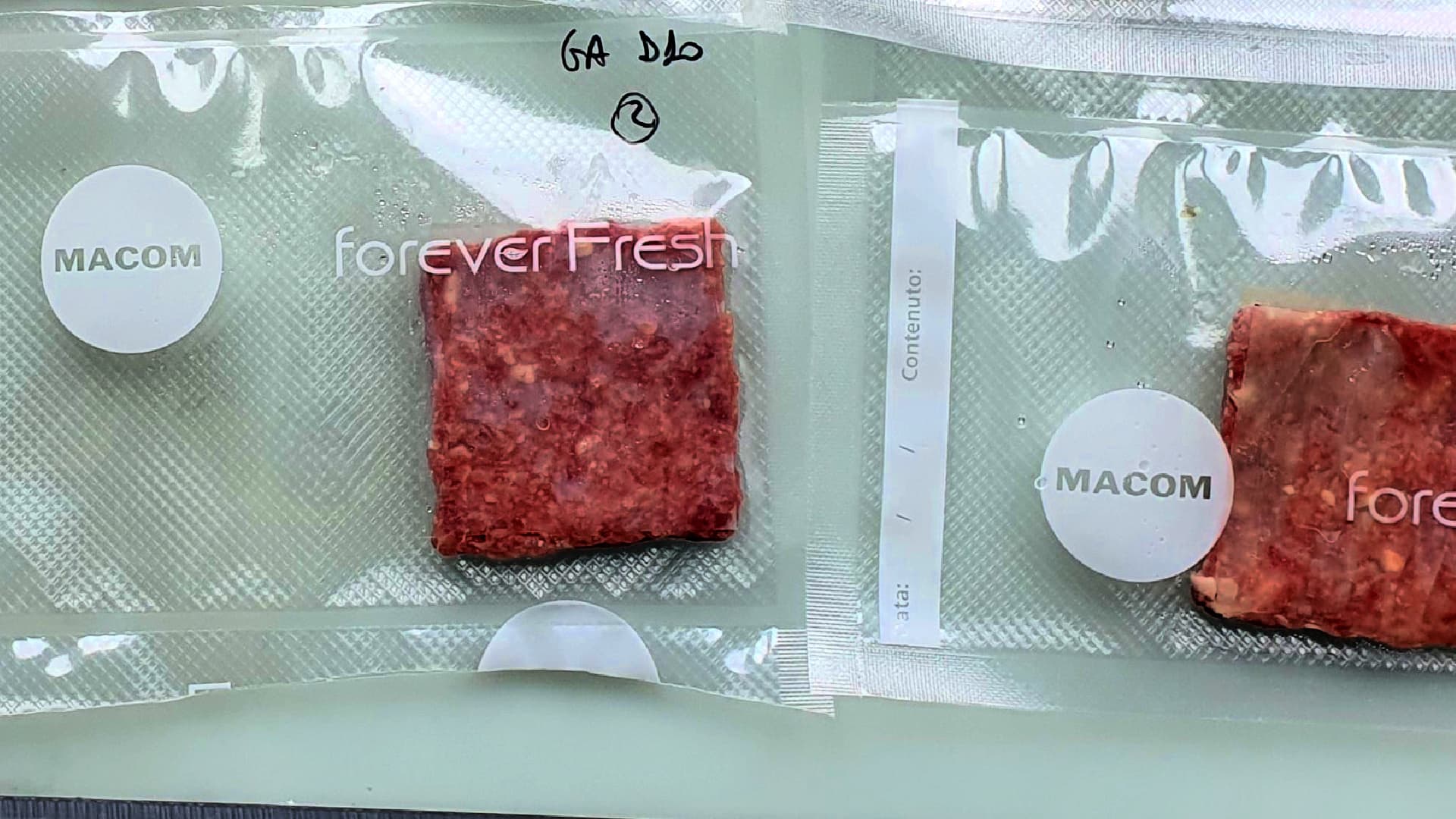 Beef samples sealed in packaging films during laboratory tests evaluating the ability of olive pit extract to slow oxidation and extend food shelf life.
“A higher fat content promotes oxidation, making it particularly useful for this type of study,” Schiavone explained. “Our goal was not to determine how long it takes for meat to degrade over an extended period, but rather to estimate its shelf life under accelerated conditions. This type of ‘accelerated shelf-life testing’ simulates real-world storage conditions, such as those found in refrigerated supermarket displays, to determine whether our approach offers any improvement.”
The researchers placed the miniature beef patties between two layers of packaging film in three configurations: untreated film, a film containing gallic acid as a reference antioxidant, and a film incorporating olive pit extract.
The researchers used thiobarbituric acid reactive substances (TBARS) tests to measure lipid oxidation in the meat on days zero, four, seven, and ten of storage.
“The tests were carried out on the fatty acids, which are the compounds most susceptible to oxidation, after their extraction from the meat samples, as well as on the meat itself,” Schiavone explained.
“The results showed that packaging treated with olive pit extract delayed oxidation and slowed the overall degradation of the meat. Its performance ranked between untreated packaging and the positive control, which was included to demonstrate high antioxidant efficacy. After 10 days of storage, the olive pit extract film reduced degradation by almost 30 percent compared to the control packaging.”
The researchers also measured the total biophenol concentration in the olive pit extract using ultra-high-performance liquid chromatography coupled with diode array detection and high-resolution mass spectrometry (UHPLC-DAD-HRMS).
Schiavone noted that researchers have extensively characterized olive polyphenols and other compounds found in olives. However, the team wanted a more detailed understanding of the chemical profile of olive pit extract.
The analysis identified more than 40 polyphenolic compounds, including phenolic alcohols, phenolic acids, flavonoids, lignans, secoiridoids, triterpenes, and their glycosylated derivatives.
The findings highlighted the complex phytochemical composition of olive pit extract and its potential as a natural source of bioactive compounds for antioxidant-enriched packaging materials.
“Compared with other antioxidant packaging systems reported in the literature, our approach differs substantially in structure and application,” Schiavone explained.
“A key advantage of our packaging prototype is that the active compounds are incorporated directly into a ready-to-use cellulose-based film without altering its mechanical properties or requiring additional structuring agents. This adds to the sustainability of the system, as the extracts are obtained through a low-impact ethanol-based extraction process.”
The researchers plan to investigate alternative, environmentally friendly extraction methods and further assess the packaging material’s safety, including whether unwanted compounds could migrate into food.
“In future work, we will test different green extraction protocols,” Schiavone said. “We will also conduct an exhaustive investigation of possible leakage of unwanted molecules from the packaging in the food. However, the current findings enable straightforward industrial adoption while maintaining regulatory compliance and leveraging a circular-economy resource. These insights pave the way for developing innovative, sustainable, and secure food packaging solutions, while at the same time elevating agricultural and industrial waste to high-value materials.”
Dining and Cooking