

With Italian expertise and groves in Argentina’s Andean foothills, Solara Estate is bringing freshly harvested, award-winning olive oil to U.S. consumers between Northern Hemisphere harvests.
In the foothills of the Andes in northwestern Argentina, a family with roots in southern Italy is working to fill a seasonal gap in the United States by supplying award-winning extra virgin olive oil while Northern Hemisphere producers are months away from their next harvest.
Alessandro De Nicolò, founder of the Solara Estate brand, which won a Gold Award for its robust blend at the 2026 NYIOOC World Olive Oil Competition, said the venture began in the 2010s, when his uncle planted 100 hectares of olive trees in La Rioja.
Our goal is to bring very high-quality oil to the U.S. market at a price that isn’t ultra-premium. We’ve positioned it as an affordable premium product.– Alessandro De Nicolò, founder, Solara Estate
“About 15 years ago, my uncle, Giuseppe Nettis, began studying the idea with a professor from the University of Florence,” he told Olive Oil Times.
According to De Nicolò, most olive groves around Chilecito, now a center of Argentine olive oil production, were dedicated to table olives at the time.
“They wanted to determine whether the geology, climate, water resources, and soil conditions would support an olive plantation dedicated entirely to oil production,” he said.
They eventually settled on four varieties — Arbequina, Arbosana, Coratina and Koroneiki — selected for their adaptability to local growing conditions and the flavor profiles they could contribute to a blend.
Today, the company, La Colorada SA, works with experts from the University of Bari, in De Nicolò’s hometown in Italy’s olive-growing region of Apulia, to blend its extra virgin olive oils each season.
“The varieties were selected for different reasons, because each has a distinct flavor profile,” De Nicolò said. “For example, Coratina from Italy has a much stronger flavor profile, with more polyphenols and antioxidants.”
“Other varieties have different characteristics,” he added. “The idea was to start with these four varieties and see how they performed. In the end, we kept all four because we liked the combination of flavors.”
The groves lie in the Andean foothills at an elevation of 600 meters. De Nicolò considers the location ideal, with gently sloping terrain that helps reduce frost risk in winter, abundant summer sunshine and low humidity that limits fungal diseases and pest pressure.
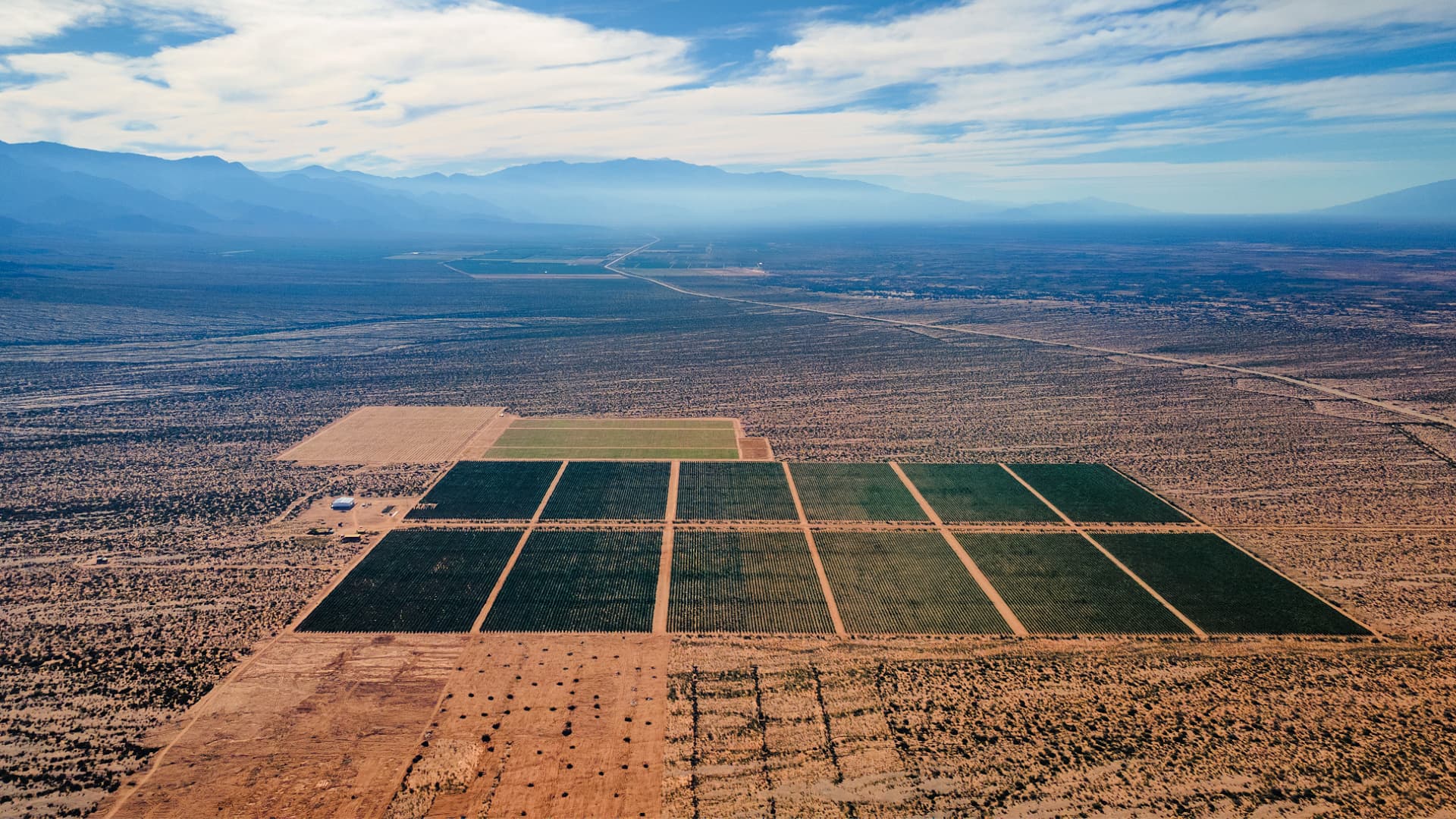 Solara Estate is located along Argentina’s scenic National Route 74, near Chilecito in La Rioja province. (Photo: Solara Estate)
The main drawback is the lack of rainfall, which makes irrigation essential. Although watering the trees adds considerably to production costs, it also helps the company maintain consistent yields and quality.
La Colorada initially produced olive oil for bulk sales in the United States and Europe. With the introduction of Solara Estate, however, the company has shifted its focus toward branded, premium olive oil.
The company is also expanding its capacity to supply fresh olive oil to the Northern Hemisphere between harvests, having recently planted another 200 hectares of olive trees.
 The company begins harvesting in early April to preserve the olives’ aromas and phenolic compounds. (Photo: Solara Estate)
Solara Estate now offers two products: a three-liter container for restaurants and foodservice customers, and a 500-milliliter bottle of its award-winning Arbosana, Coratina and Koroneiki blend.
De Nicolò said entering the NYIOOC was an obvious step once the company decided to introduce a retail bottle.
“We developed this project and the Solara Estate brand exclusively for the U.S. market,” De Nicolò said. “About a year ago, we started looking at which competitions were the most important and widely recognized.”
“In the end, we decided to enter [the NYIOOC] for several reasons: the competition’s visibility and prestige, and also because, as producers in Argentina, we wanted to receive feedback from a competition that was neither Argentine nor South American, but also one of the most prestigious international competitions,” he added.
According to De Nicolò, international recognition also strengthens the company’s position in negotiations with distributors and generates interest from larger customers, including restaurants.
Solara Estate’s approach to olive oil quality centers on rapid processing and careful storage. Its modern mill, equipped with Amenduni machinery, sits close to the groves, allowing olives to be crushed less than an hour after harvest.
 Solara Estate uses Amenduni milling equipment to cold-extract its extra virgin olive oil, preserving its aromas and beneficial compounds. (Photo: Solara Estate)
“We harvest early [usually the first week of April], so yields are lower,” De Nicolò said. “Everything is done on our estate. There is virtually no time between harvesting and milling.”
“We also have stainless steel tanks with nitrogen and temperature control,” he added, noting that the entire milling process takes place below 27 ºC, the temperature threshold associated with the European Union’s definition of cold extraction.
“Our goal is to bring very high-quality oil to the U.S. market at a price that isn’t ultra-premium. We’ve positioned it as an affordable premium product.”
Although Solara Estate does not sell directly to consumers, De Nicolò said the suggested retail price for a half-liter bottle is $20 (€17.80). He hopes the price will appeal to taste- and health-conscious middle-class consumers seeking premium olive oil without paying the highest prices.
The company has already begun working with distributors in New York, Connecticut and Florida.
 Solara Estate cultivates four olive varieties — Arbequina, Arbosana, Coratina and Koroneiki — selected for their adaptability to local growing conditions and complementary flavor profiles. (Photo: Solara Estate)
“Of course, it isn’t a low price. It’s still a premium price, but… our price allows us to cover the costs of irrigation, early harvesting, nitrogen, and transportation. It enables us to continue producing high-quality olive oil.”
Keeping those costs under control remains a challenge in Argentina’s volatile economy, De Nicolò acknowledged.
After Javier Milei’s election in 2023, his government introduced spending cuts, changes to import regulations, and measures to ease currency controls to address triple-digit inflation. Nevertheless, production costs for olive growers have continued to rise.
“Costs are rising in Argentina, including energy and labor expenses. In general, it’s becoming quite expensive to operate,” De Nicolò said.
“Energy is a particular concern because we rely on irrigation and pump water from wells, which consumes a lot of electricity,” he added. “We’re starting to evaluate alternatives, such as investing in solar panels.”
Despite the country’s longstanding economic difficulties, De Nicolò expressed hope that some of the government’s reforms would improve business conditions over the longer term.
Meanwhile, the company is seeking to offset rising costs by focusing on exports to the United States and Europe. Revenue in dollars and euros helps finance production inputs, including harvesting equipment.
“Ultimately, everything depends on the price we can obtain for our oil,” he said. “This helps us cover our rising costs. It’s not easy, but with proper management, it is possible to run a profitable business.”
Despite the challenges, La Colorada produced 150,000 liters of olive oil in 2026.
 Careful selection of olives before milling helps La Colorada maintain the award-winning quality of its Solara Estate olive oil. (Photo: Solara Estate)
“It was a good harvest,” De Nicolò said. “In recent years, we haven’t experienced much alternate bearing because we’ve been working on agronomic practices to reduce it and achieve more consistent production.”
“This mainly involves field management, including pruning and irrigation. Some varieties are more prone to alternate bearing than others,” he added. “By adjusting pruning and other agronomic practices to suit each variety, we’re trying to maintain more consistent production. There is still some alternate bearing, of course, but we’re reducing the fluctuations between years.”
With the 2027 harvest less than six months away, conditions in the groves over the coming months will help determine both the quantity and quality of the next crop.
De Nicolò is already planning to enter next year’s NYIOOC Southern Hemisphere edition.
“We’ll definitely continue participating,” he concluded.
Dining and Cooking